Why in News?
Recently India signed the US-led 14-member Indo-Pacific Economic Framework for Prosperity (IPEF) bloc’s agreements on a clean and fair economy.
What is IPEF?
- IPEF - Indo-Pacific Economic Framework for Prosperity was launched jointly by the USA and other partner countries of the Indo-Pacific region on May 23, 2022 at Tokyo.
- Goal - It seeks to strengthen economic engagement and cooperation among partner countries for advancing growth, economic stability and prosperity in the region.
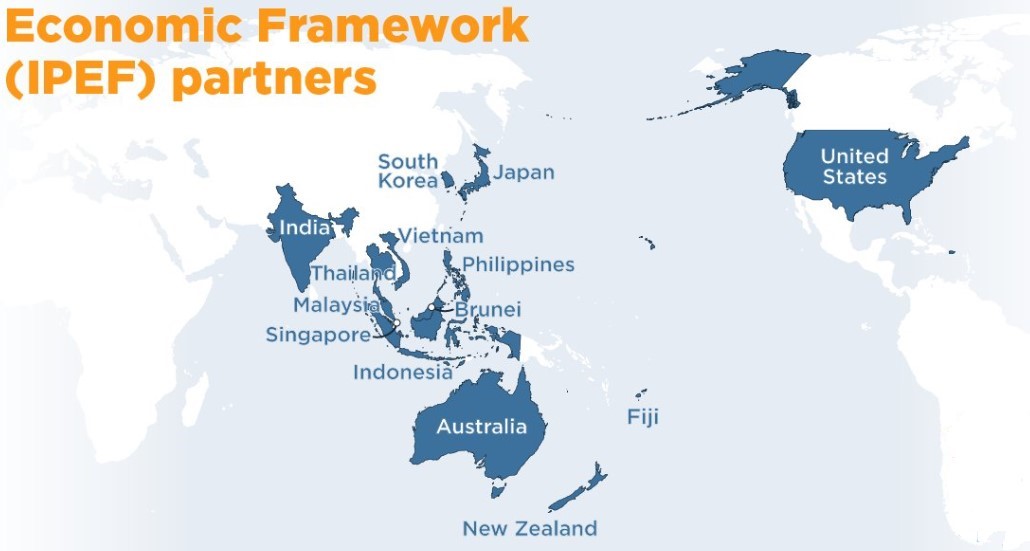
- 14 Member Countries – USA, Australia, Brunei, Fiji, India, Indonesia, Japan, Republic of Korea, Malaysia, New Zealand, Philippines, Singapore, Thailand, Vietnam.
IPEF with its 14 partner countries represents 40% of global GDP and 28% of global goods and services trade.
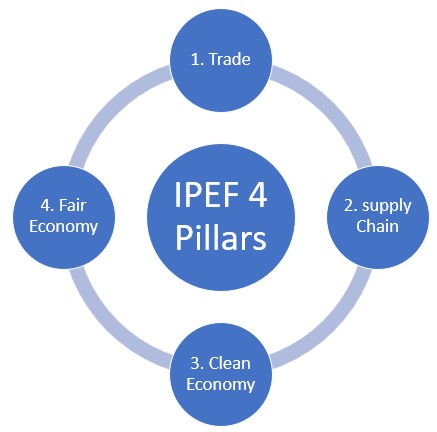
- India had joined Pillars II , III & IV of IPEF while it has an observer status in Pillar-I.
- Ministerial-level council and a commission - Agreement on the Indo-Pacific Economic Framework for Prosperity established a ministerial-level council and a commission.
|
IPEF Agreements
|
Date of Entry into Force
|
|
Supply Chain Agreement
|
February 24, 2024
|
|
Clean Economy Agreement
|
October 11, 2024
|
|
Fair Economy Agreement
|
October 12, 2024
|
|
Overarching Agreement on IPEF
|
October 11, 2024
|
- Overarching Agreement – It is an administrative agreement establishing an oversight Ministerial-level mechanism over the various individual IPEF agreements.
- Objective - To facilitate the effective implementation of subject agreements (Pillars II-IV).
- Funds under IPEF - IPEF also provides platforms for technical assistance, concessional funding, and viability gap funding.
- IPEF Catalytic Capital Fund - To pool resources and expand the pipeline of bankable climate projects.
- With an initial grant of $33 million from Australia, Japan, Korea, and the United States, it aims to catalyse private investments totalling $3.3 billion.
- PGI Investment Accelerator - To increase private investment in the Indo-Pacific.
- It has received initial funding of $300 million from the United States International Development Finance Corporation
- Significance of the IPEF - Inclusive growth, Environmental sustainability, Fair economic competitiveness.
- Reshape Economic Relations - The pillars of supply chains, a clean economy, and a fair economy will reshape economic relations in the region.
India’s merchandise exports to the U.S. have risen by over 50% (54.4%) from $54.3 billion in 2018 to $83.8 billion, as reported in 2023.
- Counter BRI - At a time when China’s Belt and Road Initiative (BRI) is leading to debt traps, the IPEF seeks transparency and open dialogue.
|
Initiatives under IPEF
|
|
IPEF Upskilling Initiative
|
Providing digital skills training to primarily women and girls in IPEF emerging and middle-income partner countries.
|
|
Critical Mineral Dialogue
|
Strengthening the critical mineral supply chain and ensuring sustainable mining practices in the region.
|
|
Tech Council
|
Coordination and cooperation on key technologies like Cyber Security, Undersea Cables and Artificial Intelligence.
|
|
Cooperative Work Program
|
Facilitate collaborative and cooperative efforts among the interested participating IPEF countries to advance the objectives of the Clean Economy Agreement.
|
What is the Pillar II - Supply Chain?
- Aim of Supply Chain Pillar
- Deepening cooperation to build more competitive and resilient supply chains.
- Better prepare for, prevent, and respond to supply chain disruptions when they happen.
- Ensure that regional supply chains raise up workers and respect labour rights.
- Supply Chain Agreement's three bodies
- Supply Chain Council
- Crisis Response Network
- Labor Rights Advisory Board(LRAB)
India was elected as Vice Chair of the Supply Chain Council with US as Chair.
- Benefits – This pillar helps in supply chain diversification among the member countries.
- Boost Domestic Manufacturing - It supports India's self-reliance initiatives (Aatmanirbhar Bharat) and Production Linked Incentive (PLI) schemes by mobilizing investments in production, logistics services, and infrastructure.
- Shift of Production Centers - The agreement is expected to attract production centers in key goods and critical sectors to India, boosting domestic manufacturing.
- Global Supply Chain Integration - The agreement facilitates deeper integration of Indian MSMEs (Micro, Small, and Medium Enterprises) into global supply and value chains.
- Economic Resilience - It helps mitigate risks of economic disruptions from supply chain shocks and adverse events, creating a more resilient economic environment.
- India’s Tech Advancement - Initiative on Critical and Emerging Technologies (iCET)-related sectors such as cyber security and artificial intelligence, will ensure that India remains at the forefront of technological advances.
- Workforce Development - It includes provisions for upskilling and reskilling the workforce, ensuring that Indian workers are well-prepared for the demands of modern supply chains.
What is the Pillar III – Clean Economy ?
- Aim - To advance cooperation on research, development, commercialization, availability, accessibility, and deployment of clean energy and climate friendly technologies.
- Objectives of Agreement on Clean Economy - Accelerate efforts of IPEF partners towards energy security and transition, climate resilience and adaptation, GHG emissions mitigation.
- Benefits - U.S.-India clean energy partnership is vital in helping India achieving net zero carbon emissions by the year 2070.
- Technical Cooperation - Collaborate to facilitate development, access, and deployment of clean energy and climate-friendly technologies
- Capacity Building - Promote technical cooperation, workforce development, capacity building, and research collaborations.
- Energy Security - Find/develop innovative ways of reducing dependence on fossil fuel energy.
- Financial Opportunities - Facilitate investments through climate financing and green bonds towards climate-related projects in the region.
- Domestic Industrial Development - Investments in renewable energy projects and technology transfers will allow India’s industries to integrate more deeply into global value chains.
What is the Pillar IV – Fair Economy ?
- Aim - To create a more transparent and predictable trade and investment environment across the Indo-Pacific.
- Strengthening anti-corruption efforts
- Enhancing the.
- Benefits - Expand trade, investment ties and ensure the benefits of trade are broadly shared throughout their economies.
- Mitigate Trade Hurdles – Reducing trade complexities & barriers, opaque regulatory requirements and tax policies that encourage corrupt behaviour in certain emerging markets.
- International Financial Cooperation - It enhances information sharing among partners, facilitating asset recovery and strengthening cross-border investigations and prosecutions.
- National Security and Economic Integrity - It helps in addressing issues such as cross-border money laundering and terror financing.
- Generate Investor Confidence – Implementation of the agreement creates a reliable trade environment and attracts investments.
- Strengthening Anti-Corruption Measures - The agreement focuses on preventing and combating corruption, including bribery and money laundering.
- Efficient Tax Administration - The agreement supports initiatives to improve tax transparency and enhance cooperation in tax administration among member countries.
What lies ahead?
- IPEF represents more than a series of trade and investment agreements and is a strategic effort to cement partnerships in the region.
- Revival of Generalized System of Preferences (GSP) of US will boost trade with US.
Generalized System of Preferences (GSP) facilitated duty-free access to more mature markets and it was withdrawn in 2019.
- Building consensus along the lines of QUAD to address geopolitical turbulence, and global economic uncertainty.
- Enhancing information sharing among partners, facilitating asset recovery and strengthening cross-border investigations and prosecutions.
- Utilize member’ strengths like technological advancements, investment capacity, market potential, requisite resources including skilled workforce.
- Develop domestic standards quickly to avoid being at a disadvantage in international negotiations on standards.
References
- The Hindu | Strengthening the India link in the IPEF
- PIB | IPEF Ministerial Meeting
- PIB | IPEF Agreements



