Prelims: Current events of national and international importance | Environment
Why in News?
Recently, the FAO has released a global assessment highlighting widespread soil degradation and its implications for food security, climate resilience, and sustainable agriculture.
Status of the World’s Soil Resources 2026
- Report released at – 17th Conference of Parties (COP17) of the United Nations Convention to Combat Desertification (UNCCD) in Ulaanbaatar, Mongolia.
- Prepared under – FAO’s Global Soil Partnership and the Intergovernmental Technical Panel on Soils.
|
Soil Biodiversity
|
- Soil biodiversity refers to ‘the variety of life belowground, from genes and species to the communities they form, as well as the ecological complexes to which they contribute and to which they belong, from soil micro-habitats to landscapes’.
- Major Components of Soil Biodiversity
- Bacteria and fungi
- Archaea and protozoa
- Nematodes
- Earthworms
- Arthropods
- Other soil organisms
- Soils contain approximately 59% of global biodiversity and support more than 95% of food production.
|
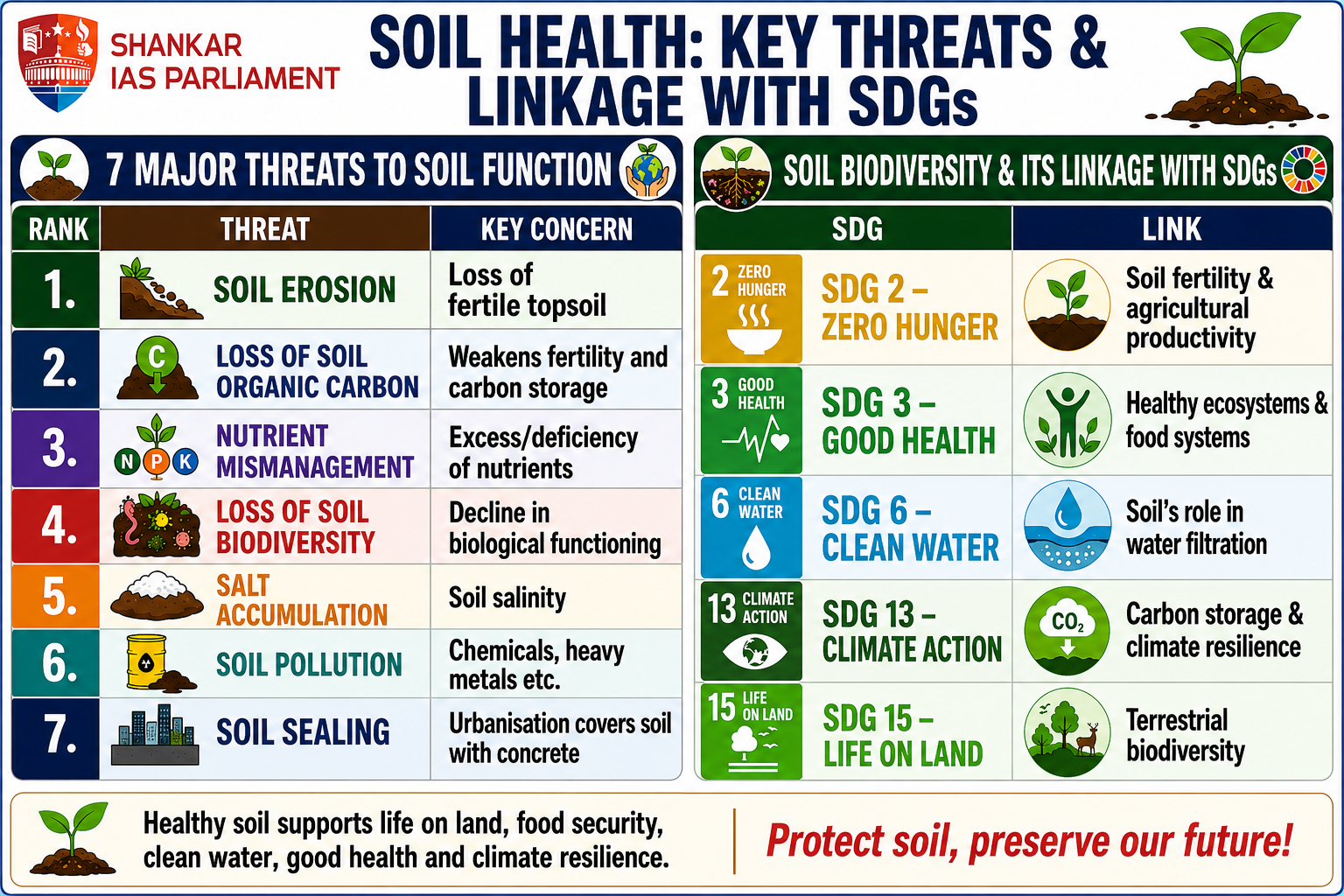
- Threats – Land-use change, intensive agriculture, pollution, pesticides, deforestation, urbanisation, climate change and soil disturbance.
- Ker recommendation from – FAO’s 2020 State of Knowledge of Soil Biodiversity report. It includes the
- Adoption of sustainable soil management practices to minimise soil biodiversity loss,
- Inclusion of biological indicators of soil health alongside physical and chemical indicators, and
- Use of standardised sampling and analytical protocols.
Reference
Down to Earth | FAO Soil Resources Report 2026



