Mains: GSIII – Environment
Why in News?
India is expanding deep-sea exploration under the Deep Ocean Mission, raising concerns over the ecological risks of commercial seabed mining in poorly understood deep-sea ecosystems.
What is the Status of India’s Growing Deep-Sea Footprint?
- Deep sea – It is the layer of the ocean starting about 200 meters (660 feet) below the surface where sunlight begins to fade
- India holds 3 International Seabed Authority (ISA) exploration contracts covering nearly 95,000 sq km.
The International Seabed Authority (ISA) is an autonomous international organization established under the 1982 United Nations Convention on the Law of the Sea (UNCLOS).
- These areas include the:
- Central Indian Ocean Basin
- Central Indian Ridge
- Carlsberg Ridge
- polymetallic nodules – Exploration has identified around 366 million tonnes of polymetallic nodules containing:
- Nickel
- Copper
- Cobalt
- Manganese
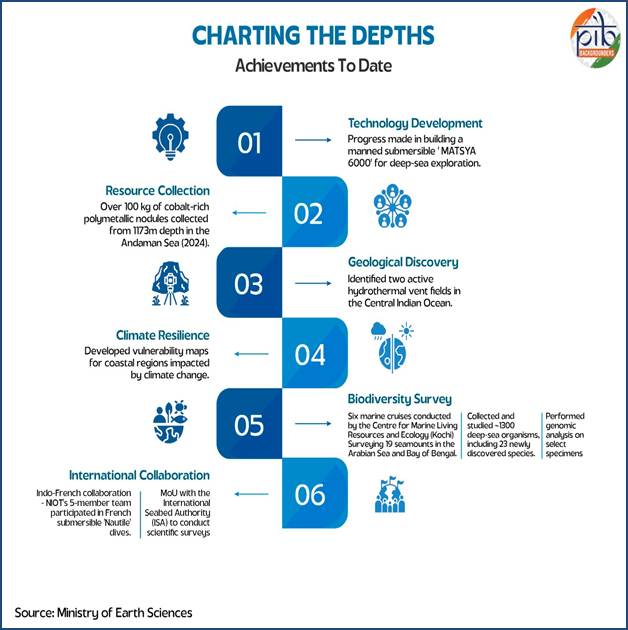
- Under the Deep Ocean Mission, India is developing:
- Deep-sea mining technology
- Underwater robotics
- MATSYA-6000 human submersible
- The National Institute of Ocean Technology has tested a mining machine at depths of about 5,270 metres.
- Biodiversity – Surveys across 19 seamounts have recorded around 1,300 deep-sea organisms, including nearly 23 species reported as new to science.
Why is Deep-Sea Exploration Important for India?
- Critical Mineral Security – Polymetallic nodules contain minerals are important for clean-energy technologies, electric mobility and advanced manufacturing.
- Strategic Autonomy – Access to critical minerals can reduce India's vulnerability to disruptions in global mineral supply chains and strengthen strategic resource security.
- Indigenous Technological Capability – Deep-sea exploration promotes advances in underwater robotics, Submersible technology, Ocean mapping.
- Scientific Knowledge – Exploration helps India understand Deep-sea ecosystems, Marine biodiversity, Ocean processes, Climate interactions, Seabed geology.
- Blue Economy – Responsible utilisation of marine resources can contribute to India's blue economy, employment, and maritime capabilities.
What are the Major Ecological Concerns?
- Limited Scientific Understanding – The deep ocean remains one of the least understood ecosystems on Earth.
- Discovery of new species indicates that significant biodiversity remains undocumented.
- Hence, large-scale intervention may have consequences that cannot presently be predicted.
- Destruction of Seabed Habitats – Mining machines can physically disturb the seabed and damage habitats supporting deep-sea organisms.
- Sediment Plumes – Mining can generate sediment plumes that may spread beyond the mining area and affect organisms in the surrounding water column.
- Biodiversity Loss – Slow-growing and highly specialised deep-sea organisms may have limited capacity to recover from large-scale disturbance.
- Irreversibility and Uncertainty – Deep-sea ecosystems may take extremely long periods to recover from disturbance.
- The absence of adequate baseline data makes it difficult to accurately assess long-term impacts.
- Climate and Ecosystem Functions – Deep oceans contribute to carbon cycling, nutrient cycling and climate regulation.
- Disturbance of these ecosystems may have wider ecological implications that are not yet fully understood.
How Can India Balance Development and Conservation?
- Adopt the Precautionary Principle – Where scientific knowledge is inadequate and environmental damage may be irreversible.
- Separate Exploration from Exploitation – Scientific exploration should continue to improve Biodiversity knowledge, Environmental baselines, Geological understanding.
- However, exploration should not automatically imply future commercial mining.
- Establish Environmental Baselines – Before any extraction, India should establish comprehensive data on Species diversity, Seabed characteristics, and Ecosystem functions.
- This will enable meaningful environmental impact assessment.
- Identify Sensitive No-Mining Zones – Areas containing unique, vulnerable or poorly understood ecosystems should be identified for permanent or long-term protection.
- Promote Circular Economy – India should reduce dependence on virgin mineral extraction through
- Recycling of critical minerals
- Reuse and repair
- Material substitution
- Resource-efficient technologies
- Sustainable product design to be consistent with the principles of Mission LiFE.
- Strengthen International Governance – India should actively participate in the International Seabed Authority and support Science-based regulations, Environmental safeguards.
- Ensure Continuous Monitoring – Any future activity should be subject to Baseline assessment, Environmental impact assessment, and adaptive regulation.
What else could be done?
- Nature-Based Solutions – Recognise ecosystems as part of the solution to environmental challenges.
- Sustainable Development Goals – Balance economic development with environmental protection and intergenerational equity.
- Circular Economy – Reduce the dependence of economic growth on continuous extraction of virgin resources.
- Mission LiFE – Promote behavioural and consumption changes to reduce resource pressure.
What lies ahead?
- India's Deep Ocean Mission provides an opportunity to develop world-class deep-sea science and technology.
- However, the success of the mission should not be measured merely by how deep India can explore or how much mineral it can extract.
- India can instead demonstrate a model of responsible blue economy, where technological progress is accompanied by ecological restraint.
- The real measure of scientific advancement is not only the ability to exploit a new frontier, but also the wisdom to identify which frontiers should remain untouched.
Reference
The Hindu| Balancing deep-sea discovery



