Prelims: Current Events of National and International Importance
Why in News?
Recently, a team from the Travancore Nature History Society, the Institute of Tropical Research, Ecology and Conservation, and the Zoological Survey of India has identified a new butterfly species.
- Location - A new butterfly species, Zographetus mathewi, has been discovered in the Western Ghats, a global biodiversity hotspot.
Western Ghats is one of the world’s 8 “hottest hotspots” of biological diversity.
- Discovered by – A team of lepidopterists (a person who studies or collects butterflies and moths).
- Nomenclature - The butterfly is named in honour of George Mathew, a prominent Indian entomologist and former head of the Kerala Forest Research Institute’s Entomology Division.
- Family – Hesperiidae.
- Common name - Sahyadri Spotted Flitter, referencing the local name for the Western Ghats.
- Genus - It is the 15th species in the genus Zographetus and the 5th recorded in India.
- It belongs to the Zographetus satwa species group.
- Appearance - Yellow-ochre scaling on the underside of the hindwing, hairy forewings with a basal hair tuft, and swollen forewing veins in males, which serve as secondary sexual characteristics.
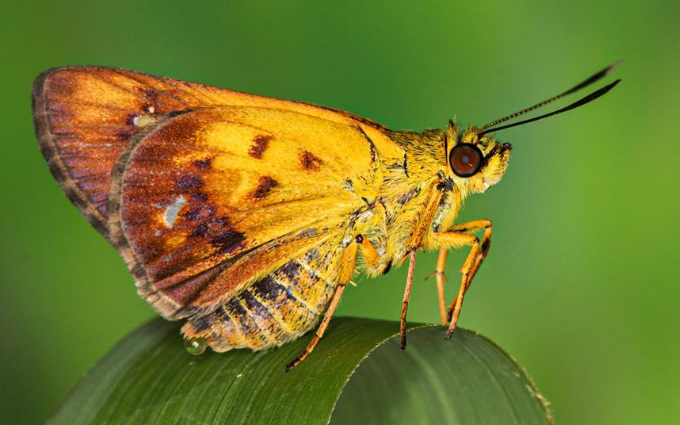
- Distinct Features - It is noted for its unique wing venation (the pattern of veins on an insect's wing) and secondary sexual traits such as swollen forewing veins in males.
- It also exhibits distinct genital structures in both males and females, key features that distinguish it from similar species such as Zographetus ogygia.
- Diet - The larvae feed on Aganope thyrsiflora, a native leguminous vine from the Fabaceae family.
- Conservation Significance - The discovery highlights the rich, unexplored biodiversity of the Western Ghats.
- It also emphasizes the need to conserve low-elevation forests that harbour such rare, endemic butterflies.
Reference
The Hindu| Zographetus Mathewi



