Prelims: Current events of national and international importance| Science and technology
Why in News?
A new study has demonstrated that thunderquakes can be used to study the Earth’s shallow subsurface.
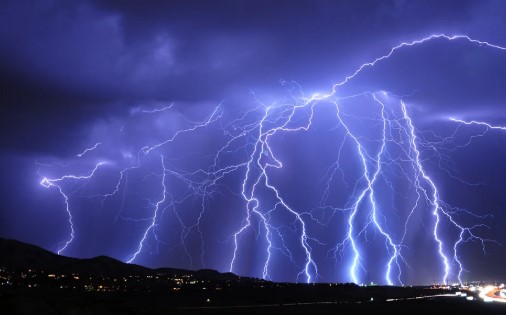
- The technique combines naturally occurring seismic energy from thunderstorms with fibre-optic cables.
- Thunderquakes – Lightning superheats the surrounding air, producing a shock wave heard as thunder.
- When part of this energy reaches the ground, it is converted into seismic waves, called as “Thunderquakes”.
- Technology – Distributed Acoustic Sensing (DAS) used to convert ordinary fibre-optic cables into thousands of vibration sensors.
- A laser-based interrogator sends light through the fibre and detects tiny changes caused by ground vibrations.
- The study used a 4+ km fibre-optic cable with more than 2,100 sensors. It recorded 458 clear thunderquakes over two years.
Thunderquakes ‘X-ray’ the Earth subsurface –
- Thunderquakes generate air-coupled Rayleigh waves.
- These waves travel along the Earth's surface and contain information about subsurface structures.
- Through seismic dispersion, different frequencies travel at different speeds and depths.
- Analysing these variations helps estimate seismic wave velocity and subsurface properties.
- The study could image the subsurface to about 100 metres depth, without drilling.
- Applications
- Detecting groundwater movement
- Identifying sinkholes and underground voids
- Detecting fractured or weathered rocks
- Monitoring environmental contamination
- Assessing building sites and foundations
- Monitoring ground subsidence
- Significance –
- The study provides a low-cost and non-invasive method of subsurface mapping while using existing telecommunication fibre infrastructure.
- It can enable continuous monitoring of urban subsurface conditions.
- Similar atmospheric shock waves may also generate useful seismic signals from Sonic booms, Volcanic eruptions, Meteor airbursts.
Karst Landscapes
- Karst terrain develops where soluble rocks such as limestone and dolomite are dissolved by groundwater.
- It can form caves, fractures and sinkholes.
- Karst landscapes cover about 20% of the world's continental land area and affect nearly 25% of the global population.
Possible planetary application
- It can be applied beyond Earth. Titan, Saturn's largest moon, is a potential candidate because atmospheric disturbances and lightning may occur there.
- NASA's Dragonfly mission is expected to explore Titan.
Reference
The Hindu| Using Thunderquakes to X-ray earth



