Forecasting GDP growth of India
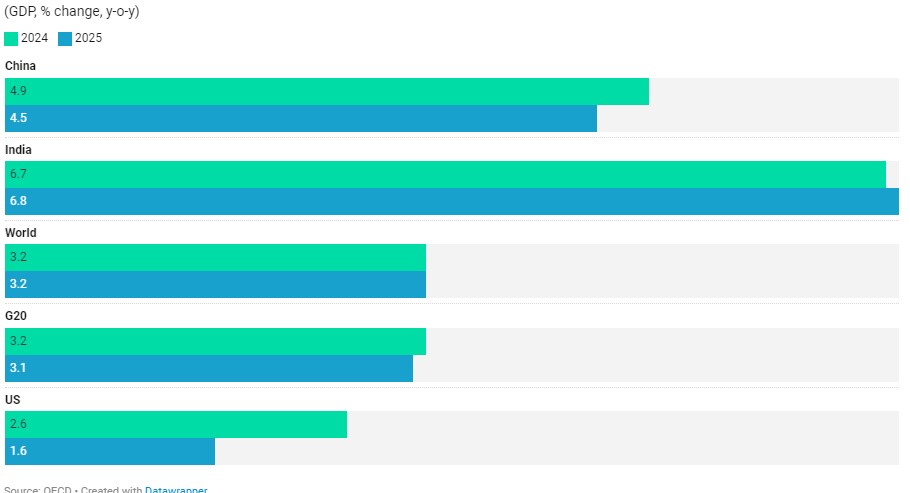
OECD recently revises India’s FY25 growth forecast upward to 6.7% in its Interim Economic Outlook.
Analysis
- OECD – It revises growth upward to 6.7% in FY25 and noted that growth is expected to increase to 6.8% in FY26.
- Asian Development Bank – It retained India’s growth at 7% for FY25, projecting a pick up to 7.2% in FY26.
- World Bank – It has raised its growth forecast for India's economy to 7 per cent for the current financial year (FY25), up from an earlier projection of 6.6 per cent
- Nomura - Lowered its FY25 economic growth forecast for India to 6.7% from 6.9%.
- RBI- Upgraded its GDP growth projection for FY25 to 7.2%.
- Morgan Stanley - Raised its India GDP growth forecast for FY25 to 6.8%.
Trends
- Inflation - Inflation is also projected to be higher at 4.5% compared with 4.3% projected in May.
- Prices would likely inch towards the RBI’s mid-point target of 4% in FY26.
- Consumer inflation – It remained below 4% in July and August and economists expect it to rise to 5% in the coming months.
- Gross Domestic Product (GDP) - It reflects demand in the economy, grew by 6.7% in the quarter under consideration, compared to 8.2% during the same period of the last fiscal and 7.8% in the previous quarter.
- Gross Value Added (GVA) - It reflects supply in the economy, rose to 6.8% during Q1 of FY25 compared to 8.3% in the corresponding quarter of the last fiscal and 6.3% of the previous quarter.
- Manufacturing - Accounts for about 17% of India’s GDP, grew by 7% year-on-year in the April-June quarter, compared to an 8.9% expansion in the previous quarter.
- Agricultural output - Grew 2% year-on-year in the same period, up from 1.1% in the previous quarter.
Global GDP growth is projected to stabilize at 3.2% in 2024 and 2025.
References
- Money Control | OECD revises India’s FY25 growth
- The Hindu Business Line | India’s GDP Growth
World Gorilla Day
Uganda Celebrates Conservation Success on World Gorilla Day titled Over 30 Years of Impact in Mountain Gorilla Conservation.
- World Gorilla Day is an annual event held on September 24.
- Established on - World Gorilla Day dates back to 2017 when the Karisoke Research Centre celebrated its 50th anniversary.
- Dr. Dian Fossey, a renowned primatologist, founded the centre in 1967 to conserve and research gorillas in Rwanda’s Volcanoes National Park.
- Fossey’s revolutionary work with mountain gorillas has significantly impacted their survival and spurred global efforts to safeguard all gorilla species.
- The day celebrates gorillas and empowers global communities to take action to protect this critically endangered species.
- The day also provides an opportunity for people to safeguard their future in alignment with the Convention on the Conservation of Migratory Species of Wild Animals.
Gorillas
- Gorillas are the largest living primates.
- Weight - Males weighing up to 485 pounds and reaching heights of 5.5 feet.
- Appearance - Gorillas have black hair and skin, large nostrils, and prominent brow ridges. They have small eyes and lack hair on their face, hands, and feet.
- Species - There are 2 gorilla species
- The eastern gorilla(G. beringei) - (The mountain gorilla(G. beringei beringei) is a subspecies of the eastern gorilla) and
- The western gorilla(Gorilla gorilla).
- Habitat - Gorillas live in the tropical forests of equatorial Africa.
- Distribution - The two types of gorillas live on opposite sides of the Republic of the Congo, separated by the Congo basin forest.
- The eastern gorillas are found in Rwanda, Uganda, and the Republic of the Congo.
- Western gorillas live in Angola, Cameroon, Central African Republic, the Democratic Republic of the Congo, Equatorial Guinea, Gabon, and Nigeria.
- Closest relatives - Gorillas share 98.3% of their genetic code with humans, making them our closest cousins after chimpanzees and bonobos.
- Structure – Gorillas are social animals and live in family groups called troops.
- Gorillas are polygamous a single adult male gorilla, called a silverback, leads a troop and mates with multiple females.
- Diet – Vegetarians.
- Conservation status - IUCN - Both the eastern and western gorilla are classified as "Critically Endangered".
- Threats - Habitat loss and fragmentation, disease, hunting, illegal logging, palm oil plantations, and forest fires.
Reference
Down to Earth | World Gorilla Day 2024
Asia Power Index, 2024
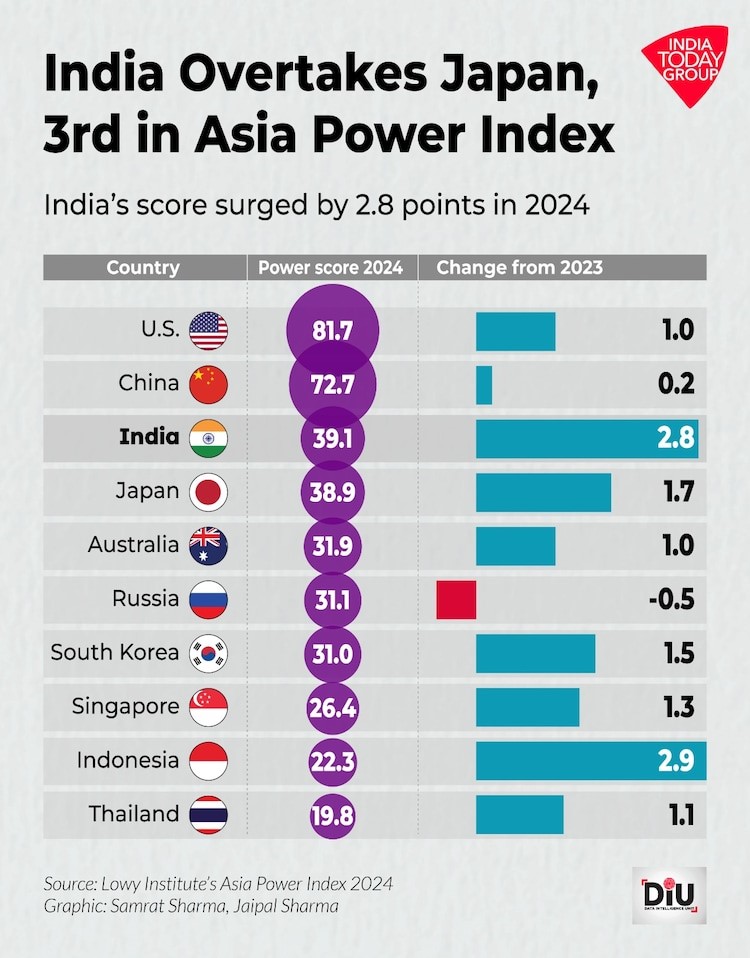
Ministry of Information and Broadcasting recently says that India surpasses Japan to become 3rd largest power in Asia power index.
- Asia power Index - The Asia Power Index measures resources and influence to rank the relative power of states in Asia.
- Launched by - The Lowy Institute in 2018.
- Evaluation - It evaluates 27 countries across the Asia-Pacific region, focusing on their ability to shape and respond to external geopolitical challenges.
- The index is an analytical tool that helps sharpen debate on power in Asia and track shifts in the distribution of power over time.
- Theme- The project evaluates international power in Asia through 131 indicators across 8 thematic measures
- Military capability and defence networks,
- Economic capability and relationships,
- Diplomatic and cultural influence,
- Resilience and future resources.
- The 2024 edition includes Timor-Leste for the first time, reflecting its growing importance as a result of likely accession to the Association of Southeast Asian Nations (ASEAN) in coming years.
Status of India, 2024
- Factors for growth - India surpasses Russia and Japan due to its rise in dynamic growth, youthful population, and its expanding economy.
- PPP - India experienced a 4.2-point boost in Economic Capability, primarily driven by its strong GDP growth and status as the world’s 3rd largest economy in Purchasing Power Parity (PPP) terms.
- Resources - India’s Future Resources score also saw a notable increase of 8.2 points, highlighting its potential demographic advantage.
- Youth population - Unlike aging populations in China and Japan, India’s youthful demographic is expected to fuel continued economic expansion and workforce growth in the coming years.
- Diplomacy - The report further noted India’s growing influence in multilateral diplomacy and regional security.
- India's active participation in groups like the Quad and its leadership in regional dialogues have bolstered its position in regional security without the need for formal military alliances.
- Geopolitics - Additionally, defense deals such as the BrahMos missile agreement with the Philippines point to India's expanding geopolitical ambitions.
- The report also finds that India’s ability to project power east of the Malacca Strait is limited.
References
- Economic Times | India surpasses Japan in Asia Power Index
- Lowy Institute | About
Doctrine of Constructive Possession
The Supreme Court called for the need to have sex education programs in schools in an effort to mitigate the menace of child pornography.
- Constructive possession - Constructive possession refers to a legal theory whereby an individual can be considered in possession of an item without having physical control over it.
- In essence, it is the ability and intent to exercise control over an object, even if it is not physically on one’s person.
- Courts use this doctrine to extend liability and responsibility to individuals who, while not directly holding an item, have dominion and control over it.
- Constructive possession legally functions as actual possession in a variety of ways.
- In criminal law, establishing constructive possession is often done to further prosecutions for possession crimes, such as possession of illegal drugs.
- In property law, establishing constructive possession grants the owner the right to obtain physical control and/or a variety of rights over someone else’s physical control of that property.
- Generally, for a court to find that a person had constructive possession of an object, the person must have had knowledge of the object, and as well as the ability to control it.
- Legal Criteria- For a successful prosecution of constructive possession, certain criteria must be met.
- Knowledge of the Item’s Presence - The individual must be aware that the item exists. Mere proximity to an item without knowledge does not constitute constructive possession.
- Ability to Exercise Control - The person must have the capability to maintain dominion over the item. This means having the power and intention to control its use.
- Intent to Possess - There must be an intent to possess the item. This can often be inferred from circumstances, such as the location of the item and the individual’s actions or statements.
References
- The Hindu | SC clarification on online content on child sex abuse
- India Today | Supreme Court bats for sex education in schools
Pact for the Future
United Nations General Assembly (UNGA) Global leaders recently embraced the Pact for the Future.
- It is a significant declaration promising tangible actions aimed at fostering a safer, more peaceful, sustainable, and inclusive world for future generations.
- Focus areas
- Sustainable development
- International peace and security
- Science and technology
- Youth and future generations and
- Transforming global governance.
- Multilateral financial institutions and the United Nations have come up short seeking solutions to 21st century problems, the pact lays out.
- By endorsing the Pact, UN Member States pledged, among other things includes
- Turbocharge the Sustainable Development Goals (SDGs) and the Paris Agreement on climate change, 2 landmark 2015 agreements that have seen halting progress and missed milestones
- Listen to young people and include them in decision-making, at the national and global levels
- Build stronger partnerships with civil society, the private sector, local and regional authorities and more
- Redouble efforts to build and sustain peaceful, inclusive and just societies and address the root causes of conflicts
- Protect all civilians in armed conflict
- Accelerate the implementation of our commitments on women, peace and security
- In annex Global Digital Compact and Declaration on Future Generations was also adopted unanimously.
Global Digital Compact
- The Global Digital Compact marks the first truly worldwide agreement on the international regulation of artificial intelligence (AI).
- It outlines commitments to ensure that digital technologies contribute to sustainable development and human rights, while addressing risks like digital divides, cybersecurity, and misuse of technology.
- The Compact aims to bridge the digital divide and ensure AI technologies are used responsibly, fostering global cooperation on both AI capabilities and security threats.
- Governments are also obligated to form an impartial worldwide Scientific Panel on AI and start an international conversation about AI governance inside the UN.
Declaration on Future Generations
- The Declaration on Future Generations focuses on securing the well-being of future generations, also highlighting the need to include their interests in decision-making processes.
- It also underlines the importance of protecting the environment, promoting intergenerational equity, and ensuring that long-term consequences of today's actions are considered.
Reference
United Nations | Pact for the Future



