Brucellosis
Why in News?
An 8-year-old girl from Kottakkal in Malappuram district of Kerala died at the Government Medical College Hospital, Kozhikode, recently after undergoing around two months of treatment for brucellosis.
- It is a bacterial infection caused by the consumption of unpasteurized milk.
- Caused by - Various Brucella species.
- It is also known as undulant fever, Mediterranean fever, Malta fever
- It mainly infects cattle, swine, goats, sheep and dogs.
- Transmission - Humans acquire it through direct contact with infected animals, by eating or drinking contaminated animal products or by inhaling airborne agents.
- Most cases are caused by ingesting unpasteurized milk or cheese from infected goats or sheep. Human-to-human transmission is very rare.
- Symptoms - Fever, weakness, weight loss, and general a feeling of discomfort. In many patients, they can be mild and may not get diagnosed at all.
- Incubation Period - It can vary from one week to two months, but it usually lasts between two and four weeks.
- Vulnerable age group - It affects people of all ages. Transmission primarily affects farmers, butchers, hunters, veterinarians and laboratory personnel.
- Treatment - Treatment options include taking doxycycline 100 mg tablets twice a day for 45 days, and streptomycin 1 g daily for 15 days as per the advice of the doctors.
- Prevention - Vaccination of cattle, goats and sheep is among the prevention options.
- Pasteurisation of milk for direct consumption and for creating derivatives such as cheese is an important step to prevent its transmission from animals to humans.
Reference
The Hindu | What is brucellosis?
Rare Diseases in India
Why in News?
Recently, a 19-year-old child actress, Suhani Bhatnagar, died due to dermatomyositis, a rare disease
Dermatomyositis
- It is an uncommon inflammatory disease marked by muscle weakness and a distinctive skin rash.
- The condition can affect adults and children, affects more females than males.
- There's no cure for dermatomyositis.
Rare disease
- A disease is considered rare if it affects fewer than 200,000 people in the U.S. and fewer than 1 in 10,000 people in the European Union.
- Definition – According to WHO, Rare disease is a lifelong disease with a prevalence of 10 or fewer per 10,000 population.
- According to Organization of Rare Diseases India (ORDI) defined rare disease as a disease when it affects 1 in 5,000 people.
Rare Disease Day was observed on the last day of February i.e., 28th February (or 29 in leap years).
- Spread – It affect approximately 3.5% to 5.9% of the population.
- Causes – 72% of rare diseases are genetic, with over 7000 characterized by diverse disorders and symptoms.
Status in India
- India lacks a standard definition for rare diseases.
- Estimate suggests that about 8 crore-10 crore Indians suffer from one rare disease or another, over 75% are children.
- India accounts for one-third of the global rare disease incidence, with over 450 identified diseases.
- These range from widely known ones such as Spinal Muscular Atrophy and Gaucher’s disease to lesser-known ones such as Mucopolysaccharidosis type 1 and Whipple’s disease.
- Centres of Excellence – They are institutions identified by the central government under the National Policy for Rare Diseases (NPRD), 2021.
- Aim – To treat patients suffering from rare diseases actively.
- Currently, 63 rare diseases are included under NPRD on recommendation of Central Technical Committee for Rare Diseases (CTCRD).
Reference
The Hindu | Rare diseases
Anti-conversion Bill, Rajasthan
Why in News?
The Rajasthan Prohibition of Unlawful Conversion of Religion Bill, 2025 was introduced in the ongoing Budget Session of the state Assembly recently.
- Provisions of the bill - Religious conversion by misrepresentation, force, undue influence, coercion, allurement or by any fraudulent means or by marriage has been made an offence in the Bill.
- The offence under the anti-conversion bill will be cognisable and non-bailable and triable by a court.
- Individuals who desire to convert their religion are required to give a declaration in the prescribed form at least 60 days in advance to the District Magistrate.
- The burden of proof that a religious conversion was not done through unlawful means rests on the person who has "caused" the conversion.
- The court may grant appropriate compensation to victims of unlawful conversion, which may extend to a maximum of ₹5 lakh.
- Repeat offenders may face double the punishment provided under the law for each subsequent offense.
- Marriages done for the sole purpose of conversion will be deemed invalid by family courts.
- Punishment and penalties - The Bill provisions imprisonment for a term not less than one year.
- It may extend to 5 years with a fine of Rs 15,000.
- Those who violate the rules in respect of a minor, a woman or a person belonging to the Scheduled Caste or Scheduled Tribe shall be punished with imprisonment for a term of 2 years.
- It may extend to 10 years along with a fine of Rs 25,000.
- In case of mass conversion, the bill provisions 3 years of jail extending up to 10 years and a fine of Rs 50,000.
- Marriages done for the sole purpose of conversion will be deemed invalid by family courts.
- Once passed, Rajasthan will become the 12th state to have an anti-conversion law.
- Other states having anti-conversion law
- Odisha, Arunachal Pradesh, Gujarat, Chhattisgarh, Karnataka, Jharkhand, Haryana, Uttarakhand, Himachal Pradesh, Uttar Pradesh and Madhya Pradesh.
Reference
The Indian Express | Anti-conversion bill
Golden-Headed Cisticola
Why in News?
According to bird watchers, the recent discovery of a golden-headed cisticola in the southern Western Ghats marks the 1st sighting after an extensive gap.
- It is a tiny bird, shines brightly with its golden crown and captivating song.
- Scientific Name – Cisticola exilis.
- Discovered in – Mathikettan Shola National Park, Idukki, Kerala.
- It is known as Bright-Capped Cisticola.
- Habitat – Grasslands, sub-coastal areas, wetlands, savannas, woodlands, scrublands, swamp margins, rivers, and irrigated farmlands.
- Distribution – Western Australia, north-east to Darwin, Cape York and India and southern China.
Golden-Headed Cisticola has been observed in parts of Karnataka, Tamil Nadu, northern Kerala and 1st time found in the southern part of the Palakkad gap in the Western Ghats.
- Morphology – Small, sandy-colored bird with short tail, cream-colored underside and brown upper side.
- Streaks of black or dark brown on the upper part of their body, black wings, golden head, throat is white and back of their neck is dull shade of gold.
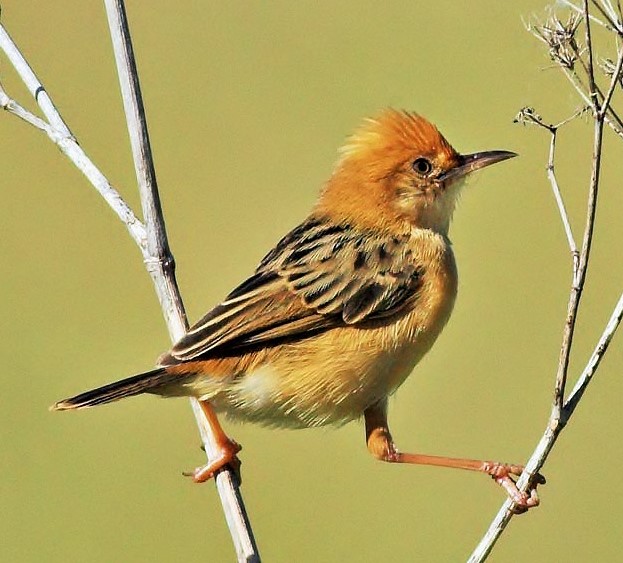
- Sexual dimorphism
- Male – Has distinct golden-orange plumage on their head, neck, and chest during breeding.
- It also has pinkish beaks and black streaks on their backs.
- Call – It produces a variety of sounds distinct from other birds range from a teewip to wheezz, whit-whit.
- Diet – It is omnivorous, feed on invertebrates such as insects, small slugs, and eat grass seeds.
- Threats – Urbanization
- Land development
- Changes in agricultural practices
- Wetland degradation.
- Conservation Status
- IUCN – Least Concern.
- Wildlife (Protection) Act, 1972 – Schedule II.
References
- The Hindu| Golden-headed Cisticola
- Thai National Parks| Bright-capped cisticola
- Simply Birding| Golden-headed Cisticola’s Threats
|
One Liners 05-02-2025
|
|
History, Art and Culture
|
|
State Emblem of India
Home Ministry asked state governments to prevent misuse of State Emblem of India.
- It is the official seal of the Government of India, and an adaptation from the Sarnath Lion Capital of Asoka.
- Structure – Lion Capital showing 3 Lions mounted on the abacus,
- Centre – Dharma Chakra.
- Right – Bull.
- Left – Galloping horse.
- Motto – Satyameva Jayate (in Devanagari script), inscribed below the profile of Lion Capital.
- Respective Act – Prohibition of Improper Use Act, 2005.
|
|
Geography
|
|
Indo- Bangladesh Border
- India and Bangladesh have a border that spans 4,096.7 km, making it the longest land border India has with any neighboring country.
- Bordering States - West Bengal, Assam, Meghalaya, Tripura & Mizoram.
- Fencing -A total of 3,141 kilometers has been fenced along the India-Bangladesh border, which encompasses all eastern states, from the total 4,156.
- Over 800 km of the India- Bangladesh border still needs fencing.
|
|
Polity & Governance
|
|
Gyan Bharatam Mission
Union Budget 2025-26, announced new Gyan Bharatam Mission.
- Launched in – 2003.
- Launched by – Ministry of Tourism and Culture.
- Aim – To preserve and digitize India’s rich manuscript heritage, ensuring knowledge accessibility for future generations.
- Purposes – Documentation and conservation of our manuscript heritage with academic institutions, museums, libraries and private collectors.
- It will be undertaken to cover more than 1 crore manuscripts.
Atal Tinkering Laboratories (ATLs)
50,000 (ATLs) will be set up in government schools in next 5 years.
- Launched in – 2016.
- Umbrella scheme – Atal Innovation Mission (AIM).
- Nodal Ministry – NITI Aayog.
- Vision – Cultivate one million children in India as Neoteric Innovators.
- ATL – It provides activity-based learning in the identified schools across the country where young minds can give shape to their ideas for societal problems.
National Bamboo Mission (NBM)
- Launched in – 2018.
- Nodal Ministry – Ministry of Agriculture & Farmers Welfare.
- Objectives – It provides assistance to both the government & private sectors for the propagation and cultivation of,
- Bamboo in non-forest land
- Bamboo treatment
- Establishment of markets
- Incubation centers
- Value added product development & processing
- Development of tools & equipments.
- Funded by – Both Centre and State government for all states except North Eastern & Hilly states.
Soil Health Card (SHC) Scheme
- Launched in – 2014.
- Nodal Ministry – Ministry of Agriculture & Farmers Welfare.
- Umbrella scheme – Rashtriya Krishi Vikas Yojana (RKVY).
- SHC – A massive programme of soil sampling, testing and generation of SHCs.
- Assist State Governments to issue soil health cards to all farmers in the country.
Deendayal Antyodaya Yojana- National Rural Livelihood Mission (DAY-NRLM)
- Launched in – 2010.
- Nodal Ministry – Ministry of Rural Development.
- Aim – To reduce poverty by enabling poor households to access gainful self-employment and skilled wage employment resulting in sustainable and livelihood options for the poor.
- NRLM – It was renamed as Deendayal Antyodaya Yojana – National Rural Livelihood Mission (DAY-NRLM) in 2016.
- Funded by – Both central and state governments.
|
|
International Relations and Issues
|
|
India's Contribution to UN Regular Budget
- The UN Regular Budget is the annual budget for the UN.
- The General Assembly approves the budget, which is funded by contributions from member states.
- It funds agencies like the World Food Programme, the UN Refugee Agency, and the children's fund (UNICEF).
- India has paid USD 37.64 million for the 2025 United Nations Regular Budget.
- India is now on the "honour roll" of 35 member states that paid their assessments fully and on time.
|
|
Agriculture
|
|
Central Rice Research Institute (CRRI)
- Established in – 1946.
- Established at – Bidhyadharpur, Cuttack, Odisha.
- Under – Indian Council of Agricultural Research (ICAR).
- CRRI – It is committed to provide the highest quality analysis of rice conforming to international standards.
- 3 sub-stations at – Hazaribag (Jharkhand), Gerua (Assam), and Naira (Andhra Pradesh).
- Accredited from – National Accreditation Board for Testing and Calibration Laboratories (NABL) under the standard for chemical testing.
|
|
Security
|
|
Indian Army to Use Bamboo Based Composites
- Purpose – For High Altitude Bunker Construction.
- MOU - Signed between Indian Army's 4 Corps and IIT Guwahati.
- It will replace traditional materials for high altitude bunkers.
|



