Kalasa-Banduri project
A team from the Progressive River Authority for Water and Harmony (PRAWAH) recently visited Belagavi district, reigniting the dispute between Karnataka and Goa over the Mahadayi River.
- Background - The Kalasa-Banduri Project is a Karnataka government initiative first proposed in the 1980s.
- It aims to divert water from the Mahadayi River to the Malaprabha River to improve drinking water supplies to the districts of Belagavi, Bagalkote, Dharwad, and Gadag.
- The Kalasa nala project, part of the Kalasa-Banduri Project, involves building barrages to store and lift water from the stream and divert it into the Malaprabha.
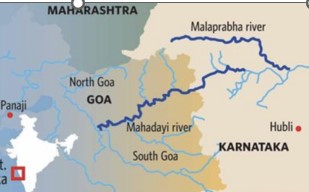
- The entire project aims to construct a total of 11 dams on the river Mahadayi.
- The project would also involve diverting around 27 hectares of land, including 11 hectares in a tiger corridor between Karnataka and Goa.
- The Dispute - The project has been delayed due to inter-state water dispute between Karnataka, Goa, and Maharashtra.
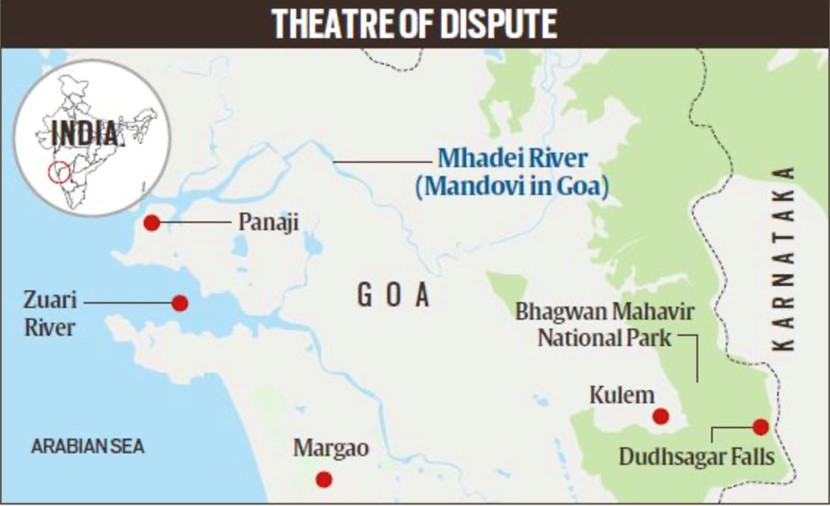
- Goa has argued that the project would reduce the flow of water into the Mahadayi, damaging its natural flow and ecology.
- While Goa has also claimed the project would impact tiger conservation and concerns over ecological damage.
- Tribunal - The Mahadayi Water Dispute Tribunal was set up in 2010 to look into the issue.
- The Tribunal in 2018 awarded 13.42 TMC water from Mahadayi river basin to Karnataka, 1.33 TMC to Maharashtra and 24 TMC to Goa.
Mahadayi River
- Mahadayi originates inside the Bhimgad Wildlife Sanctuary in the Belagavi district of Karnataka.
- It flows through Karnataka, Goa, and Maharashtra.
- It is called as Mandovi River in Goa.
- Salim Ali Bird Sanctuary in Chorao Island, Goa is located on the Mandovi River.
- Tributaries - Kalasa Nala, Surla Nala, Haltar Nala, Poti Nala, Mahadayi Nala, Pansheer Nala, Bail Nala, Andher Nala.
References
- Down to Earth | Kalasa-Banduri project
- The Indian Express | Kalasa-Banduri project
AXIS of resistance
Hamas leader Ismail Haniyeh recently assassinated in an air strike in Tehran, Iran.
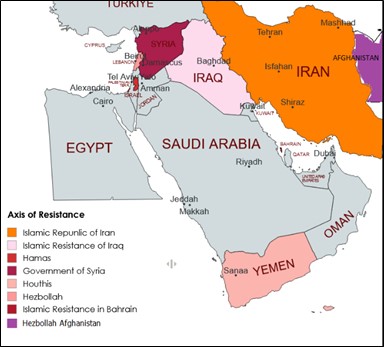
- AXIS of resistance - It is a coalition of Iranian-backed anti-US and anti-Israel political and militant groups.
- Origin of the Name – Its name is inspired by former US President George W Bush’s use of the term ‘axis of evil’.
- It referred to Iran, Iraq, and North Korea.
- Group Members
- Hezbollah - Shiite militant organization
- Hamas - Palestinian Sunni militant group in Gaza
- Palestinian Islamic Jihad (PIJ) - Sunni Islamist militant group, Palestine
- Houthis - Zaydi Shia militant group, Yemen
- Formation of the coalition - The Iranian Revolution of 1979 paved the way for radical Shia Muslim clerics to come to power in the Middle East region.
- Middle East was dominated by US and Israel supported Sunni-majority nations such as Saudi Arabia.
- To expand its political and military influence in a region Iran’s new regime began to support non-state actors.
- Iran has seen Israel’s creation in 1948 as a means for the US (and the West) to influence the region for its strategic interests.
Reference
Indian Express | Axis of Resistance
Kakori Train Action
The historic Kakori train action, a significant event in Indian freedom will be celebrated throughout Uttar Pradesh.
- Kakori Train Action – It was a train robbery event that took place at Kakori, a village near Lucknow, on 9 August 1925.
- Organizers - It was the first major action organized by the Indian revolutionaries of Hindustan Republican Association (HRA).
- Leaders - Ram Prasad Bismil and Ashfaqullah Khan.
- Other member of the plan- Rajendra Lahiri, Chandra Shekhar Azad, Sachindra Bakshi, Keshab Chakravarty, Manmathnath Gupta, Mukundi Lal, Murari Lal Gupta and Banwari Lal.
- The 100th anniversary of this incident will be celebrated in 2025.
- Event
- On 9 August 1925, the Number 8 Down Train was travelling from Shahjahanpur to Lucknow.
- It carried treasury bags meant to be deposited in the British treasury in Lucknow.
- When it passed Kakori village, Rajendra Lahiri pulled the emergency chain to stop the train.
- Subsequently Ram Prasad Bismil , Ashfaqullah Khan and others entered the train and looted the money.
- Due to a misfiring, one passenger (a lawyer named Ahmad Ali) was killed during the robbery.
- Reaction by the British - British authorities launched violent crackdown and arrested several members of the HRA.
- Rajendranath Lahiri , Ashfaqullah Khan, Ram Prasad Bismil and Thakur Roshan Singh were hanged for it in 1927.
- The only major leader of HRA at this time who evaded arrest was Chandrashekhar Azad.
- Transform into HRSA - In 1928, after the execution of the Kakori Conspiracy accused, the HRA merged with various other revolutionary groups in Punjab, Bihar and Bengal and became the Hindustan Socialist Republican Association (HSRA).
|
Quick Facts
- Hindustan Republican Association (H.R.A.) was formed in 1924, as a radical revolutionary organization under the aegis of Ram Prasad Bismil, Ashfaqulla Khan, Sachindra Nath Bakshi, Sachindranath Sanyal, and Jogesh Chandra Chatterjee.
- Their manifesto Krantikari (Revolutionary) was released on January 1, 1925.
|
References
- The Print | Kakori Train Action
- Indian Express | Kakori Train Action Anniversary
Sloth bear
A recent study on sloth bear behaviour during tiger encounters suggests strategies to prevent fatal human attacks.
- The sloth bear also known as the Indian bear, is a myrmecophagous bear species native to the Indian subcontinent.
Myrmecophagous, meaning that they specialize in eating termites and ants.
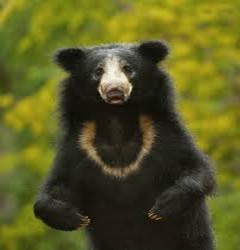
- Scientific name- Melursus ursinus
- Diet- They are omnivorous but primarily feeds on fruits, ants and termites.
- Physical Characteristics- Sloth bears have a long, shaggy coat of black fur, a mane around their shoulders, and a whitish, V- or Y-shaped marking on their chest.
- Behaviour- Sloth bears are mostly nocturnal, foraging for food at night and resting during
- Lifespan- In the wild, sloth bears can live up to 20 years, while in captivity they may live slightly longer.
- Habitat- They prefer tropical and subtropical forests, grasslands, and scrublands.
- They are often found in areas with rocky outcrops and caves, which they use for shelter.
- Distribution- Sloth bears are primarily found in India, but their range also extends to Nepal, Sri Lanka, and Bhutan.
- Conservation Status
- IUCN Red List Status- Vulnerable
- CITES- Appendix I
- Wildlife Protection Act, 1972- Schedule I
Sloth bears are responsible for more attacks on humans than any other large carnivore, with a notable percentage of these attacks being fatal.
References
- Down to Earth | sloth bears
- Wildlifesos | Sloth bears
Tarang Shakti
The Indian Air Force (IAF) is set to conduct its largest international air exercise, 'Tarang Shakti,' with participation from 30 countries.
- About- It will be the biggest air combat exercise to be hosted by India.
- Aim- The aim is to foster interoperability and share best practices and to showcase the indigenous defence industry.
- It will involve the practicing of a variety of combat missions in a realistic environment, boost mutual trust and help explore avenues for interoperability and imbibe best practices from one another.
- Focus- The focus of the exercise will be to showcase the indigenous capabilities under Aatmanirbharta.
- Location- First phase of the exercise will be held in Tamil Nadu's Sulur and the second phase will be in Jodhpur.
- Participants- Germany, France, Spain, UK to participate in 1st phase of exercise.
- US, Australia, Greece, Singapore, UAE to take part in 2nd phase.
- Russia not taking part due to ongoing war with Ukraine.
- Participation from India- IAF fighters participating in the drills include Rafales, Sukhoi-30 MKIs, Mirage 2000s, Jaguars, and MiG-29s.
- Locally produced assets include the Tejas LCA Mk-1, Prachand light combat helicopter, Dhruv advanced light helicopter, and its armed version, Rudra.
References
- The Print | Tarang Shakti
- Hindustan Times | Tarang Shakti 24



