0.1660
7667766266
x

UNESCO Memory of the World Register, 2026

iasparliament Logo
November 11, 2026

Prelims: Current events of national and international importance | Art & Culture

Why in news?

Manuscripts of the epic Mahabharata, Rajatarangini and Arthashastra have been inscribed on UNESCO’s Memory of the World Asia-Pacific Regional Register.
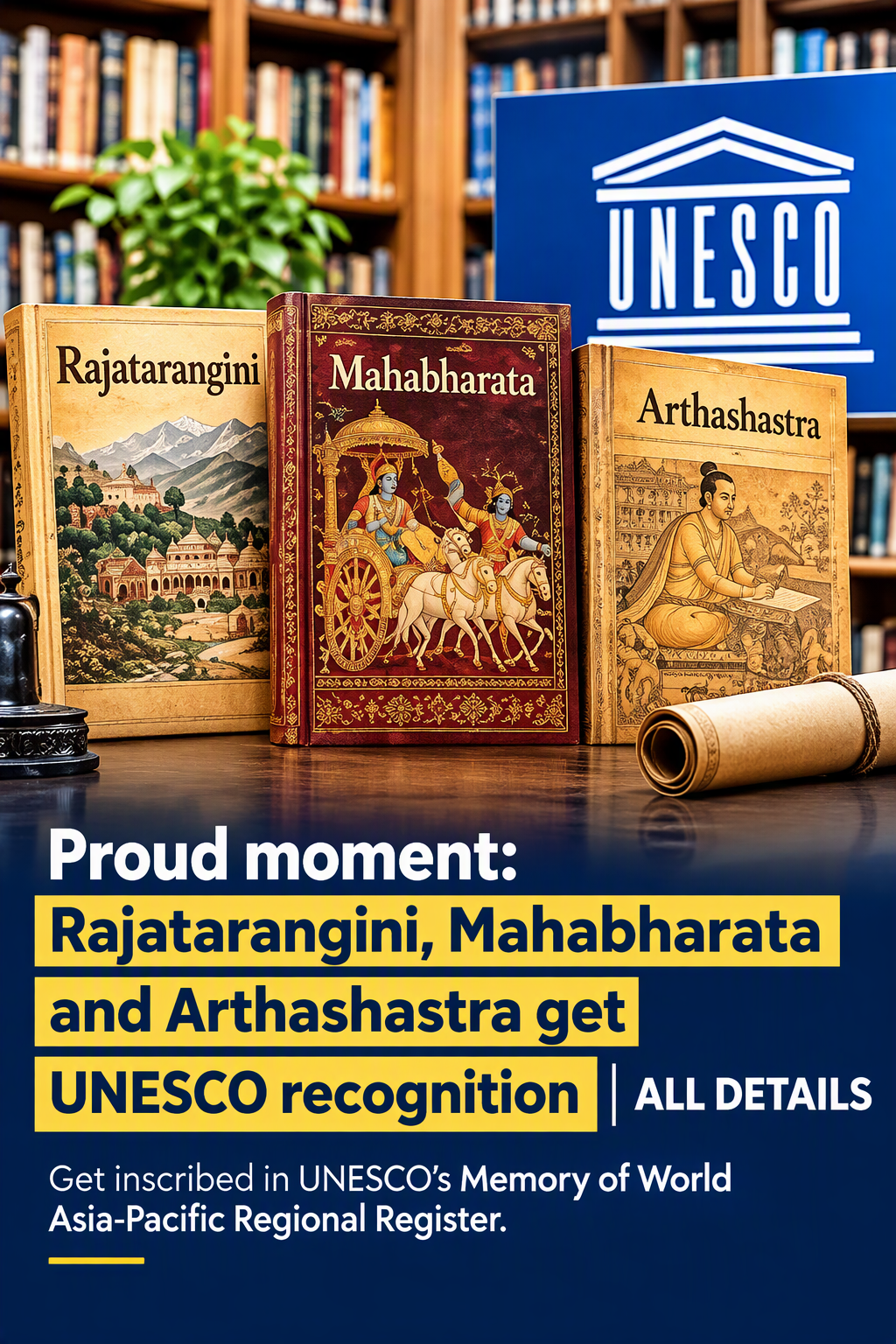
  • UNESCO's Memory of the World Programme – Launched in 1992 to protect documentary heritage against loss, deterioration and collective amnesia.
  • The programme seeks to ensure that historically and culturally significant documents remain preserved and accessible to future generations.
  • The Asia-Pacific Regional Register is administered through Memory of the World Committee for Asia and the Pacific (MOWCAP).
  • It maintains a regional register to preserve and recognise significant documentary heritage across 43 Asia-Pacific nations.
  • Nominations are evaluated biennially.
  • It operates through international, regional and national registers. While the International Register recognises documentary heritage of global significance, regional registers identify collections and documents that hold particular importance for specific geographical and cultural regions.
  • India's participation – Coordinated by the Indira Gandhi National Centre for the Arts (IGNCA), designated as the country's nodal institution in 2014.
  • It facilitates nominations, promotes archival awareness, supports manuscript conservation and organises capacity-building programmes.
  • Recent Indian Inscriptions – During the 11th Session of the Memory of the World Asia-Pacific Regional Register held in Jakarta, Indonesia, the three major ancient Indian manuscripts were inscribed –
    • The Birch-bark (burjapatra) 'Manuscript ’ of Mahabharata – A Perennial Epic of South Asia’ housed at the Bhandarkar Oriental Research Institute, Pune;
    • ‘Kautilya’s Arthashastra, Ancient palm-leaf Manuscript on Governance and Statecraft’ housed at the Oriental Research Institute, Mysuru; and
    • ‘The Manuscript of Rajatarangini by Kalhana: A Twelfth-century Chronicle of Kashmir’ housed at the Oriental Research Library, Sri Pratap Singh Library Complex, Srinagar.

unesco-memory.png.upsc

  • Rajatarangini – It was composed by the 12th-century Kashmiri historian Kalhana and is widely regarded as one of the most important historical chronicles of medieval India.
  • Written in Sanskrit, it traces the history of Kashmir through successive dynasties, rulers, political developments and social transformations.
  • Its significance lies in its attempt to present historical events through chronological narration, critical examination of sources and literary composition, making it an important resource for understanding Kashmir's political and cultural past.
  • Mahabharata – One of the world's longest epic narratives, occupies a central position in South Asian literary, philosophical and religious traditions.
  • Beyond its account of the conflict between the Kauravas and Pandavas, the epic explores questions of duty, justice, morality, power, kinship and the responsibilities of individuals and rulers.
  • Its philosophical dimensions, particularly the Bhagavad Gita, have influenced generations of thinkers and continue to shape discussions on ethics and human conduct across cultures.
  • Arthasastra – Traditionally attributed to Kautilya, also known as Chanakya, is a foundational work on governance, administration, economics, diplomacy and military strategy.
  • Its detailed examination of statecraft, taxation, law enforcement, intelligence networks and public administration offers valuable insights into political organisation and the functioning of ancient Indian states.
  • The text remains an important reference for scholars studying the history of political and economic thought.
  • Significance – The official termed the inscriptions a recognition of India’s knowledge traditions that contributed to human understanding of history, ethical values, philosophy, Dharma and good governance, and represented dimensions of India’s intellectual heritage.
  • 2024 Inscriptions – During the 10th General Meeting in Ulaanbaatar, Mongolia, India inscribed three foundational classical literary works (presented by the Indira Gandhi National Centre for the Arts)
    • Manuscripts of the Ramcharitamanas, featuring intricate miniature paintings, preserving Tulsidas’ work;
    • A rare 15th-century manuscript containing animal fables and moral stories from the Panchatantra; and
    • The manuscript of the Sahrdayaloka-Locana, a text of Indian poetics by Acharya Anandvardhan.

References

  1. The Hindu | Mahabharata, Arthashastra, Rajatarangini manuscripts added to UNESCO memory regional register
  2. NDTV | 'Mahabharata', 'Arthashastra', 'Rajatarangini' Added To UNESCO Memory Register
There are no reviews yet. Be the first one to review.

ARCHIVES

sidetext


