Mains: GS III | Environment
Why in News?
A study analyzed 83 video recordings of 19 wild indris using frame-by-frame motion tracking and field audio to absorb how vocal Tract Tuning Works in Indris and Singers.
What are wild indri lemurs (Indri indri) and formant tuning?
- It is the only known singing lemur species, native to the rainforests of Madagascar.
- It opens their mouths wider as the pitch of their songs rises, using a vocal adjustment similar to formant tuning practiced by trained opera singers.
- Formant tuning – It means shaping the mouth, jaw, and vocal tract so their natural resonance matches the pitch of the sound being produced, making the voice carry more clearly without needing extra strain.
- Coordinating Mouth Opening with Pitch- Frame-by-frame tracking of upper and lower lip movements showed that as the pitch of an indri's song increased, the lemur opened its mouth wider.
- Projecting Sound through Dense Forests- Indris sing long, complex calls in the thick rainforest canopy of eastern Madagascar to reinforce group bonds, coordinate when separated, and signal territory to neighboring groups.
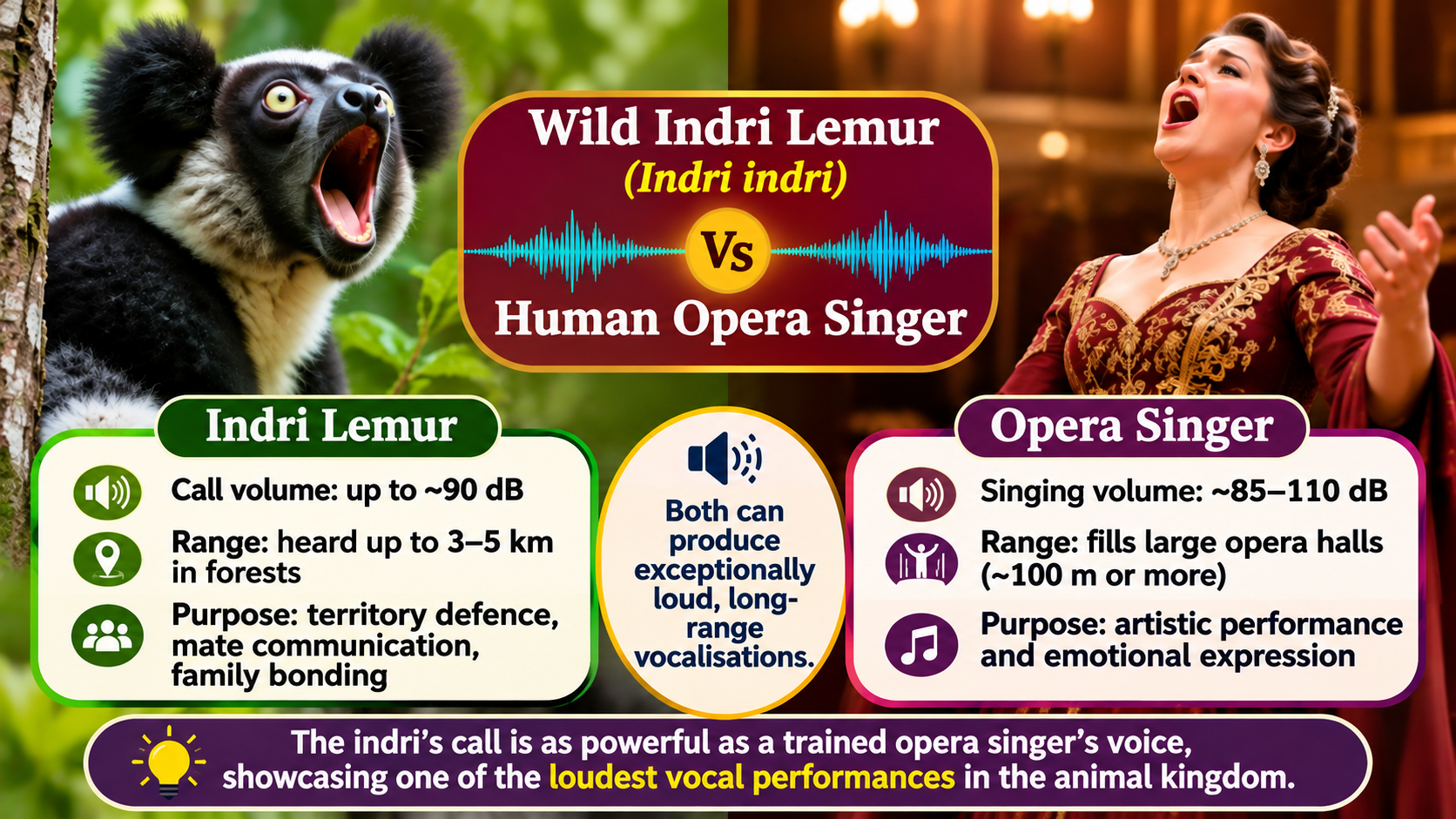
- A Parallel with Opera Singers- Just as a trained soprano widens the mouth on high notes to amplify vocal resonance so sound reaches a large hall, wider mouth opening helps indris project calls across dense forest distance.
How does it converge evolution across 74 million years?
- Humans and indris last shared a common ancestor roughly 74 million years ago.
- Because this vocal-body coordination appears in two distantly related primate lineages.
- It facing very different environments human concert halls versus Madagascar's rainforest canopy scientists point to convergent evolution, where separate species independently arrive at a similar functional solution over deep evolutionary time.
Comparing singing Indris and human opera singers
|
Dimension
|
Wild Indri Lemur (Indri indri)
|
Human Opera Singer
|
|
Primary Setting
|
Dense tropical rainforest canopy in Madagascar
|
Concert halls and opera stages
|
|
Vocal Behavior
|
Opens mouth wider as song pitch rises during group/territorial calls
|
Widens mouth and adjusts vocal tract resonance on high notes
|
|
Purpose of Amplification
|
Carries long-distance songs across thick forest and social groups
|
Projects unamplified voice clearly across large auditoriums
|
|
Evolutionary Origin
|
Independent adaptation in the wild (convergent with humans)
|
Deliberate human vocal training building on anatomical capacity
|
What are the conservation implications for Indris?
- Beyond acoustics, researchers emphasize the urgency of conserving indris in their natural habitat.
- Because indris have proven very difficult to keep and breed in captivity, their long-term survival depends directly on protecting Madagascar's remaining rainforest ecosystems.
What is the way forward?
- Safeguard contiguous rainforest corridors in Madagascar where wild indri groups live, forage, and communicate.
- Continue applying remote audio-visual and motion-tracking methods to study endangered wildlife behavior without disturbing animals in the wild.
- Use accessible stories like how a forest primate uses a trick familiar to opera singers to build public support for biodiversity protection.
Reference
The Hindu | What do lemurs and opera singers share?



