Prelims: Current events of national and international importance
Why in News?
The cyclonic disturbances over the North Indian Ocean, which include the Arabian Sea, the Bay of Bengal, and the land area in between, have changed drastically over the last century.
- Major trends - There are 4 major trends.
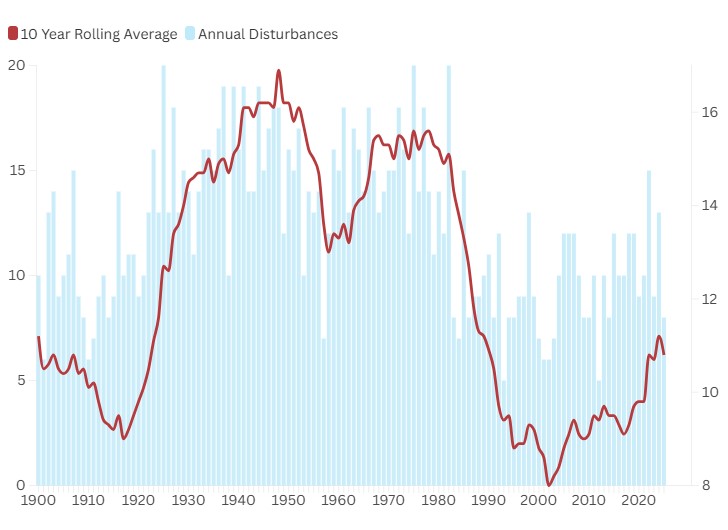
- Shifting of frequency - First, the frequency of cyclonic disturbances has shifted significantly.
- The below plots annual disturbances (left axis) alongside a 10-year rolling average (right axis) from 1900 to 2025.
- The chart reveals a distinct inverted U-shaped trend in the past century.
- Drop-in activity - Second, the overall decline in disturbances in recent years is driven almost entirely by a sharp drop in activity within the Bay of Bengal.
- The below chart breaks down the 10-year rolling average of cyclonic disturbances by origin: the Bay of Bengal, the Arabian Sea, and inland/other areas.
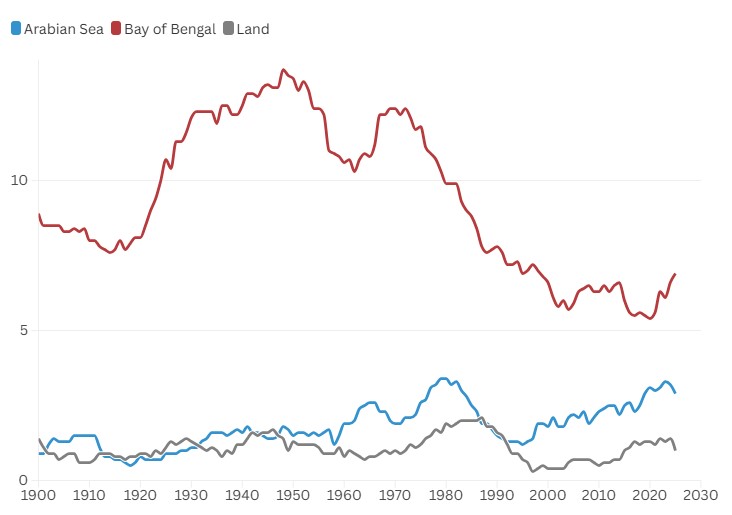
- The Arabian Sea has seen a marked increase in activity, though its frequency remains lower than that of the Bay even in recent years.
- Increase in severity - Third, while the number of disturbances has decreased, their severity has intensified.
- Typically, a disturbance begins as a low-pressure area (winds <31 kmph) and can intensify into a depression (31–49 kmph) or a deep depression (50-61 kmph).
- Beyond this point, they are classified as cyclonic storms (62-88 kmph) or severe cyclonic storms (89-117 kmph).
- The most destructive stages follow: very severe (118-166 kmph), extremely severe (167-221 kmph), and super cyclonic storms (≥222 kmph).
- The below chart illustrates the percentage of disturbances that intensify into severe cyclonic storms or higher.
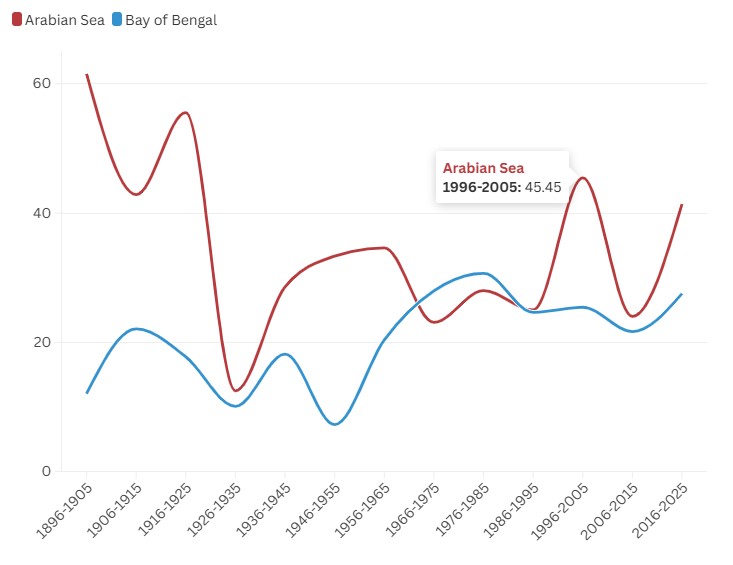
- Generally, warmer oceans provide more energy to tropical storms, making cyclones stronger and their paths harder to predict.
- Data show that the Arabian Sea is heating up more than average, leading to more intense, tougher-to-predict cyclones.
- Shift in seasonality - Fourth, there has been a significant shift in the seasonality of these storms.
- In the Bay of Bengal, disturbances are increasingly originating in the final quarter of the year (October–December) rather than in the July–September window.
Reference
The Hindu | Trends reshaping Indian ocean



