Prelims: Current events of national and international importance | Art and Culture
Why in News?
Somnath Swabhiman Parv marks 1,000 years of resilience since the first attack on the Somnath Temple, celebrating its enduring faith and revival.
- Location – Situated in India’s western coast at Prabhas Patan, Gujarat, at the confluence of the Kapila, Hiran, and Saraswati rivers.
- Deity – It is dedicated to Lord Shiva. (Somnath – “Protector of the Moon”).
- It is revered as the first Jyotirling among the 12 mentioned in the Dwadasha Jyotirling Stotram.
- Mythical origins – It was built first by Somraj (Moon God) in gold, was later rebuilt by Ravana in silver, by Krishna in wood, and by Bhimdev in stone.
- History –Under the patronage of Bhima I, ruler of the Chalukya (Solanki) Dynasty the temple is reconstructed, after its destruction by Maḥmud of Ghazni in 1025–1026 CE.
- Invasion – It was first attacked in January 1026 by Mahmud of Ghazni.
- It was again destroyed in 1297 CE by Alauddin Khilji’s forces, in 1546 by Portuguese and in 1706 by Aurangzeb.
- Modern Structure – The temple was reconstructed in May 1951 under the leadership of Sardar Vallabhbhai Patel.
- Reopened in 1951 in the presence of Dr Rajendra Prasad.
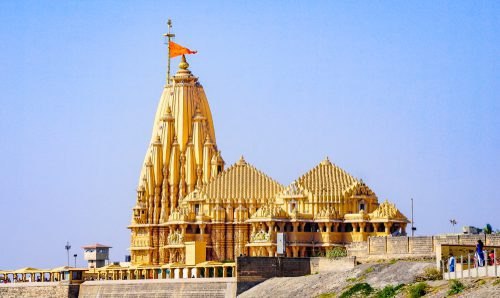
- Architecture – It is built in the Chaulukya (Solanki) style, a type of Nagara style.
- Key Components - Garbhagriha (sanctum), Sabha Mandapa and Nritya Mandapa.
- The main shikhara (spire) is around 50m high.
- It is constructed in sandstone facing east to align with the sunrise.
- Resilience –Despite continuous destruction, the temple was rebuilt again and again by successive generations.
- Cultural Relevance – It is an important pilgrimage site associated with the Triveni Sangam of Kapila, Hiran and Saraswati rivers.
- The Temple is known as “the Shrine Eternal,” symbolizing India’s civilizational continuity, spiritual strength, and national spirit.
- Visited and reflected upon by figures like Swami Vivekananda.
- Historical Accounts - Al-Biruni (a Persian scholar) gave a detailed description of the temple in his historical accounts.
Reference
The New Indian Express | Somnath Swabhiman Parv



