Mains: GS Paper III | Environment
Why in News?
The Supreme Court has extended its February 2024 order, mandating prior approval for mining within a 10-km radius of the Asan Wetland Conservation Reserve, to all wetland conservation reserves across India.
What is the background to the Asan Wetland case?
- The Asan Wetland Conservation Reserve lies at the confluence of the Asan and Yamuna rivers in Uttarakhand and was designated a Ramsar site in 2020.
- It is an important habitat for migratory waterbirds and supports rich aquatic biodiversity.
- The Supreme Court in an interim order dated February 14, 2024, directed that no mining activity should be carried out within a 10-km radius of the reserve.
- The project proponent first obtained permission from the Standing Committee of the National Board for Wildlife (NBWL) and/or the Ministry of Environment, Forest and Climate Change (MoEFCC) for mining activity inside the 10-km radius.
- The latest clarification indicates that the same principle would apply to other wetland conservation reserves across India.
What are Ramsar Sites?
- A Ramsar site is a wetland area recognised globally as a place of international importance.
- These are designated under the Ramsar Convention on Wetlands, an international treaty adopted in Ramsar, Iran, in 1971.
- Aim - To promote the conservation and wise use of wetlands of international importance.
- Diverse ecosystems - Includes lakes, marshes, rivers, mangroves, swamps, and coral reefs.
- Man-made additions - Covers human-made pools, reservoirs, and rice paddies.
- Natural functions- Acts like nature's filters to clean water, reduce floods, and store carbon.
- Ramsar Sites in India - India became a Contracting Party to the Convention in 1982.
- India currently has 101 Ramsar sites, the maximum among Asian countries.
- Glaw Lake in Arunachal Pradesh became the country’s 101st Ramsar site and the State’s first, taking India’s tally from 98 earlier this year to 101.
- A Ramsar designation does not itself create a separate statutory protection regime under Indian law.
- Rather, it recognises the international ecological importance of a wetland and commits India to maintaining its ecological character through domestic environmental laws.
What does the law say about mining in Ramsar Wetlands?
- Neither the Ramsar Convention nor the Wetlands Rules, 2017, specifies
- A mandatory buffer zone;
- A fixed distance restriction on mining activities.
- The Supreme Court's decision, therefore, creates an additional layer of judicial protection.
- Wetlands (Conservation and Management) Rules, 2010 - The earlier Wetlands (Conservation and Management) Rules, 2010 contained a detailed list of prohibited activities within wetlands, including
- Reclamation,
- Establishment of new industries,
- Dumping of solid waste and
- Any activity likely to adversely affect the wetland ecosystem.
- They also required prior approval for activities within a wetland’s zone of influence and mandated environmental impact assessments for specified projects.
- Wetlands (Conservation and Management) Rules, 2017 – It replaced this framework with a decentralised system under State Wetland Authorities.
- They removed the explicit list of prohibited activities contained in the 2010 Rules and shifted responsibility for identifying and regulating wetlands largely to the States.
- The constitutional validity of these rules is currently under challenge before the Supreme Court.
- Petitioners argue that the framework excludes many artificial wetlands recognised under the Ramsar Convention and weakens protections that existed under the 2010 Rules.
- Against this backdrop, the Supreme Court’s Asan directions assume significance, as it creates an additional judicial safeguard by requiring wildlife clearances before mining.
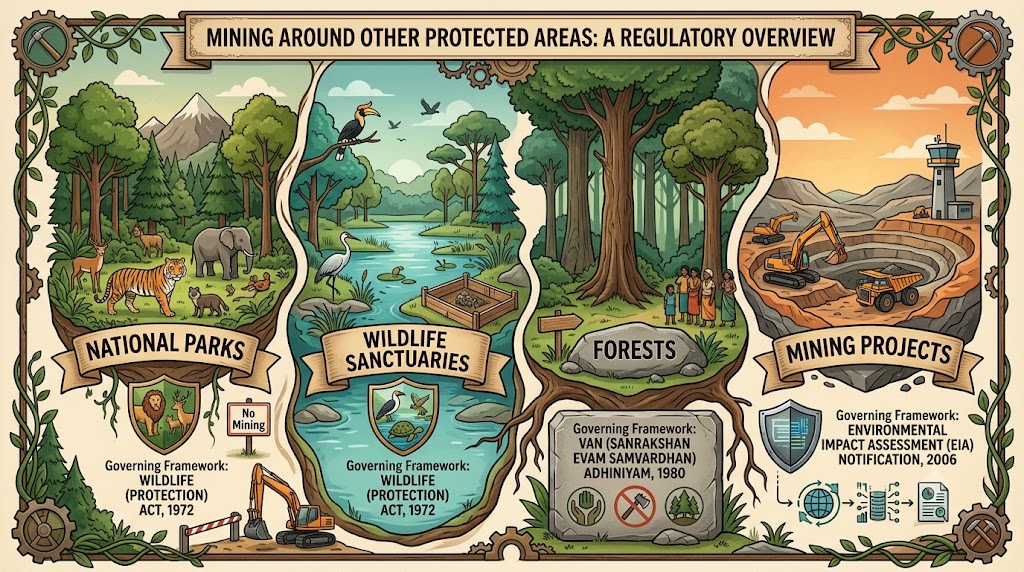
How does this compare with mining around national parks, wildlife sanctuaries and forests?
- Mining around protected forests and wildlife habitats is governed by a combination of statutes and Supreme Court directions.
- Wildlife (Protection) Act, 1972 - Within national parks and wildlife sanctuaries, mining is prohibited under the Wildlife (Protection) Act, 1972.
- SC Prohibition - The Supreme Court has prohibited mining activities within one kilometre of the boundaries of all national parks and wildlife sanctuaries across India.
- However, if a larger Eco-Sensitive Zone (ESZ) has already been notified, the larger buffer zone will apply instead.
- The Court extended this prohibition nationwide after observing that mining within 1 kilometre of protected areas is hazardous for wildlife.
- Projects located within protected areas or likely to affect wildlife habitats also require scrutiny by the Standing Committee of the National Board for Wildlife.
- Van (Sanrakshan Evam Samvardhan) Adhiniyam, 1980 - In forest areas, diversion of forest land for mining requires prior approval of the Central government under the Van (Sanrakshan Evam Samvardhan) Adhiniyam, 1980.
- Environment Impact Assessment Notification, 2006 - Mining projects are also generally subject to environmental clearance under the Environment Impact Assessment Notification, 2006.
What is the significance of the judgement?
Environmental significance
- It strengthens the protection of ecologically fragile wetlands.
- It conserves biodiversity and safeguards migratory bird habitats.
- It preserves groundwater resources and ecological balance.
Legal significance
- It establishes a uniform standard of protection across the country.
- It strengthens the precautionary principle and sustainable development doctrine.
Economic significance
- It encourages environmentally responsible mining practices.
- It promotes a balance between conservation and development.
What is the way forward?
- The Supreme Court's ruling marks a significant step towards strengthening wetland conservation in India.
- By extending the principle to all wetland conservation reserves, the Court has reinforced the importance of safeguarding these ecosystems against unsustainable exploitation.
Reference
The Hindu | Supreme Court order on Ramsar wetland sites



