Why in News?
Recently, The Punjab Cabinet passed a resolution against the Centre notifying the appointment of Ashwani Kumar Mishra as the Chief Justice of the Punjab and Haryana High Court, claiming it was done without awaiting the State government’s views, bypassing Constitutional norms and set procedures.
What is the role of a State government in appointing the Chief Justice of the High Court?
- Consultative role – The State government has a consultative role, but it does not have the power to appoint or veto the appointment of a High Court Chief Justice.
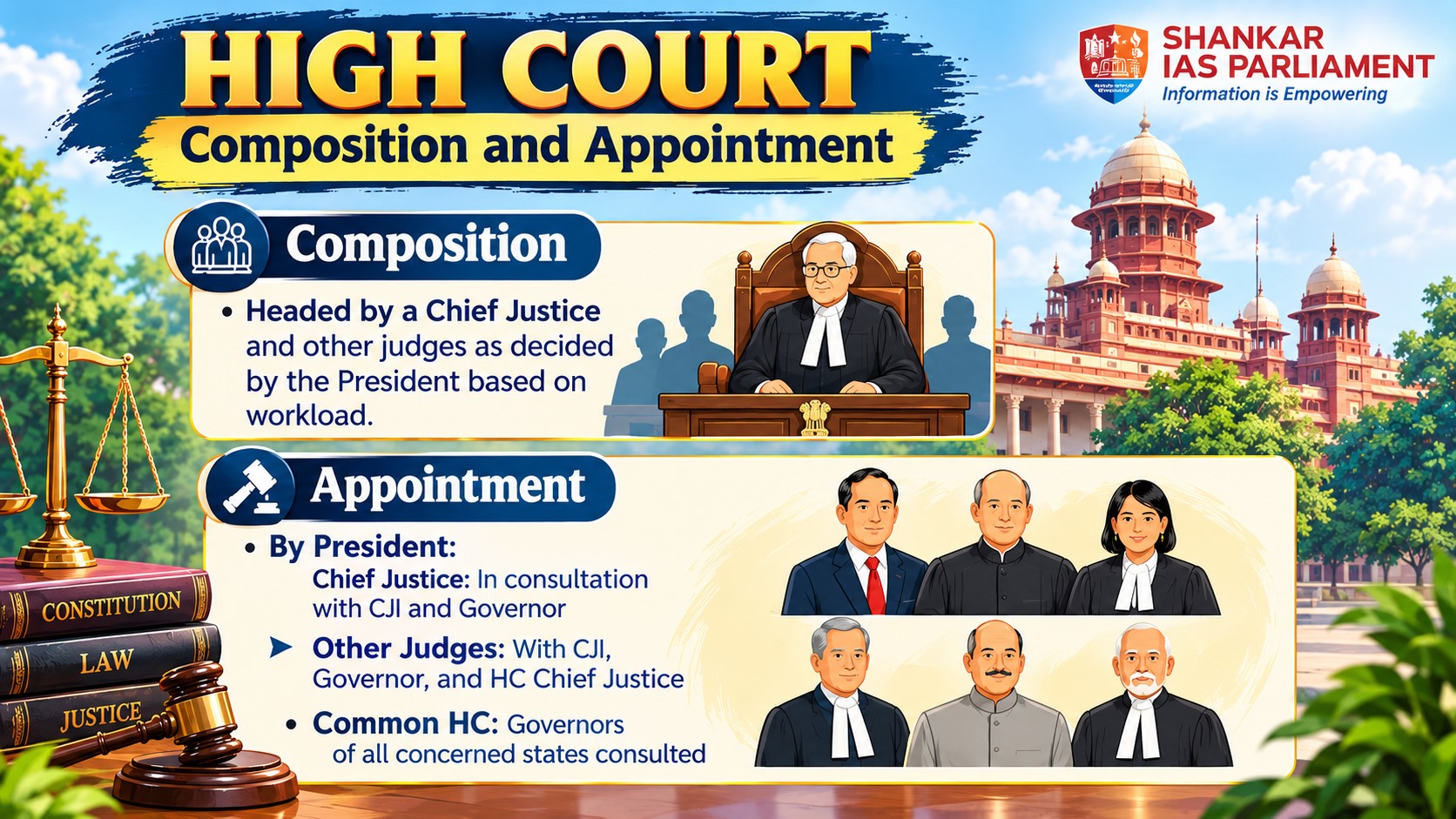
- Article 217 – Under this article of the Constitution, a High Court judge is appointed by the President after consultation with the Chief Justice of India (CJI) and the Governor of the State concerned.
- In the case of a judge other than the Chief Justice, the Chief Justice of that High Court is also consulted.
- The State government’s role comes into the process through the Governor.
- Article 163 – The Governor ordinarily acts on the aid and advice of the Council of Ministers headed by the Chief Minister.
- Therefore, the views of the State government form part of the consultation with the Governor.
- However, the State’s concurrence is not required.
- Article 217 uses the term “consultation”, rather than “consent” or “approval”.
- Therefore, the State government cannot veto a recommendation merely because it disagrees with it.
What have the courts said about the role of the executive in judicial appointments?
The current system of judicial appointments resulted from a series of Supreme Court judgments that gradually shifted primacy in judicial appointments from the executive to the judiciary.
- First Judges Case (S.P. Gupta v. Union of India, 1981) – The Supreme Court held that the word “consultation” did not mean “concurrence”.
- This gave the executive a greater role in judicial appointments, as the government was not bound to accept the CJI’s recommendation.
- Second Judges Case (Supreme Court Advocates-on-Record Association v. Union of India, 1993) – A nine-judge Bench held that the judiciary should have primacy in judicial appointments and introduced the Collegium system.
- The court held that the CJI’s opinion had to be a collective institutional opinion, formed in consultation with the two senior-most judges of the Supreme Court.
- Third Judges Case (Re: Special Reference 1 of 1998) – It further clarified the Collegium system.
- For appointments to the Supreme Court, the Collegium was expanded to include the CJI and four senior-most judges.
- For High Court appointments, the Collegium comprises the CJI and two senior-most judges.
- The Supreme Court’s reasoning was rooted primarily in the need to protect the independence of the judiciary from executive influence.
Was there ever an attempt to change the Collegium system?
- 99th Constitutional Amendment – In 2014, Parliament enacted the 99th Constitutional Amendment and the National Judicial Appointments Commission (NJAC) Act, seeking to replace the Collegium system with the NJAC.
- The proposed NJAC included the CJI, two senior-most Supreme Court judges, the Union Law Minister and two eminent persons.
- It would therefore have given the executive and non-judicial members a greater role in judicial appointments.
- Response from Supreme Court – However, in Supreme Court Advocates-on-Record Association v. Union of India (2015), the Supreme Court, by a 4:1 majority, struck down the 99th Constitutional Amendment and the NJAC Act.
- The majority held that giving the executive a greater role in judicial appointments would affect the independence of the judiciary, which is part of the Constitution’s Basic Structure.
- The Collegium system was consequently restored, though the court acknowledged the need to make the system more transparent and accountable.
- Thus, under the present system, the judiciary has primacy in recommending High Court judges and Chief Justices, while the executive, including the State government, has a role in the consultation and processing of appointments.
Reference
The Hindu| Role of State government in appointment of High Court Chief Justice



