Prelims: Current events of national and international importance | Polity
Why in News?
The Supreme Court dismissed Tamil Nadu's appeal against a 2024 order extending reservation benefits to BC, MBC, DNC, and SC converts to Islam.
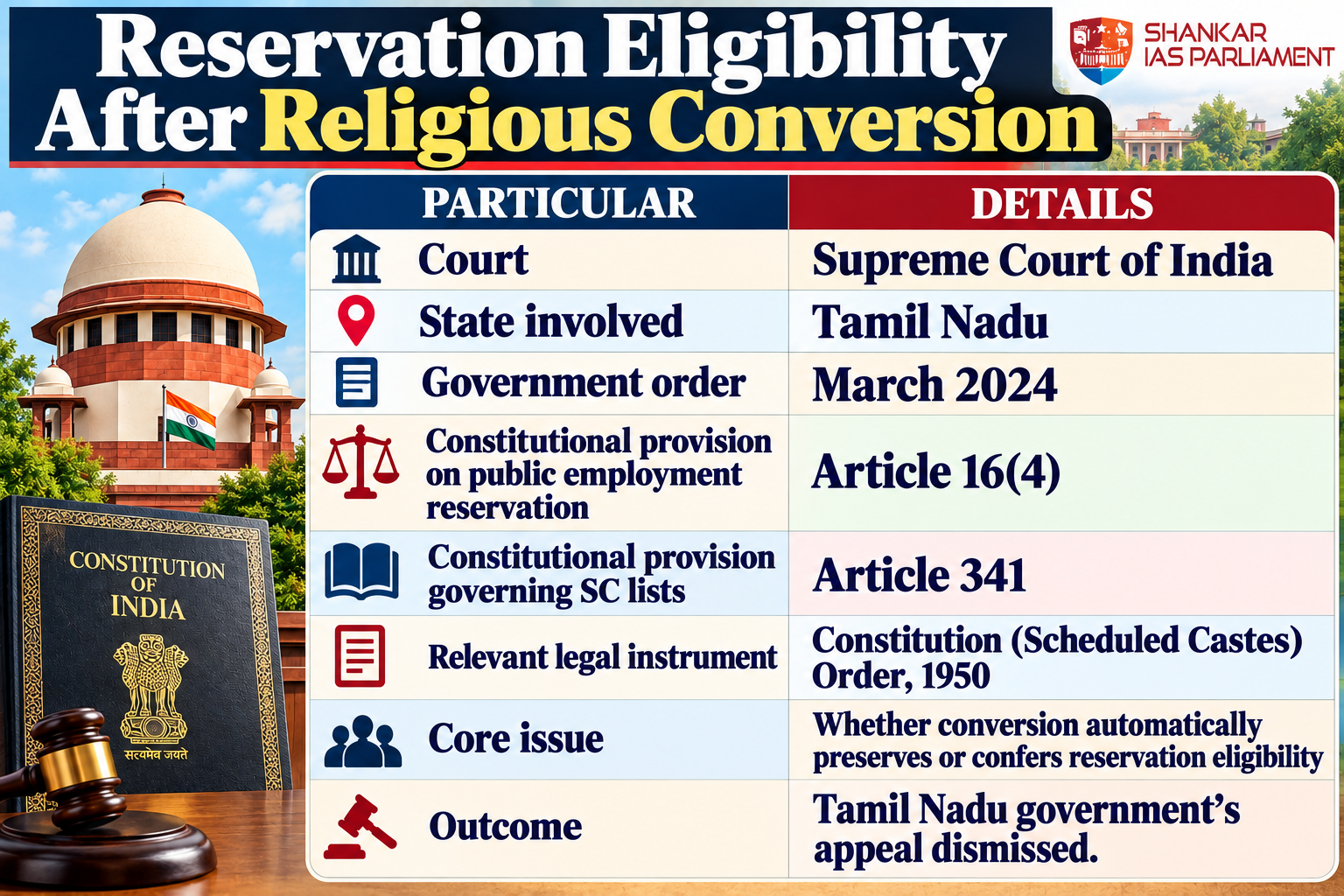
- The Court determined that religious conversion does not inherently grant membership in a different notified Backward Class or maintain Scheduled Caste status.
- An individual cannot claim reservation under Article 16(4) solely based on social backwardness linked to their former religious or community identity.
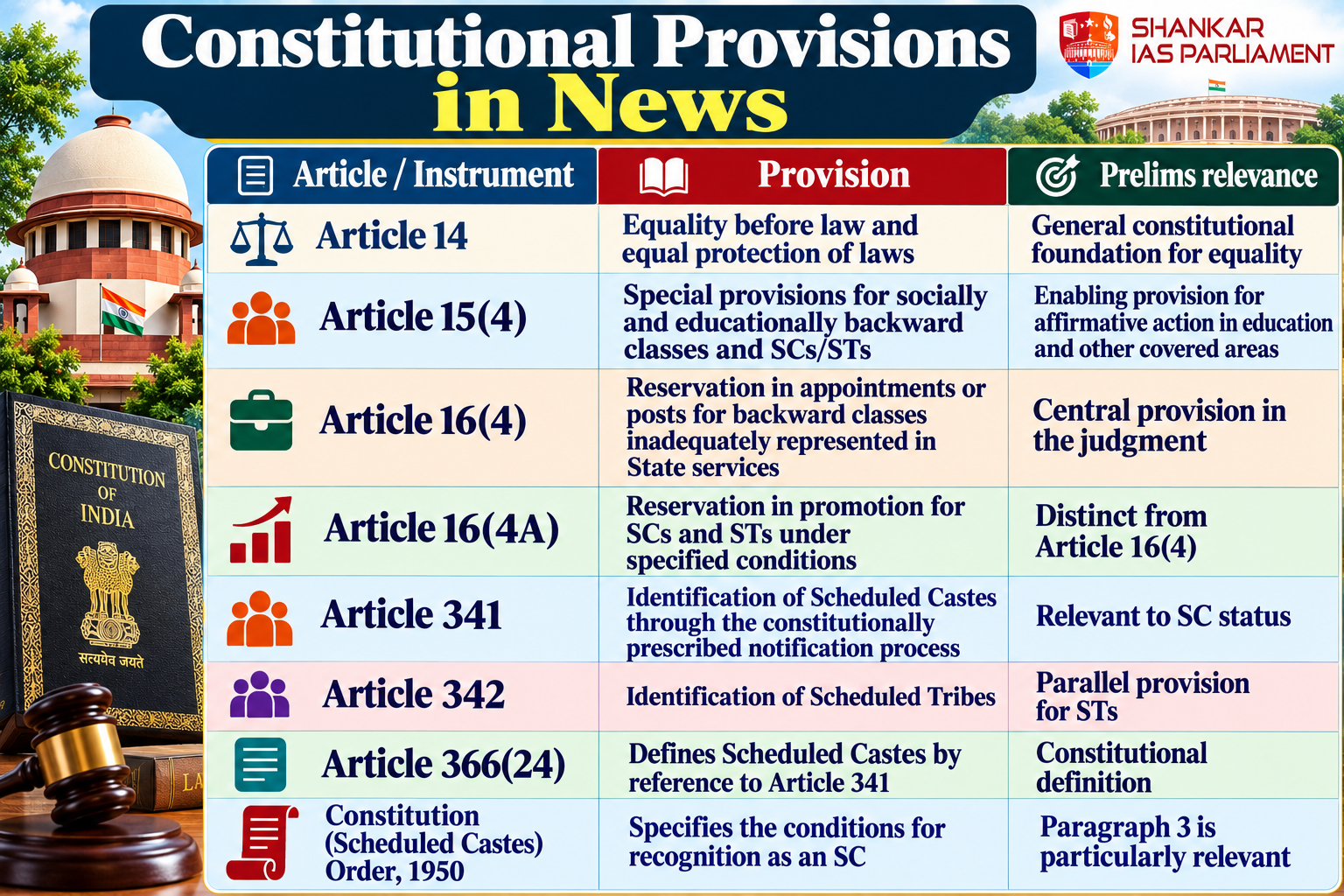
Article 16(4)
- Article 16(4) serves as an enabling provision rather than conferring an automatic individual entitlement to a specific reserved position.
- This provision addresses backward classes that, according to the State's assessment, are inadequately represented in State services.
- Eligibility is determined by the relevant constitutional and legal framework.
Scheduled Caste Status in Relation to Religious Conversion
- The Constitution (Scheduled Castes) Order, 1950 serves as the primary legal framework governing this issue.
- Paragraph 3 of the Order restricts Scheduled Caste recognition to individuals who profess the religions explicitly listed in the Order.
- Hinduism
- Sikhism
- Buddhism
- Consequently, individuals who profess Islam, Christianity, or any religion not specified in the Order are generally ineligible to claim Scheduled Caste status solely based on their caste of origin.
Key Observations of the Supreme Court
- Religious Conversion Does Not Ensure BC Status – An individual from a Hindu Backward Class does not become a member of a notified Muslim Backward Class solely by converting to Islam.
- Membership in a notified community must be demonstrated in accordance with the relevant legal framework.
- A conversion certificate by itself does not constitute sufficient evidence of eligibility for reservation under Article 16(4).
- Historical disadvantage and community membership – The Court differentiated between an individual's prior social identity and membership in a distinct community recognized for reservation purposes.
- Prior membership in a Hindu Backward Class (BC), Most Backward Class (MBC), or Denotified Community does not, by itself, establish eligibility for inclusion in the notified Muslim Backward Classes.
- The State is required to establish a legally sustainable basis for identifying the relevant community and determining eligibility for reservation.
- Limitations of Executive Orders – A State government order cannot unilaterally confer Scheduled Caste status in a manner that contravenes the constitutional framework.
- The March 2024 order was criticized for considering prior community membership as adequate to establish eligibility for inclusion in another notified Backward Class.
BC/MBC and SC Status
|
Feature
|
BC/MBC reservation
|
Scheduled Caste status
|
|
Governing framework
|
Applicable Central or State backward-class lists and eligibility rules
|
Article 341 and the Constitution (Scheduled Castes) Order, 1950
|
|
Community recognition
|
Must establish membership of the relevant notified community
|
Must satisfy the applicable constitutional and statutory conditions
|
|
Effect of conversion
|
Does not automatically establish membership of another notified BC
|
Conversion to a religion outside Hinduism, Sikhism and Buddhism generally prevents continued SC recognition under the existing Order
|
|
Can a conversion certificate alone establish eligibility?
|
No
|
No
|
|
Can a State executive order independently create SC status?
|
Not applicable in the same manner
|
No
|
Reference
The Hindu | Reservation Eligibility After Religious Conversion



