Mains: GS II – Governance
Recent, recurring controversies in NEET, UGC-NET and other public examinations indicate vulnerabilities within the examination ecosystem.
IIT admissions – Significant irregularities prompted observations by the Delhi High Court in 2014, which subsequently resulted in the implementation of transparency reforms.
NEET – Allegations included paper leaks, errors in examination questions, impersonation, score inflation, and an unusual concentration of high scores.
NEET-2024 – The distribution of incorrect question papers, delays in OMR sheet collection, the awarding of grace marks, and unusually high scores raised significant concerns.
NEET-2026 – The alleged circulation of targeted question material prior to the examination, along with the purported involvement of individuals associated with question-setting, highlighted internal vulnerabilities.
UGC-NET 2026 – Examinations in three subjects were reconducted after errors were identified in the question papers.
UPSC CSE Prelims 2026 – Eight General Studies questions reportedly lacked a correct answer option, underscoring the importance of robust answer-key challenge mechanisms.
Public Examination Reform (PER 1.0) denotes transparency-oriented reforms that emerged primarily through the Right to Information (RTI) Act, litigation, and public debate between 2006 and 2015.
Key safeguards
Selection criteria are disclosed prior to the examination.
A formal mechanism exists to challenge examination questions and provisional answer keys.
Candidates are granted access to Optical Mark Recognition (OMR) sheets for independent verification of scores.
A unified counselling process is implemented to enhance preferential seat allocation and minimize seat wastage.
These reforms originated from the transparency requirements established by the Right to Information (RTI) Act, 2005, especially the mandate for proactive disclosure by public authorities.
Many of these measures subsequently became de facto standards for major multiple-choice question (MCQ)-based examinations.
Internal vulnerabilities – Risks may originate from question-setting, translation, digitisation, and logistics, in addition to external paper leaks.
Weak process accountability – Critical stages often lack clearly defined ownership and independent oversight.
Inadequate implementation – Committee recommendations are frequently not implemented as enforceable reforms.
Centre-level risks – Malpractice, collusion, and insufficient centre management contribute to centre-level risks.
OMR/evaluation risks – Errors may occur during collection, scanning, reconciliation, and result processing.
Lack of continuous auditing – Existing systems typically respond to controversies instead of proactively identifying vulnerabilities.
Supreme Court (2011) – It emphasized that examinations and merit ranking must be transparent, accurate, and subject to regular updates.
Examination reform should be regarded as a continuous process rather than a response to isolated crises.
Committee Recommendations
Acharyya, Kakodkar, and Ramasami Committees (2009–2014) – These committees provided technical recommendations; however, their proposals did not culminate in a comprehensive, implemented reform framework.
Dr. Radhakrishnan Committee – This committee submitted comprehensive recommendations following the NEET-2024 controversy; however, an actionable Action Taken Report was not prepared.
Nandan Nilekani Task Force (2026) – Constituted in July 2026, this task force's agenda reportedly overlapped significantly with the earlier Radhakrishnan Committee recommendations.
Core Concern – The repeated constitution of committees without effective implementation may result in 'committee-hopping' rather than sustained institutional reform.
PER 2.0 should advance beyond transparency by establishing a common, standardised, and independently auditable Public Examination Integrity Framework that encompasses the entire examination lifecycle.
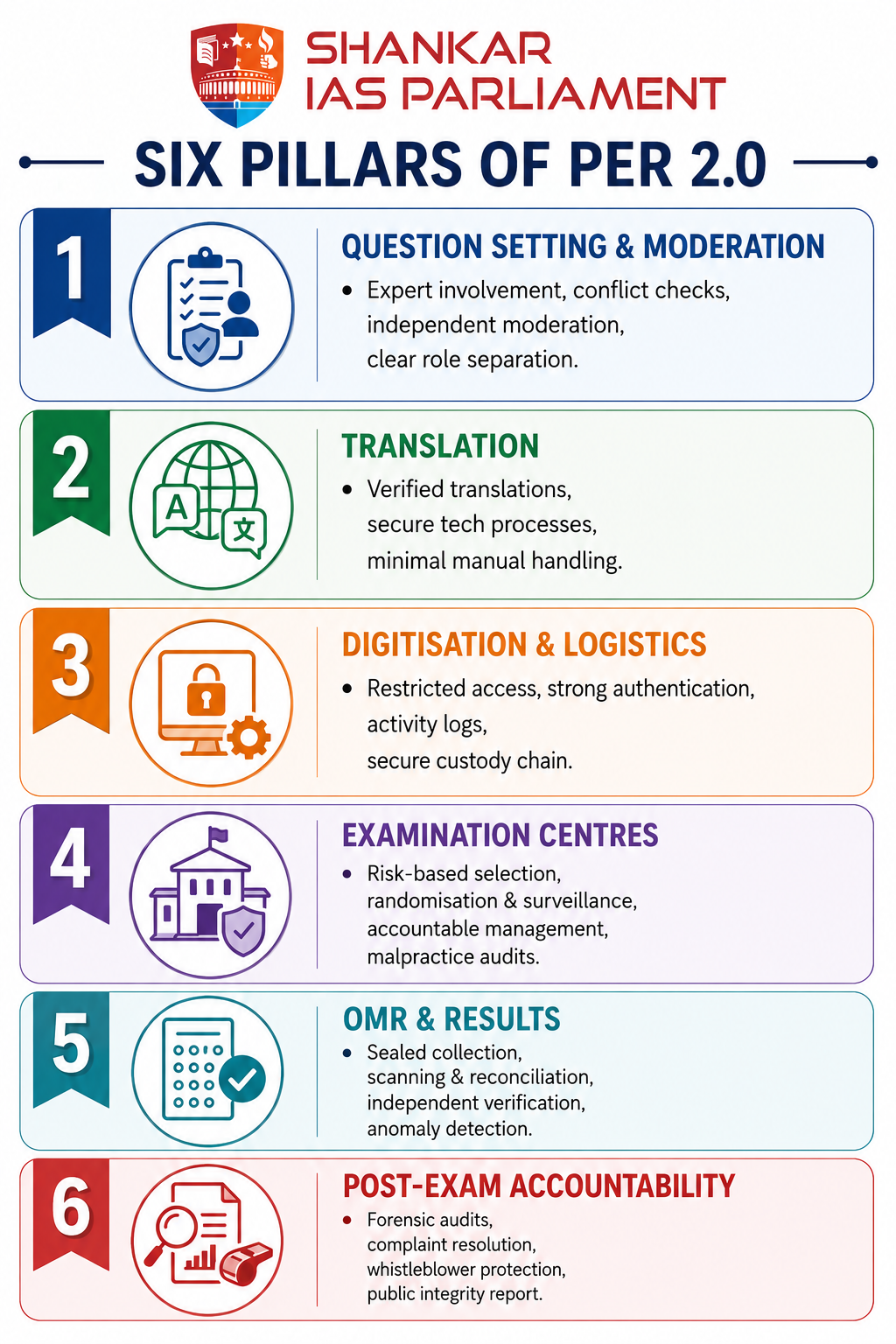
Six pillars 0f PER 2.0
Question Setting & Moderation
Engagement of qualified subject matter experts
Implementation of conflict-of-interest and background checks
Provision for independent moderation
Clear separation of duties among personnel
Translation
Independent verification of translated materials
Utilization of secure, technology-assisted translation processes
Minimization of unnecessary manual intervention
Digitisation, Compilation & Logistics
Enforcement of restricted access protocols
Implementation of robust authentication measures
Maintenance of comprehensive activity logs
Establishment of a secure chain of custody
Examination Centres
Adoption of risk-based selection criteria
Application of randomisation and surveillance measures
Establishment of accountable examination centre management
Conduct of independent malpractice assessments
OMR, Evaluation & Results
Implementation of sealed collection and tracking procedures
Execution of scanning and reconciliation processes
Independent verification of evaluation outcomes
Detection of anomalies prior to result publication
Post-Examination Accountability
Conduct of forensic audits
Provision for independent complaint resolution
Establishment of protected whistleblower mechanisms
Publication of a public examination integrity report
Common Integrity Framework – Develop a unified Public Examination Integrity Framework applicable to the National Testing Agency (NTA) and all state and national examination authorities.
White Paper Documentation – Produce a comprehensive white paper that documents recent failures and systematically identifies both successful and unimplemented best practices.
Standardised SOPs – Translate validated safeguards into standardized and regularly updated Standard Operating Procedures (SOPs).
Independent Audits – Implement independent audits and oversight mechanisms at all critical stages of the examination process.
Accountability & Ownership – Establish explicit ownership, accountability, and comprehensive audit trails for each process.
Continuous Risk Assessment – Implement ongoing risk assessment protocols rather than relying solely on post-crisis security interventions.
India should transition from a reactive approach of 'security after a breach' to a proactive model of 'integrity by design.'
A robust examination system should integrate security, transparency, independent auditing, clear accountability, and continuous improvement to ensure that examination integrity and merit are upheld.



