Prelims: Current events of National and International Importance| Science& technology
Why in News?
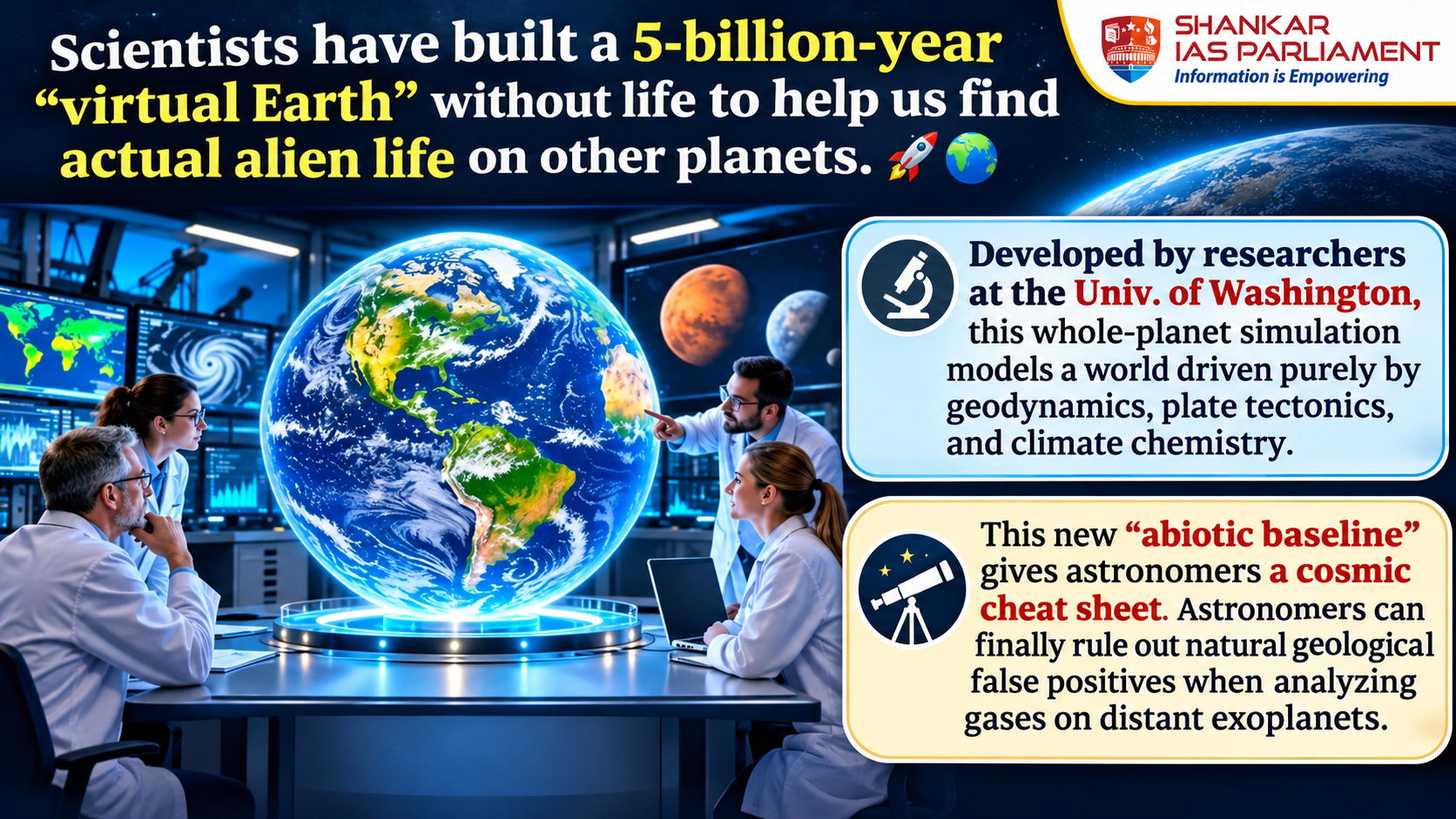
Scientists from the University Of Washington (USA) have developed a sophisticated computer simulation of the entire Earth to help identify potentially habitable planets and search for extraterrestrial life.
The important feature is that scientists simulated Earth without life to understand how a planet behaves naturally.
What is a Whole-Earth Simulation?
- It is a computer-based scientific model that studies the interconnected functioning of the entire planet.
- It combines five major components:
- Five interconnected Earth systems
- Core – The innermost region of Earth, responsible for major internal heat and magnetic-field processes.
- Mantle – The thick layer beneath the crust, involved in heat transfer and geological activity.
- Crust – The outer solid layer where geological processes and chemical exchanges occur.
- Surface – Includes oceans, land and interactions between geological and environmental systems.
- Atmosphere – The gaseous envelope surrounding Earth, which regulates temperature and climate.
- The model also considers energy received from the Sun and exchanges between these systems.
What is special about this simulation?
- The researchers created a virtual Earth in which biological activity was excluded.
- The simulation covered approximately five billion years:
- Past – From Earth's formation around 4.5 billion years ago.
- Future – Approximately 500 million years from now.
- It reproduced 19 important planetary properties within estimated observational uncertainties.
- It examined how geological and chemical processes could maintain conditions suitable for liquid water even without life.
Why simulate Earth without life?
- This is the most important scientific concept in the news.
- Scientists distinguish between two terms:
|
Term
|
Meaning
|
|
Habitable planet
|
A planet capable of supporting life
|
|
Inhabited planet
|
A planet where life actually exists
|
- A planet may have Liquid water, A suitable temperature, An atmosphere, and Appropriate geological conditions.
- But these characteristics do not automatically prove the existence of life.
- For Example, Earth's plants and animals release gases such as oxygen and methane into the atmosphere.
- If astronomers detect certain gases in another planet's atmosphere, they must determine whether those gases were produced by biological activity or natural geological and chemical processes.
- The simulation provides a baseline for making this distinction.
What are Biosignatures?
- Biosignatures are substances, patterns or signals that may provide evidence of biological activity.
- Examples:
|
Biosignature
|
Significance
|
|
Oxygen (O₂)
|
Can be associated with photosynthesis
|
|
Methane (CH₄)
|
Can be produced by biological and geological processes
|
|
Ozone (O₃)
|
Can indirectly indicate atmospheric oxygen
|
- An important point is that Oxygen alone does not conclusively establish the existence of life because non-biological processes can also produce it.
- Scientists must examine multiple indicators and eliminate non-biological explanations.
- Role of future space telescopes – A proposed NASA space telescope designed to study Earth-like planets around other stars and investigate possible signs of life.
- The new simulation could help scientists:
- Identify potentially habitable exoplanets.
- Interpret atmospheric chemical compositions.
- Distinguish biological and non-biological signals.
- Improve the design and scientific objectives of future telescopes.
Reference
Times of India| Whole-Earth Simulation for Exoplanet Habitability



