Prelims : Current events of National and International Importance | Polity / Governance
Why is in news?
On 27 November 2026, the Supreme Court directed that the Karthigai Deepam be lit at the Deepathoon stone pillar atop Thiruparankundram Hill, Madurai, on 28 November.
- The Court also issued show-cause contempt notices to officials and temple authorities, suspended the temple Board of Trustees and appointed two former judges as receivers.
- The lamp was lit at Deepathoon at 5 pm on 28 November under court-appointed supervision.
Background of the issue
- The dispute concerns the location for lighting the ceremonial Karthigai Deepam on Thiruparankundram Hill in Madurai, Tamil Nadu.
- On 20 November 2026, the Supreme Court made a one-time interim arrangement permitting a restricted, temple-authorised team to light the lamp at the stone pillar identified as Deepathoon on 24 November, subject to safeguards.
- The order expressly clarified that the one-time arrangement did not recognise or enforce any asserted customary, religious or proprietary right.
- It left open questions relating to title, possession, customary usage, religious entitlement, temple administration and access to the site.
Supreme Court’s order dated 27 November 2026
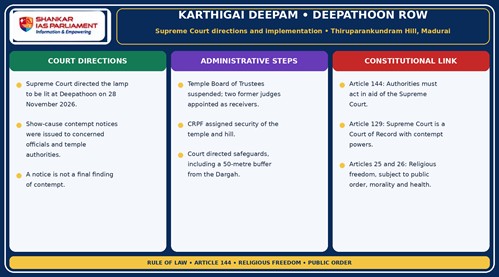
- The Court found prima facie wilful disobedience of its 20 November order and directed the receivers to ensure that the Deepam was lit at Deepathoon on 28 November.
- It issued show-cause notices to the concerned officials and temple authorities, asking why contempt proceedings should not be initiated. A notice is not a final finding of contempt.
- The Board of Trustees of Arulmigu Subramaniaswamy Temple was suspended; former judges Justice S. Vaidyanathan and Justice V. Parthiban were appointed as receivers to take charge of temple administration.
- The Court directed the Central Reserve Police Force (CRPF) to take over security of the temple and the hill, citing failure of local authorities to implement its earlier order.
- The Court directed that the lamp-lighting arrangements maintain a distance of 50 metres from the Sikandar Dargah on all sides, with security and public-order safeguards.
- The Court directed the receivers to permit devotees to light lamps at designated places subject to conditions and security considerations.
Constitutional provisions involved
- Article 144: All authorities, civil and judicial, in the territory of India shall act in aid of the Supreme Court.
- Article 129: The Supreme Court is a Court of Record and has the power to punish for contempt of itself.
- Article 25: Freedom of conscience and the right freely to profess, practise and propagate religion, subject to public order, morality, health and other provisions of Part III.
- Article 26: Freedom of religious denominations to manage their own affairs in matters of religion, subject to public order, morality and health.
- Article 14: Equality before law and equal protection of laws; relevant to non-arbitrary public administration.
- Contempt of Courts Act, 1971: Provides the statutory framework for civil and criminal contempt.
Governance and federal dimensions
- Rule of law: Court orders bind public authorities and institutions; compliance is central to constitutional governance.
- Judicial enforcement: Article 144 requires authorities to act in aid of the Supreme Court.
- Religious freedom and public order: The case involves balancing religious observance, public safety and the protection of multiple places of worship.
- Administrative accountability: The suspension of the temple board and appointment of receivers illustrate judicial intervention in the administration of a public religious institution in the context of alleged non-compliance.
- Important distinction: The interim directions on lamp lighting did not finally decide the historical custom, title, possession or essential religious practice questions.
Latest development
- The Karthigai Deepam was lit at Deepathoon at 5 pm on 28 November 2026 in the presence of court-appointed receivers and under CRPF security.
- The flame reportedly extinguished on its own at around 7.55 pm; this does not alter the fact that the ceremony was carried out pursuant to the Court’s direction.
- The Supreme Court proceedings were listed for a further update on 12 December 2026.
Prelims watch-outs
- Article 144 – Authorities to act in aid of the Supreme Court; Article 129 – Supreme Court as Court of Record.
- Contempt notice / show-cause notice is not equivalent to a final conviction for contempt.
- Interim arrangement ≠ final adjudication of customary or proprietary rights.
- CRPF is a Central Armed Police Force under the Ministry of Home Affairs.
Infographic | Supreme Court directions and constitutional provisions
Reference
The Indian Express | Deepathoon row: Supreme Court suspends temple board, orders lamp lighting



