Prelims: Current events of national and international importance | Environment
Why in News?
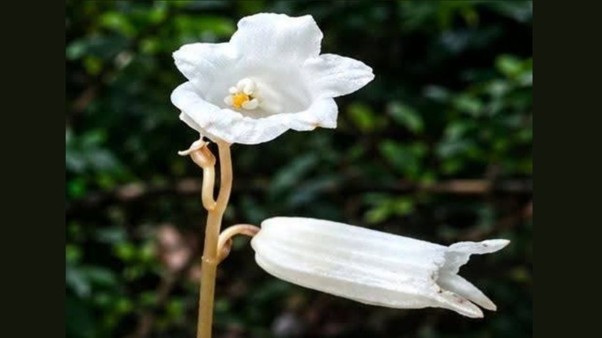
Scientists discovered a new species of rare, leafless orchid, Gastrodia keyiensis, in the Keyi Panyor district of Arunachal Pradesh.
- Location- Recorded in a shaded gorge along the right bank of the Keyi River (after which the species is named) at an altitude of approximately 1,000 meters.
- Local Name - Referred to as "Oram Opuh" (meaning "Ghost Flower") in the indigenous Nyishi dialect, reflecting its cryptic, subterranean life cycle and fleeting appearance.
- Micro-Habitat - Grows under deep shade amid thick layers of decaying leaf litter within moist bamboo groves.
- Holomycotrophic / Mycoheterotrophic Life - Completely lacks chlorophyll and functional leaves, rendering it incapable of photosynthesis.
- Fungal Symbiosis - Obtains all essential organic carbon, water, and mineral nutrients via obligate parasitic/symbiotic associations with subterranean soil fungi.
- Morphology
- Reaches up to 35 cm in height, bearing 1 to 3 flowers per stalk.
- Flowers exhibit a white to pale-bluish hue with a distinctive, strongly curved yellow apex on the labellum (lip).
- Features a broadly obovate basal labellum section marked by 6 to 7 prominent, longitudinally thickened ridge structures that distinguish it from related Asian Gastrodia species.
- Cryptic Life Cycle - Spends nearly its entire life cycle hidden as an underground rhizome, emerging above the forest floor only briefly during its short flowering phase.
- Conservation Status - IUCN Category - Assessed as Data Deficient (DD) due to the lack of exhaustive population surveys and its highly elusive nature.
- Its currently recorded Area of Occupancy (AOO) is estimated at just 4 km2, with only 5 flowering individuals documented at the type locality.
- Orchid Hotspot - Reinforces Arunachal Pradesh's standing as India's "Orchid Paradise", home to over 600 documented orchid species (~50% of India's total orchid flora).
- Ecological Baseline - Underlines the ecological vulnerability of Eastern Himalayan bamboo-grove ecosystems to localized habitat fragmentation and road construction.
Reference
India Today | 'Ghost Flower' orchid



