Prelims: Current events of national and international importance | Geography
Why in News?
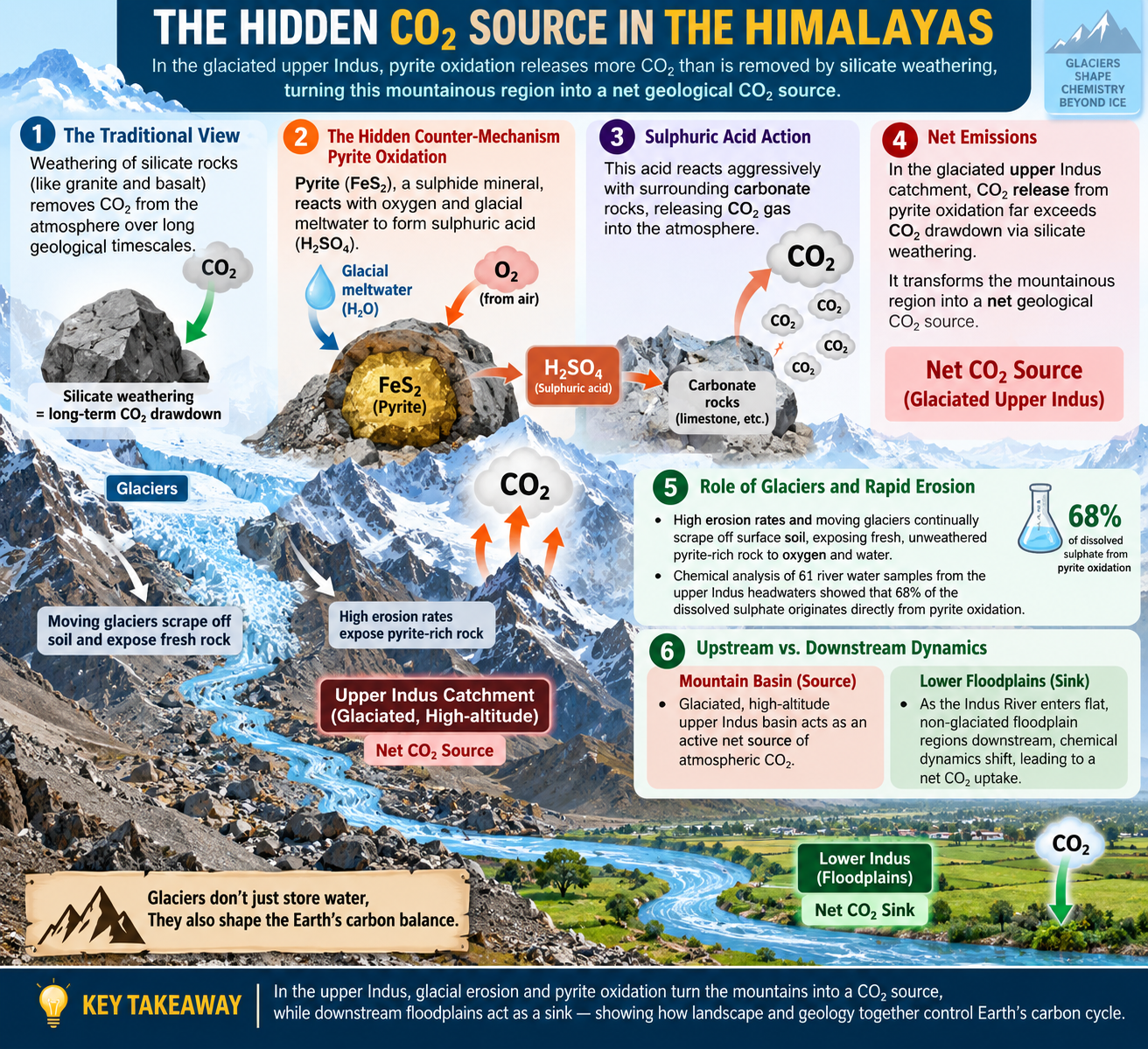
A new study reveals that rapid erosion and glacial cover in the glaciated upper Indus basin trigger significant chemical weathering of pyrite ("fool's gold"), causing the northwestern Himalayas to release more carbon dioxide (CO₂) than they absorb.
Key Mechanism
- The Traditional View - Weathering of silicate rocks (like granite and basalt) removes CO₂ from the atmosphere over long geological timescales.
- The Hidden Counter-Mechanism
- Pyrite Oxidation - Pyrite (FeS2), a sulphide mineral, reacts with oxygen and glacial meltwater to form sulphuric acid (H2SO4).
- Sulphuric Acid Action This acid reacts aggressively with surrounding carbonate rocks, releasing CO₂ gas into the atmosphere.
- Net Emissions- In the glaciated upper Indus catchment, CO₂ release from pyrite oxidation far exceeds CO₂ drawdown via silicate weathering.
- It transforms the mountainous region into a net geological CO₂ source.
Role of Glaciers and Rapid Erosion
- Exposing Fresh Rock - High erosion rates and moving glaciers continually scrape off surface soil, exposing fresh, unweathered pyrite-rich rock to oxygen and water.
- Isotopic Confirmation - Chemical analysis of 61 river water samples from the upper Indus headwaters showed that 68% of the dissolved sulphate originates directly from pyrite oxidation.
Upstream vs. Downstream Dynamics
- Mountain Basin (Source)- The glaciated, high-altitude upper Indus basin acts as an active net source of atmospheric CO₂.
- Lower Floodplains (Sink)-As the Indus River enters flat, non-glaciated floodplain regions downstream, chemical dynamics shift, leading to a net CO2 uptake.
Significance for Climate
- Counters the simplified assumption that all mountain building and physical erosion unconditionally act as atmospheric carbon sinks.
- Essential for refining models predicting how Himalayan uplift and global climate shifts affect the long-term carbon cycle.
- Highlights the need to conduct similar isotopic studies across the Ganga and Brahmaputra river basins to determine the net carbon balance of the entire Himalayan arc.
Reference
The Hindu | Rapid Himalayan erosion



