Prelims: Current events of national and international relations | Environment
Why in News?
The population of Pygmy Hog, once thought to be extinct, has increased from six individuals in 1996 to 194 through a captive breeding programme in Assam.
- It is the world's smallest and rarest wild pig.
- Scientific name – Porcula salvania.
Pygmy Hog is an indicator species (Organism whose presence, absence or abundance reflects a specific environmental condition).
- Appearance - Males are slightly bigger than females. Their coats have blackish-brown bristles over gray-brown skin and they have no facial warts.
- Both sexes have a tail and females have 3 pairs of mammae.
- Habitat – Pygmy hogs live in tall, dense grasslands that have a mixture of shrubs and trees.
- Distinct Features – Adult males possess visible upper canines that protrude from the sides of their mouths.
- Unlike other wild pigs, they lack prominent facial warts.
- Distribution – The mammals are now found in the Sonai-Rupai Wildlife Sanctuary, Bornadi Wildlife Sanctuary, Orang National Park, and Manas National Park.
- It remain hidden in tall dense grass and rarely emerge in the open.
- Diet – they have well developed teeth, with upturned canines and molars with rounded cusps. This allows them to enjoy an omnivorous diet.
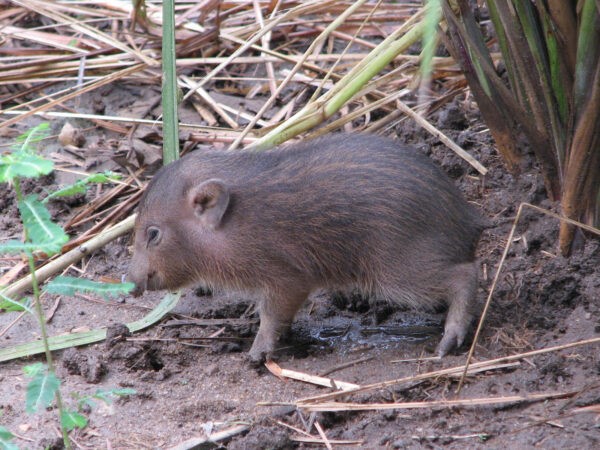
Pygmy Hog Conservation Programme (PHCP)
- It is a long-running partnership in Assam, India, created to save Pugmy Hog from extinction.
- Formed in – 1995 and launched breeding in 1996 after capturing 6 wild founders from Manas National Park.
- Key Partners – Assam Forest Department, Durrell Wildlife Conservation Trust, Ministry of Environment, Forest and Climate Change (Govt. of India), IUCN/SSC Wild Pig Specialist Group, Aaranyak, and EcoSystems-India.
Reference
The Hindu| ‘big comeback’ of ‘small hog’



