Matsya Sampada Jagrukta Abhiyan (MSJA)
National Institute of Fisheries Post Harvest Technology and Training (NIFPHATT) organized a workshop on Matsya Sampada Jagrukta Abhiyan recently.
- MSJA - It is an outreach programme that aims to reach fish farmers and 3477 coastal villages and ensures last mile connectivity.
- It disseminates information and knowledge about 9 years of achievements in the fisheries sector.
- Duration - 6 months Campaign
- Organized by - Ministry of Fisheries, Animal Husbandry and Dairying.
Pradhan Mantri Matsya Sampada Yojana (PMMSY)
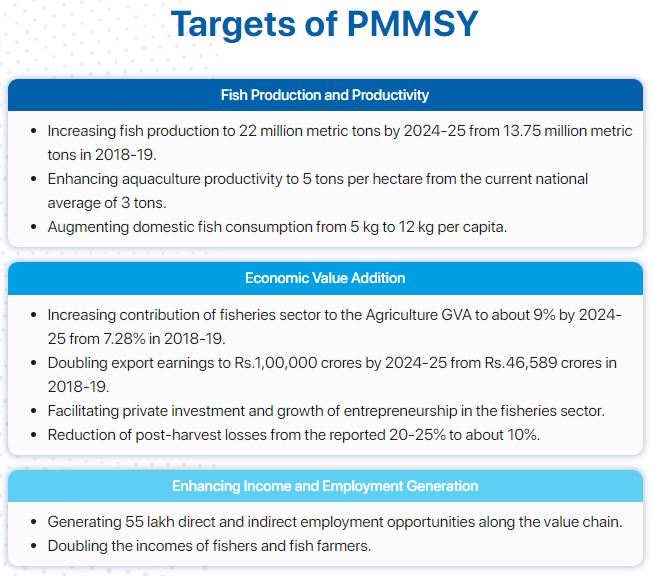
- PMMSY - It is a flagship scheme for focused and sustainable development of fisheries sector.
- Aim - To double the income of fish farmers and fishers in the country and to bring about Blue Revolution.
- Launched - 2020.
- The PMMSY is an umbrella scheme with 2 separate Components namely
- Central Sector Scheme (CS) and
- Centrally Sponsored Scheme (CSS).
- PMMSY is implemented in all the States and Union Territories for a period of 5 years from 2020-21 to 2024-25.
References
- PIB | Matsya Sampada Jagrukta Abhiyan
- PMMSY | Pradhan Mantri Matsya Sampada Yojana
Bedouin Arabs
A video on social media shows local Israelis expressing their gratitude to a Bedouin commander for putting up an effective defence against Hamas fighters recently.
- About - The Bedouins are a nomadic Muslim Arab people who live mainly in the Negev desert of southern Israel.
- Occupation - They have traditionally been pastoralists with no powerful or exclusive national affiliation.
- Before the formation of Israel, groups of Bedouin were employed by early Jewish settlers to guard clusters of their communities in Palestine.
- During the Arab-Israeli war of 1948-49, many Bedouin provided valuable intelligence to the Jewish militias and the newly formed Israel Defence Forces (IDF).
- In the 1950s, Israel recognised a large number of Bedouin as its citizens, and subsequently helped build settlements for them in the Negev.
- Many Bedouin continued to serve in the IDF, primarily in scouting or tracking units.
Click here to know more about Israel-Palestine Conflict
Hezbollah
- Hezbollah (Party of God) - It is a Shiite Islamic militant organisation from Lebanon.
According to Centre for Strategic and International Studies (CSIS) Hezbollah’s are the world’s most heavily armed non-state actor.
- Origin - During the Lebanese Civil War (1975-1990)
- Cause of origin - Discontent with presence of armed Palestinian in Lebanon and inspiration from theocratic Islamic government of Iran in 1979.
- Funding and Training - Iran and its Islamic Revolutionary Guard Corps (IRGC).
- Aim - It opposes Israel and Western influence in West Asia.
- Conflict with Israel - Israeli forces invaded southern Lebanon in 1978 and again in 1982 to expel Palestinian guerrilla fighters.
- It fought a war with Israel in 2006.
References
- The Indian Express | Bedouin Arabs in the Israeli army
- The Indian Express | Hezbollah
- Hindustan Times | Hezbollah
Dogra architecture
Srinagar Smart City Limited and the Kashmir chapter of INTACH have joined hands to conserve vernacular elements of Kashmiri architecture recently.
- Dogra architecture is a distinct culture that formed in Jammu, where cultures mixed together.
- Dynasty - The Dogra dynasty was a dynasty of Hindu Rajputs who ruled Jammu & Kashmir from 1846 to 1947.
- Examples - Some examples of Dogra architecture include:
- Mubark mandi - A hub of Dogra culture until 1947, with a jharokha style of balcony.
- Maharaj Gunj - A market area with a variety of colonial and vernacular architecture.
- Rani Charak Mahal - A mahal with phenomenal architecture and interiors.
Maharaj Gunj
- It was established by Maharaja Ranbir Singh to provide fillip to Kashmir’s trade and commerce.
- The [Maharaj Gunj market] area has a rich mix of vernacular and colonial architecture.
- Most residential buildings constructed in the taq or dhajji dewari styles.
- The market once housed Khatri businesspeople, who introduced a different lifestyle to the city.
- Maharaj Gunj’s strategic location along the banks of the Jhelum river rendered it an attractive destination for traders from diverse locations within Kashmir.
References
- The Hindu | Dogra architecture gets a revival
- Abhipedia | Dogra and Jammu architecture
RBI on Floating Rate Savings Bonds (FRBs)
Individual investors can now subscribe to FRSBs through Reserve Bank of India's Retail Direct Portal.
- RBI has expanded the basket of products offered through its Retail Direct Portal by allowing individual investors to subscribe to Floating Rate Savings Bonds (FRBs), 2020 (Taxable).
- Currently, individual (retail) investors can invest in Central Government Securities, Treasury Bills, State Government Securities and Sovereign Gold Bonds through the Retail Direct Portal.
FRSBs are interest bearing, non-tradeable bonds, issued by the Government of India, which are repayable on the expiration of 7 years from the date of issue.
- Until recently, these bonds were exclusively accessible at select branches of the State Bank of India, nationalized banks, private sector banks authorized by the RBI.
- The subscription of bonds will be in the form of cash (up to Rs.20,000 only)/drafts/cheques or any electronic mode.
RBI-Retail Direct Scheme (RDS)
- The scheme was launched on November, 2021.
- Under the Scheme, individual investors are permitted to open Retail Direct Gilt account with RBI through which investments in Government Securities can be made in primary and secondary market.
References
- Livemint | Individual investors can now subscribe to FRSBs
- The Hindu Business Line | Floating Rate Savings Bonds
- CNBCTV | Floating Rate Savings Bonds via RBI's portal
Puri Jagannath Temple's Ratna Bhandar
Demands to open the Ratna Bhandar gained strength after the Archaeological Survey of India (ASI) gave a requisition for repair/conservation of the chamber.
- The Ratna Bhandar is the treasury of the Puri Jagannath Temple in Odisha, India.
- The precious ornaments of sibling deities Lord Jagannath, Lord Balabhadra and Goddess Subhadra given by devotees and erstwhile kings over centuries, are stored in this 12th century shrine.
- It is located within the temple and has two chambers
- Bhitar Bhandar (inner chamber) and
- Bahara Bhandar (outer chamber).
- The last inventory of the gems and jewelry in the Ratna Bhandar was made in 1978.
- The outer chamber is opened regularly to fetch ornaments for the deities but the inner chamber has not opened in the past 38 years.
Puri Jagannath Temple
- Jagannath Temple in Puri, Odisha, is a revered temple where Lord Krishna is worshipped as Lord Jagannath.
- Lord Jagannath is present in this temple along with elder brother Lord Balbhadra and younger sister Goddess Subhadra.
- It's a circular temple that was built during the Kachchhapaghata Dynasty. It's the only circular temple in India.
- It's known for its annual Ratha Jatra, or chariot festival. The temple is one of the 4 great 'Char Dham' pilgrimage sites.
- The temple's design is believed to have inspired the Indian Parliament building.
- The temple is called the "White Pagoda". A sign at the Lion's Gate (main entrance) of the Temple states: “Only Hindus are allowed”.
References
- The Indian Express | Ratna Bhandar of the Puri Jagannath Temple
- Economic Times | Puri temple's Ratna Bhandar
- Times now | Jagannath temple ratna bandhar



