Forum Shopping
The Chief Justice of India (CJI) DY Chandrachud condemns ‘forum shopping’.
- Forum shopping as the practice of choosing the court which is likely to provide the most favourable outcome.
- Litigants or lawyers attempt to deliberately move their case to a particular judge or Court where they think the judgment could be more favourable.
- In 2017 ruling of ‘Union of India & Ors. Vs. Cipla Ltd.’ case, the court condemned forum shopping.
- It laid down a ‘functional test’ to be adopted to determine whether a litigant is indulging in forum shopping or not.
- Test - If there is any functional similarity in the proceedings between one court and another or there is some sort of subterfuge on the part of a litigant, then it is considered forum shopping.
- Prevention - Most common law countries use the ‘forum non-conveniens’ principle to prevent forum shopping.
- It is the discretionary powers of a court to refuse to exercise its jurisdiction over a matter where another court, or forum, may more conveniently hear a case.
- Using this power, the court can dismiss a case in the interests of justice and the parties while allocating it to the appropriate bench.
‘Bench hunting’ refers to petitioners managing to get their cases heard by a particular judge or court to ensure a favourable order.
References
- IE - CJI Chandrachud condemns ‘forum shopping’
Leatherback Turtles
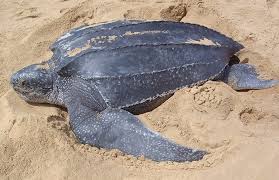
The nesting site of leatherback turtles is threatened by a massive infrastructure plan of great Nicobar Island.
- Leatherback turtle (Dermochelys coriacea) are marine turtles found worldwide.
- Leatherback turtles are named for their shell, which is leather-like.
- Leatherback turtles are the largest turtles on Earth. They can grow up to 2 meters long and weigh as much as 700 kilograms.
- Diet - They feed almost exclusively on jellyfish.
- Distribution - Leatherbacks are distributed circumglobally.
- Nesting Sites - Tropical sandy beaches
- Forage Sites - Temperate coastal waters and sub-polar latitudes.
- In India - The Great Nicobar Island is a globally important nesting site of leatherback turtles in India.
- The turtles nests at Galathea Bay in the Great Nicobar Island.
- Threats - Fisheries bycatch, marine pollution, habitat loss due to climate change, egg collection and coastal development affecting critical turtle habitat.
| Conservation Status |
| IUCN |
Vulnerable |
| CITES |
Appendix I |
| CMS |
Appendices I and II |
Great Nicobar Island
- Great Nicobar Island a remote archipelago at the southernmost tip of India which spans about 1,000 square kilometres.
- Great Nicobar Island lies about halfway between India and Thailand.
- It is home to the indigenous Shompen and Nicobarese people.
- It has a rich diversity of plant and animal species.
References
- The Hindu - A mega port in India threatens Leatherback Turtles
- IUCN - Leatherback Turtles
- Sea Turtle Conservancy - Leatherback Turtle
Kutch Harappan Graveyard
A Kutch Harappan graveyard unravels the mystery of the life and times of those buried.
- Khatiya village is located in the outskirts of Gujarat’s Kutch district.
- A pre-urban Harappan cemetery was discovered in this village.
- The burial site is found in the dry, arid soiled outskirts of the village which spreads over 16 hectares.
- This site is considered to be the largest pre-urban Harappan cemetery.
- Since 2018, a multi-disciplinary team of archaeologists has discovered 500 graves and excavated 197 of those.
- The site demonstrates the transition from earth-mound burials to stone graves.
- The rectangular graves were made of shale and sandstone.
- A shell bangle, pottery shards, stones blades are also found in this site.
- So far, the findings at the burial site are consistent with its pre-urban Harappan status.
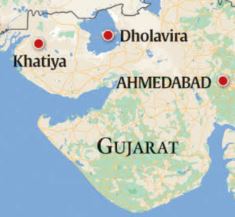
- Another Harappan site Dholavira is 150 kilometres away from Khatiya village.
- Dholavira is an UNESCO World Heritage Site and one of the biggest metropolises of the Harappan civilisation.
- Desalpar and Khirsara, Kotda Bhadli and Nadapa are the other well-known Harappan sites in western Kutch.
- All these sites are located more than 50 km away from Khatiya and belong to urban and post-urban periods of the Harappan civilisation.
References
- IE - At a Kutch Harappan graveyard, team works to unlock a mystery
- TOI - Gujarat’s Harappan necropolis reveal 5000 year old death rituals
Global Polio Eradication Initiative
The Global Polio Eradication Initiative (GPEI) observes its 35th Anniversary in 2023.
- GPEI held a high-level influencer briefing with polio experts from around the world in which over 200 attendees from 63 countries took part.
- The leaders of the G7 countries urged for global support to the Global Polio Eradication Initiative (GPEI) during the G7 summit.
- GPEI was launched in 1988 after the World Health Assembly passed a resolution to eradicate polio.
- Its goal is to eradicate polio worldwide.
- The Global Polio Eradication Initiative is a public-private partnership led by national governments with 6 core partners -
- World Health Organization (WHO),
- Rotary International,
- US Centers for Disease Control and Prevention (CDC),
- United Nations Children’s Fund (UNICEF),
- Bill & Melinda Gates Foundation and
- Gavi, the Vaccine Alliance.
- In 2020, the GPEI launched a revision of the strategy for polio eradication called ‘Polio Eradication Strategy 2022-2026: Delivering on a Promise’
- Polio Endemic countries - Afghanistan and Pakistan are the only countries where indigenous wild poliovirus subtype-1 transmission continues uninterrupted.
- Polio Status - When the World Health Assembly established GPEI, wild poliovirus subtype-2 and subtype-3 have been successfully eradicated.
- According to a recent report in the Morbidity and Mortality Weekly Report, 859 cases of circulating vaccine-derived polioviruses (cVDPVs) have been reported last year.
- cVDPVs have been reported from countries where poliovirus transmission had long been eliminated such as Canada, Israel, the U.K. and the U.S.
References
- The Hindu - Global polio targets set for this year unlikely to be met
- GPEI - 35th Anniversary
Animal health emergency in Brazil
Brazil has declared 180-day animal health emergency for the first time amid avian flu cases in wild birds.
- Brazil has so far confirmed 8 cases of the H5N1 in wild birds.
- Brazil is the world's biggest chicken meat exporter.
- Infection by the H5N1 subtype of avian flu in wild birds does not trigger trade bans, based on guidelines of the World Organization for Animal Health (WOAH).
- Avian influenza (AI) is a highly contagious viral disease that affects both domestic and wild birds.
- It is a viral disease and the viruses are divided into multiple subtypes (i.e. H5N1, H5N3, H5N8 etc.)
World Organisation for Animal Health
- World Organisation for Animal Health (WOAH) is an intergovernmental organisation working across borders to improve the health of animals.
- WHOA is headquartered in Paris.
- It has 182 Members including India.
- WHOA has adopted its Seventh Strategic Plan for 2021 - 2025.
- It aims to help policymakers and governments to improve animal health globally as well as promote safe international trade.
- They coordinate the global response to animal health emergencies, the prevention of zoonotic diseases and better access to animal health care.
References
- The Hindu - Brazil declares 180-day animal health emergency
- WHOA - Avian Influenza



