Guillotine Closure
The Lok Sabha passed the demands for grants for ministries without any discussion due to disruptions in Parliamentary procedure.
- The Union budget after prepared is presented in the Parliament and goes through a process before its passage.
- The steps involved are -
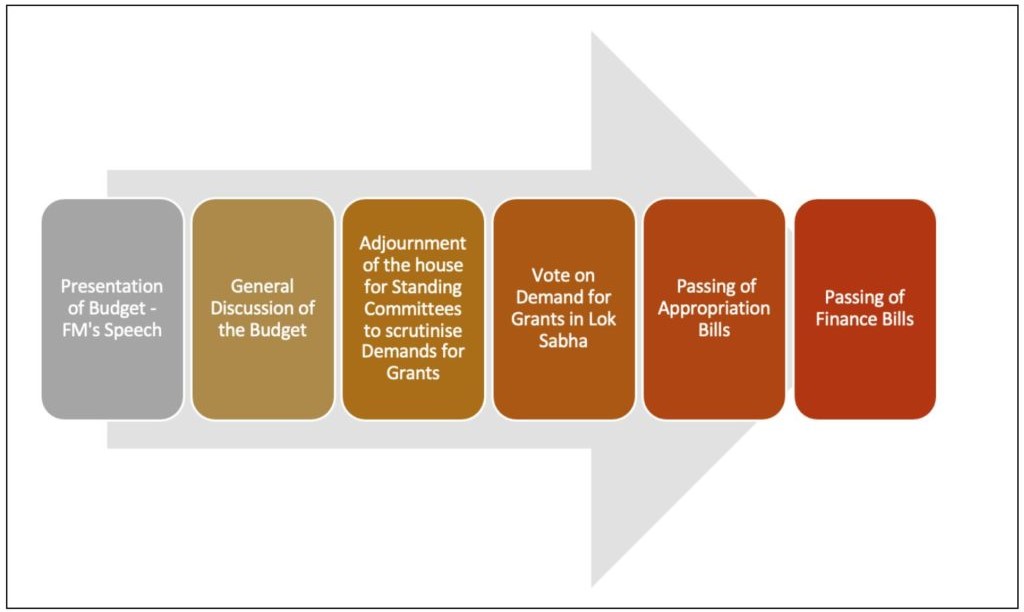
- Closure Motion is a type of motion moved by a member to cut short the debate on a matter before the House.
- If the motion is approved by the House, the debate is stopped forthwith and the matter is put to vote.
- There are 4 kinds of closure motions. They are:
- Simple Closure
- Closure by Compartments
- Kangaroo Closure
- Guillotine Closure
- Guillotine Closure is a parliamentary procedure which refers to the passage of a legislation without debate or discussion.
- Once the House is done with these debates, the Speaker applies the ‘guillotine’, and all outstanding demands for grants are put to vote at once.
- This usually happens on the last day earmarked for the discussion on the Budget.
- It is to ensure timely passage of the Finance Bill.
- Appropriation - After the implantation of the guillotine during the Budget session, the government formally introduces the Appropriation Bill.
- The Appropriation Bill is passed to authorise the government to withdraw funds from the Consolidated Fund of India for the budgetary expenditure.
Other Types of Closure
- Simple Closure: It is one when a member moves that the ‘matter has been sufficiently discussed be now put to vote.
- Closure by Compartments: In this case, the clauses of a bill or a lengthy resolution are grouped into parts before the commencement of the debate. The debate covers the part as a whole and the entire part is put to vote.
- Kangaroo Closure: Under this type, only important clauses are taken up for debate and voting and the intervening clauses are skipped over and taken as passed.
References
- IE - What does ‘guillotine’ refer to in legislative parlance?
- DNA - Union Budget 2023: What is Guillotine in Parliament?
Parvatmala Project
The detailed feasibility studies completed for 8 projects for implementation of Ropeways under Parvatmala program.
- The National Ropeway Development Programme is also known as ‘Parvatmala’ (Parvatmala means garlanding mountains).
- The project aims to decongest mountainous areas where road and train connectivity cannot be upgraded beyond a limit.
- 30 priority points or stretches will be constructed under phase-I of the project.
- The Parvatmala project was announced in the 2022-23 Union Budget.
- Parvatmala will construct ropeways in mountainous terrains of India under the Public Private Partnership (PPP).
- Nodal Ministry - The Ministry of Road Transport and Highways undertakes the project.
- The ministry will oversee all the affairs related to the ropeway construction, research, and policy-making.
- Implementing Agency - The National Highways Logistics Management Limited (NHLML) has been mandated by the ministry to implement the project.
- NHLML is a 100% owned SPV of National Highways Authority of India (NHAI).
- NHLML has aimed to complete construction of 8 ropeways in FY 2022-2023.
- Advantages of Ropeways
- Economical mode of transportation
- Faster mode of transportation
- Environmentally friendly
- Last mile connectivity
- Ability to handle large slopes
- Ideal for hilly and difficult terrain
- Low footprint - Low land use
- Similar Initiatives - Sagarmala, Bharatmala
References
- PIB - Implementation of Ropeways under Parvatmala program
- PIB - Parvatmala-An efficient and safe alternate transport network
- News Nine - Parvatmala Project
Terminator Zones
A new study describes how extra-terrestrial life has the potential to exist on distant exoplanets inside a special area called the “terminator zone”.
- Tidally locked planet - ‘Tidally locked’ is a gravitational phenomenon in which one side of the planet always faces the star.
- Most of the exoplanets are tidally locked and have a permanent day side and a permanent night side.
- The dark sides of terminator planets could have perpetual night and freezing temperatures.
- The side facing the star could be too hot for water to remain liquid.
- Such planets are quite common as they exist around M-dwarf stars.
M-dwarf stars are relatively dimmer than our sun and make up about 70% of the stars seen in the night sky.
- Such planets can sustain habitable climates confined to the terminator region
- Terminator Zone - The ‘terminator’ is the dividing line between the ‘day’ and ‘night’ sides of the planet.
- Terminator zones are the border region between light and dark halves of an exoplanet.
- Terminator zones are the regions that could exist in that sweet spot between too hot and too cold.
- They are also known as ‘Twilight zones’.
References
- The Hindu - What are ‘Terminator zones’?
- Live Science - Aliens could be hiding in 'terminator zones'
Vedic Heritage Portal
The Union Home Minister inaugurated the Vedic Heritage portal and ‘Kala Vaibhav’ in New Delhi.
The ‘Kala Vaibhav’ inaugurated is a virtual museum based on 64 arts.
- The ‘Vedic Heritage Portal’ was created by the Indira Gandhi National Centre for the Arts (IGNCA) in New Delhi.
- It gives detailed information about oral traditions, textual tradition in form of published books/manuscripts, or implements.
- The portal aims to communicate message enshrined in the Vedas.
- The portal is a one-stop solution for common users and researchers seeking any information regarding ‘Vedic’ heritage.
- The Indira Gandhi National Center for the Arts (IGNCA) is an autonomous institution of the Union Ministry of Culture
References
- The Hindu - Technology to secure ancient scriptures for future
- News On Air - HM Amit Shah inaugurates Vedic Heritage portal
- Vedic Heritage - Portal
Evergreening of Patents
The Indian Patent Office rejected Johnson & Johnson’s (J&J) attempt to extend its monopoly on manufacturing Bedaquiline in India beyond July 2023.
- J&J’s primary patents on Bedaquiline will expire in July.
- This will pave the way for generic drug manufacturers to produce Bedaquiline ensuring cheaper and wider access to the drug.
- ‘Evergreening’ is a strategy to extend the life of patent which is about to expire in order to retain revenues from them.
- Evergreening is sought filing for patent by making multiple claims in its applications for patent extensions.
- Basis of Claim - J&J had invented the method for making a derivative of quinoline in its salt form.
- Basis of Rejection - Section 3(d) of the Patents Act of 1970 states that salt forms and derivatives of known substances are not patentable.
- Article 3(d) of the Indian Patent Act - Section 3 and Section 3(d) deals with what does not qualify as an invention under the Act.
- The section acts as a safeguard against evergreening of patents and allows for generic competition by patenting only novel and genuine inventions.
- The Novartis vs. Union of India case upheld the validity of section 3(d) stating that it complies with the TRIPS agreement and the Doha Declaration.
Bedaquiline
- Bedaquiline is a crucial drug in the treatment of multi-drug resistant TB patients for whom the first-line drug treatment has stopped working.
Multidrug-resistant TB (MDR TB) is defined as resistance to isoniazid and rifampin, the two key first-line anti-TB drugs.
Extensively drug-resistant (XDR) TB refers to MDR-TB strains that are resistant to fluoroquinolones and second-line injectable drugs.
References
- The Hindu - India rejects J&J’s attempt to extend monopoly on Bedaquiline



