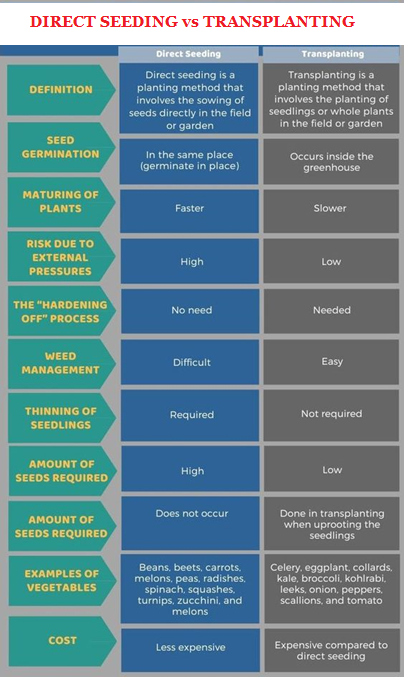
Direct Seeding Vs Transplanting
Paddy
- Origin - South India.
- Scientific name - Oryza sativa.
- Top producing country – China.
- 2nd largest rice producing country – India.
- Top producing state in India – West Bengal.
- Paddy (rice with husk) is a highly water-intensive crop.
- Temperature - High temperature above 25-degree Celsius
- Rainfall - High humidity with annual rainfall above 100 cm.
Transplanting of Rice
- Transplanting consists of preparing seedlings in nursery and then planting these seedlings in the prepared main field.
- Transplanting ensures a uniform plant stand.
- In transplanting, the flooded fields basically deny oxygen to the weed seeds in the soil, thus acting as a natural herbicide.
Direct Seeding of Rice (DSR)
- Paddy is sown directly in the field without any nursery preparation, puddling or flooding.
- DSR is effective against weeds and saves water compared to transplanting.
- Direct seeding is more cost-effective than transplanting.
- Plants mature faster when grown via direct seeding.
- It is not necessary to disturb root systems when planted via direct seeding.
- Disadvantages
- Higher seed rates
- Seeds exposed to birds and pests
- Weed management
- Higher risk of lodging
Reference
The Indian Express | Paddy and the price of water
ICMR's Recent Report on Diabetes
ICMR’s recent study says that India has 101 million people living with diabetes
- Published by - The Madras Diabetes Research Foundation and Indian Council of Medical Research (ICMR).
- Findings - More than a quarter of the population was either diabetic or in pre-diabetic stage.
- 11.4% of India’s population or 101 million people are living with diabetes.
- Hypertension - Around 35.5% of the population or 315 million people are living with the hypertension or high blood pressure.
- Obesity - The study found that 28.6% of the population would be considered to be obese as per the BMI measure, 39.5% of the population had abdominal obesity.
- BMI (body mass index) - Generally used as a measure for obesity.
- Hypercholesterolemia - 24% of the population were living with hypercholesterolemia (a condition where the bad cholesterol or LDL levels are high).
Diabetes & its Types
- Diabetes is a condition that happens when your blood sugar (glucose) is too high.
- It develops when your pancreas doesn’t make enough insulin or any at all, or when your body isn’t responding to the effects of insulin properly.
- Diabetes affects people of all ages.
- Type 1 diabetes - It is an autoimmune disease in which the immune system attacks and destroys insulin-producing cells in pancreas.
- It’s usually diagnosed in children and young adults, but it can develop at any age.
- It is non-curable.
- Type 2 diabetes - With this type the body doesn’t make enough insulin and body’s cells don’t respond normally to the insulin (insulin resistance).
- This is the most common type of diabetes.
- It mainly affects adults, but children can have it as well.
- Other types
- Gestational diabetes
- Type 3c diabetes
- Latent autoimmune diabetes in adults (LADA)
- Maturity-onset diabetes of the young (MODY)
- Neonatal diabetes
- Brittle diabetes
Reference
The Indian Express | India has 101 million people living with diabetes
Intersex-Inclusive Progress Pride Flag
The new variation of Intersex-Inclusive Progress Pride Flag, a representation of the LGBTQIA+ community is increasingly being accepted by many organizations in India.
- LGBTQIA+ - Lesbian, gay, bisexual, transgender, queer, questioning, intersex, asexual, and the + holds space for the expanding and new understanding of different parts of the very diverse gender and sexual identities.
Pride flag
- It represents the pride associated with LGTQIA+ social movements and allies as a symbol of resistance and acceptance.
- In 2021, Intersex Equality Rights (UK) decided to adapt the Pride Progress flag design to incorporate the intersex flag, creating the Intersex-Inclusive Pride flag.
- The recent flag is created by Valentino Vecchietti of Intersex Equality Rights UK in 2021.
- This is a new version of the previous Progress Pride Flag created in 2018 by Daniel Quasar.
- Various color representation and its meanings
- Red= Life
- Orange= Healing
- Yellow= New Ideas
- Green= Prosperity
- Blue= Serenity
- Violet= Spirit
- Chevron Part
- Black and brown= people of colour
- White, blue and pink= transpeople
- Yellow with purple circle= Intersex people.
India’s case
- In India, section 377 in Navtej Singh Johar vs Union of India case (gay sex) was decriminalised in 2018.
- India’s 2011 Census was the first census in its history to incorporate the number of ‘trans’ population of the country.
- According to the 2011 Census, the number of persons who do not identify as ‘male’ or ‘female’ but as ‘other’ stands at 4,87,803 (0.04% of the total population).
Yogyakarta Principles recognise that all human beings are born free and equal in dignity and rights and can fulfil that precious birthright.
Reference
The Indian Express | The new Pride flag
Prevalence of Anaemia in India
The 6th round National Family Health Survey (NFHS), is scheduled to begin on July 1.
Anaemia
- Anaemia is linked to insufficient healthy red cells (haemoglobin) that carry oxygen in the body.
- Reasons - Iron deficiency, deficiencies in folate, Vitamin B12, Vitamin A, chronic conditions such as diabetes or inherited genetic disorders.
- There are 5 documented types of anaemia:
- Aplastic anaemia,
- Iron deficiency anaemia,
- Sickle cell anaemia,
- Thalassemia,
- Vitamin deficiency anaemia.
Anaemia in India
- An estimate shows 1.3% of the GDP for children and 4% of the GDP for children and adults combined are lost due to anaemia-related illnesses in India.
- NFHS-5 showed at least 67% of children having anaemia as compared to 58.6% in the last survey conducted in 2015-16.
- World Bank data shows one in two Indian women is anaemic, 20% higher than the world average.
- India has recognised anaemia as a public health challenge.
- Schemes related to Anaemia
WHO standard on Haemoglobin diagnostic cut-off for
- Men - 14 gm/deciliter,
- Women 12 gm/decilitre
- Boys and girls - Between 11 and 12 gm/deciliter.
Reference
The Hindu | Can the new Diet and Biomarker Survey trace the roots of India’s anaemia problem
Curiosity Rover
NASA’s Curiosity rover sends a beautiful postcard image from Mars.
- Launch Year – 2012.
- It is a part of Mars Science Laboratory (MSL) mission of NASA.
- It is the largest and most capable rover ever sent to Mars.
- Aim - To climb onto the layered deposit in the center of the Gale Crater to assess its possible origins.
- Gale crater, located just south of the Martian equator was formed by the impact of a large meteorite sometime between 3.5 and 3.8 billion years ago.
- Findings - Curiosity's scientific tools found chemical and mineral evidence of past habitable environments on Mars.
- It continues to explore the rock record from a time when Mars could have been home to microbial life.
687 Earth days = One Mars year
|
Mars Missions
|
Countries
|
|
Mangalyaan
|
India
|
|
Perseverance
|
U.S.
|
|
Hope
|
UAE
|
|
Tianwen-1
|
China
|
|
Mars 2 and Mars 3
|
Russia
|
|
Insights
|
U.S.
|
Reference
The Indian Express | NASA’s Curiosity rover sends a beautiful postcard



