Dengue
Developing a viable universal vaccine for dengue has remained a challenge.
- Dengue is largely accepted as an annual epidemic in several countries and it is the world’s fastest-growing vector borne disease.
- Dengue (break-bone fever) is a viral infection that spreads from mosquitoes to people.
- Spread - It is more common in tropical and subtropical climates.
- Transmission - Dengue is transmitted to humans by the Aedes mosquito species, which also spreads Chikungunya and Zika virus.
- Types - There are four serotypes of the dengue virus - DEN-1, DEN-2, DEN-3 and DEN-4.
- Each virus interacts differently with antibodies in the human body and is capable of manifesting into dengue fever, dengue hemorrhagic fever and dengue shock syndrome.
- Symptoms - mostly asymptomatic, but the most common symptoms are high fever, headache, body aches, nausea and rash.
- Treatment - No specific treatment. Generally treated with pain medicine.
- Vaccine - Dengvaxia was the first vaccine to receive a nod in 2015, and has been licensed in 20 countries since.
- Dengvaxia - It is a live attenuated vaccine.
- WHO recommends ‘Dengvaxia’ for children aged 9 to 16 years.
- But Dengvaxia’s efficacy is limited to those with confirmed previous infections.
- Dengvaxia is not licensed in India.
- Five types of dengue vaccines are currently being investigated:
| Vaccine Type |
Description |
Example |
| Live Attenuated Vaccine |
Uses the weakened or “attenuated” form of the virus |
Measles or chickenpox vaccine |
| Inactivated vaccine |
Uses the dead virus |
Hepatitis A and rabies |
| Recombinant subunit vaccine |
Non-structural proteins of the dengue virus are used, aiding a balanced immune response |
COVISHIELD |
| Viral vectored vaccine |
A modified, weakened version of a different virus |
Ebola vaccine |
| DNA vaccine |
Use engineered DNA to induce an immunologic response |
HIV, malaria, TB |
- Challenges in Vaccine development - Lack of research around different dengue types.
- The evolving ‘inimitable’ nature of the virus making vaccine development a dynamic challenge.
- Apprehensions over vaccine safety.
- Lack of funding for a disease.
References
- The Hindu - Why is a viable dengue vaccine not yet available?
- WHO - Dengue and Severe Dengue
Dancing girl
The Prime Minister unveils Mascot of the International Museum Expo 2023 - the Chennapatnam style dancing girl.
- The International Museum Expo is being organized as part of Azadi ka Amrit Mahotsav to celebrate the 47th International Museum Day.
- The Mascot of the International Museum Expo is a contemporized version of the Dancing Girl made of wood in the Channapattana art style.
Channapattana Toys
- Channapattana is a place in Ramanagara district in Karnataka famous for handmade lacquer wooden toys.
- The origin of the wooden toys date back to the period of Tipu Sultan.
- Tipu Sultan, the ruler of Mysore, was a great admirer of wooden toys.
- He invited artisans from Persia and trained the local artists to earn the process of making of the wooden toys.
- The artisans still follow the traditional method of making the toys, using only ivory wood for making the toys.
- Very rarely rosewood and sandalwood are used.
- Now the artisans have also started to use other woods like teak, pine, rubber and cedar wood.
- The colours used on these toys are vegetable dyes, non-toxic and safe for children.
- Channapattana toys hold GI tag under Handicrafts category.
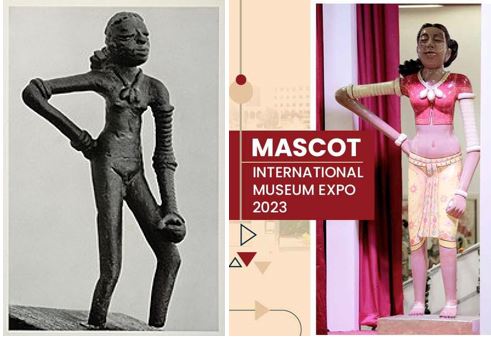
Dancing Girl of Mohenjo-Daro
- The 'Dancing Girl' belongs to the Indus Valley Civilization and dates back to 2500 BCE.
- The dancing girl is a sculpture made of bronze.
- The sculpture was made using the 'Lost Wax' method.
- The statue is named the 'Dancing Girl' owing to her posture, with her right hand on the back of her hip and the left hand resting on her left thigh.
- She is adorned by a necklace and some bangles.
- Presently, it is on display in the Indus Valley Civilization gallery in the National Museum, New Delhi.
References
- PIB - PM inaugurates International Museum Expo 2023
- Government of Karnataka - Ramanagara District
- Indian Culture - Dancing Girl
Operation Karuna
India launched ‘Operation Karuna’ to assist Myanmar which has been devastated by Cyclone Mocha.
- Super cyclone Mocha hit Bangladesh and Myanmar causing widespread devastation.
- In Myanmar, Rakhine state is the worst-hit while in Bangladesh the Cox’s Bazar which shelters in the world’s largest refugee camp is worst-hit.
- Indian Navy remains committed to ensuring Security and Growth for All in the Region and continues to be the first responder in the region during such calamities.
- India launched 'Operation Karuna' to provide assistance to Mocha-hit Myanmar.
- Indian Naval Ships Shivalik, Camorra and Savitri were the first naval ships to arrive at Yangon with relief material.
- The fourth ship is also sent with relief material.
- The ships are carrying emergency food items, tents, essential medicines, water pumps, portable generators, clothes, sanitary and hygiene items, etc.
References
- The Hindu - India launches ‘Operation Karuna’ to assist Myanmar
- News On Air - Cyclone Mocha: Operation Karuna
Quantum Biology
Quantum physics proposes a new way to study biology which could revolutionise our understanding of how life works.
- Quantum biology is the application of quantum theory to aspects of biology that cannot be accurately described by the classical laws of physics.
- Electrons, protons, excitations, chemical bonds, and electronic charges are by definition quantum.
- Biology and biological processes often deal with electrons, protons and their transfer.
- The protons and electrons are continuously being transferred between different parts of a cell or a macromolecular system.
- In these transfer processes the system exchanges energy with its environment in the form of molecular vibrations and phonons.
- Such a system is called an ‘open quantum system’.
- The open quantum systems are connected to life and life processes.
- Quantum biology aims to develop a consistent open quantum systems model to explain all these phenomena.
- With open quantum system and quantum mechanics, there is a scope to understand life and life processes.
References
- The Hindu - Quantum physics proposes a new way to study biology
- The Royal Society - The future of quantum biology
Sendai Framework
India and Japan organized a side event during the High-level meeting of the midterm review of Sendai Framework for Disaster Risk Reduction (SFDRR) 2015-2030.
India’s National Disaster Management Authority (NDMA) and Japan International Cooperation Agency (JICA) participated in the Risk Reduction Hub Event held at UN headquarters in New York.
- The Sendai Framework for Disaster Risk Reduction 2015-2030 (Sendai Framework) is an international document on disaster risk reduction.
- The framework provides Member States with concrete actions to protect development gains from the risk of disaster.
- It was adopted at the Third UN World Conference on Disaster Risk Reduction in Sendai, Japan, in 2015.
- It is the successor instrument to the Hyogo Framework for Action (HFA) 2005-2015.
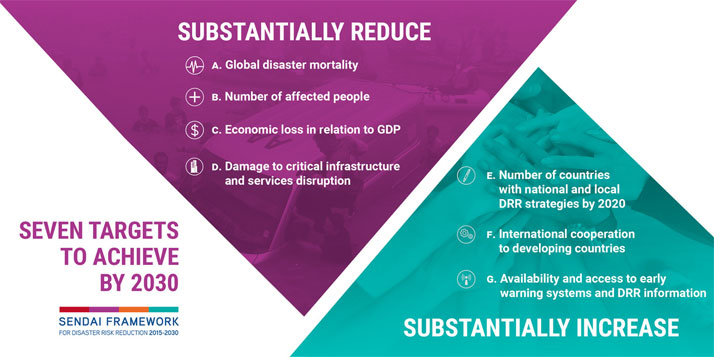
- The Sendai Framework outlines 4 specific priorities of action and 7 global targets to guide and against which to assess progress.
- It focuses on the adoption of measures which address the 3 dimensions of disaster risk in order to prevent the creation of new risk, reduce existing risk and increase resilience.
- UN Office for Disaster Risk Reduction (UNDRR) supports the implementation, follow-up and review of the Sendai Framework.
The 3 dimensions of disaster risk are exposure to hazards, vulnerability and capacity, and hazard’s characteristics.
References
- PIB - Midterm review of Sendai Framework for Disaster Risk Reduction
- UNDRR - Sendai Framework for Disaster Risk Reduction 2015-2030



