Millets
Grain-processing of millets raises new concerns in the consumption of millets.
- Millets are a group of cereal grains that belong to the Poaceae family (grass family).
- Millets are primarily grown during the kharif season in rainfed areas as these crops require less water and agricultural inputs than other cereals.
- As proposed by India, the United Nations General Assembly (UNGA) has declared 2023 as International Year of Millets (IYM).
- Nutrients - The nutritional content of millets includes carbohydrates, proteins, fibre, amino acids, and various minerals.
- Different millet varieties have different nutrient profiles.
|
Millet Variety
|
Rich in
|
|
Pearl millet
|
Higher protein content than rice, maize, and sorghum
|
|
Foxtail millet
|
Amino acid lysine
|
|
Finger millet
|
More crude fibre than wheat and rice
|
|
Proso millet
|
Amino acids leucine, isoleucine, and methionine
|
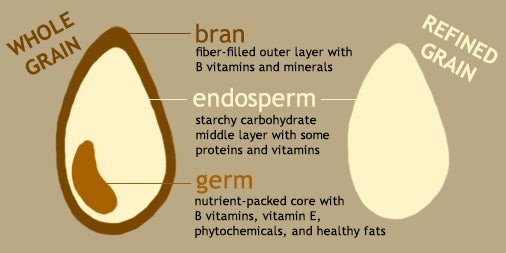
- Processing of Millets - ‘Whole grain’ refers to the endosperm, germ, and bran (pericarp + aleurone) whereas ‘refined grain’ refers only to the endosperm.
- Each millet kernel consists of 3 major parts, called pericarp, endosperm, and germ.
- The pericarp has an outer covering called the husk.
- The husk and the pericarp together protect the kernel from inhospitable ambient conditions, disease, and physical damage.
- The husk is removed from the grains because it is composed of cellulosic matter that the human body can’t digest.
- Decortication of Grain - Removes any other outer covering and expose the seed.
- Both mechanical and hand-worked removescrude and dietary fibre.
- Milling - Grinding the grains into flour, and sieving to remove large ‘impurities’, including bran.
- Sieving makes the flour more digestible and its nutrients more accessible to the body but reduced nutrient content due to the loss of bran.
- The longer the grains were milled, the more protein, fat, and fibre contents the process removed.
- Polishing - Polishing is the process where the bran and the germ are rubbed off.
- For example, brown rice is changed to white rice by polishing.
- Effects of polishing - Processing and preparing millets for consumption can affect nutrients in three ways:
- Enhance them
- Suppress/remove them
- Ignore them
- Polishing which removes 8-10% of grain weight also removed 60-80% of iron, magnesium, phosphorus, potassium, and manganese in both varieties.
- The loss of bran also compromised the grains’ fibre content.
References
- The Hindu - How are nutrients in millets affected by processing and polishing?
Carbon Dating
The Allahabad High Court ordered a ‘scientific survey’, including carbon dating, of a ‘Shivling’ said to have been found at the Gyanvapi mosque complex in Varanasi.
- Carbon dating is a widely-used method to establish the age of dead organic materials.
- Isotopes - Carbon occurs naturally in three isotopes: carbon 12, carbon 13 and carbon 14.
- The most abundant isotope of carbon in the atmosphere is C-12. A very small amount of C-14 is also present.
- The ratio of C-12 to C-14 in the atmosphere is almost static.
- The dating method uses Carbon-14 (C-14) which is radioactive and decays at a well-known rate.
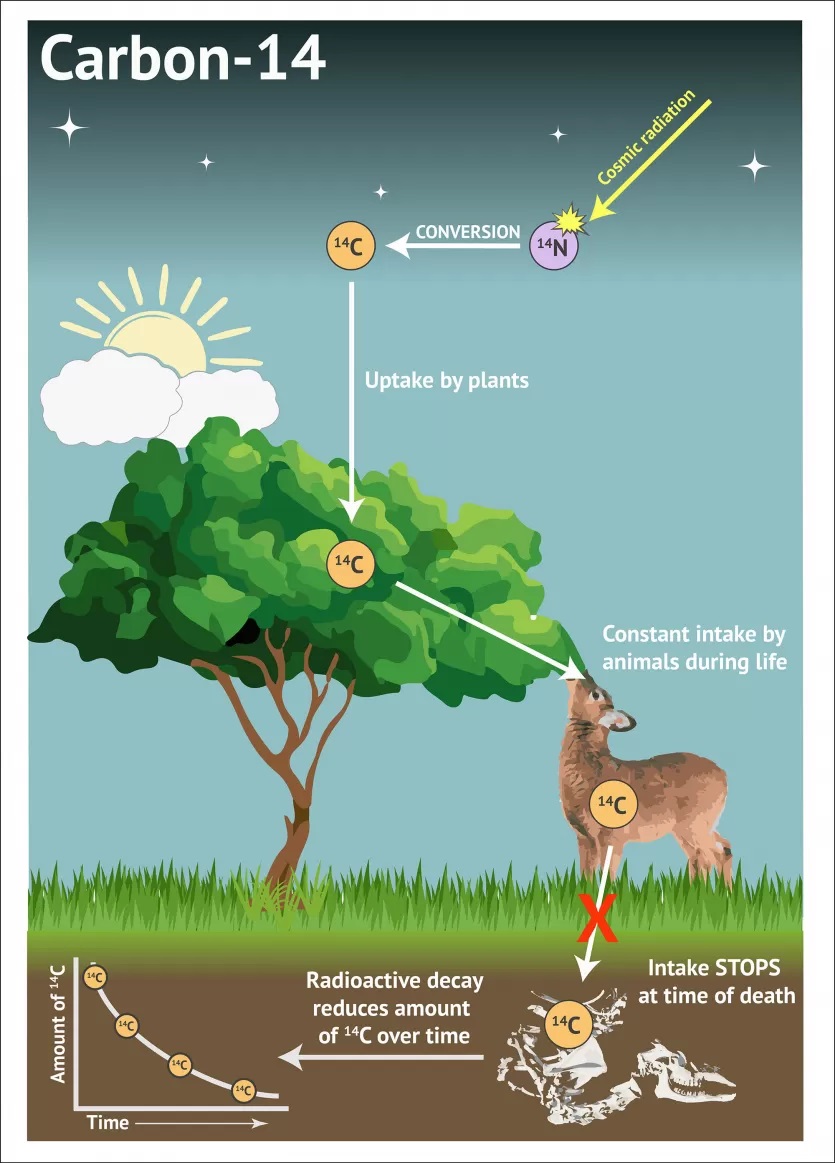
- Half-life - The radioactive C-14 reduces to one half of itself in about 5,730 years, known as its ‘half-life’.
- Carbon dating - Living things have carbon in them in various forms. Plants and animals get their carbon from the atmosphere.
- When they die, C-14 decay and the ratio of C-12 and C-14 changes.
- The changing ratio of C-12 to C-14 in the remains of a plant or animal after it dies is measured to deduce its approximate age.
- Exceptions to carbon dating - It cannot be used to determine the age of non-living things like rocks, for example.
- Also, the age of things that are more than 40,000-50,000 years old cannot be arrived at through carbon dating.
- This is because after 8-10 cycles of half-lives, the amount of C-14 becomes almost very small and is almost undetectable.
- Alternate methods - Radiometric dating methods which involve elements with half-lives of billions of years are used to determine age of very old objects.
- Potassium-argon dating - The radioactive isotope of potassium decays into argon, and their ratios can give a clue about the age of rocks.
- Uranium-thorium-lead dating - Uranium and thorium have several radioactive isotopes, and all of them decay into the stable lead atom.
- Cosmogenic nuclide dating (CRN) - It is applied to study the age of ice cores in Polar Regions.
References
- IE - carbon dating of Gyanvapi ‘Shivling’: How does carbon dating work?
SDGs Localisation
Bhopal becomes the first city in India to adopt the localisation of the United Nations-mandated sustainable development goals (SDG).
- In 2015, all 193 member states of the UN adopted the Agenda 2030, which comprises of 17 SDGs and 169 targets.
- The member states report their progress towards achieving the goals through a voluntary national review (VNR) to UN’s high-level political forum (HLPF).
- ‘Agenda for Action: Sustainable Urban Transformation in Bhopal’ was released by the Chief Minister of Madhya Pradesh.
- Bhopal will now have voluntary local reviews (VLR) demonstrate local government’s capacity and commitments.
- Bhopal Municipal Corporation, UN-Habitat, other local stakeholders collaborate for VLR to track the progress towards the 2030 Agenda.
- Bhopal’s VLR will measurably demonstrate the city’s aspirations for a sustainable and inclusive urban transformation.
- The SDGs localisation translates the ‘Agenda 2030’ into local actions and impacts that contribute to the global achievement of the goals.
- In SDG localisation, VLRs have emerged as a powerful tool that forefronts local action towards SDGs.
- New York City became the first city to present its VLR to the HLPF in 2018.
- By 2021, some 33 countries had made 114 VLRs or similar review documents publicly available.
References
- DTE - Bhopal: 1st Indian city to track progress towards meeting SDGs
- SDGs UN - Voluntary Local Reviews
Electronic Voting Machines
The Election Commission denies Congress’ claim on EVMs being brought from South Africa for Karnataka elections.
- Electronic Voting Machine (EVM) is an electronic device for recording votes.
- An Electronic Voting Machine consists of two Units – a Control Unit and a Balloting Unit – joined by a five-meter cable.
- The Control Unit is placed with the Presiding Officer or a Polling Officer and the Balloting Unit is placed inside the voting compartment.
- The Polling Officer in-charge of the Control Unit will release a ballot by pressing the Ballot Button on the Control Unit.
- This will enable the voter to cast his vote by pressing the blue button on the Balloting Unit against the candidate and symbol of his choice.
- Capacity - An EVM can record a maximum of 2,000 votes and a Balloting Unit has a provision for 16 candidates.
- EVMs (M3 EVMs) can cater to a maximum of 384 candidates including NOTA by connecting 24 Balloting Units.
- Design - The EVMs are devised and designed by the Technical Experts Committee (TEC) of the Election Commission in collaboration with 2 other Public Sector undertakings.
- Manufacturing - Bharat Electronics Ltd., Bangalore and Electronic Corporation of India Ltd., Hyderabad are the 2 PSUs that manufacture EVMs.
- Discarding - ECI has laid down a Standard Operating Procedure to discard EVMs and its chip.
- The process of destruction of EVM & its chip is carried out in the presence of the Chief Electoral Officer of the state or his representatives inside the factory of manufacturers.
- Abroad connections - India does not use any EVMs produced abroad, but many countries used EVM machines made in India in their elections, like Bhutan, Nepal and Namibia.
- The chip is manufactured abroad because India does not have the capability of producing semi-conductor microchips within the country.
- Time line of EVMs - EVMs were first used in 70-Parur Assembly Constituency of Kerala in the year 1982.
- EVMs are used from 1989 after the 1988 amendment to the Representation of the People Act of 1951.
- By 2001, all State Assembly elections saw EVM usage.
- In 2004’s Lok Sabha election, all 543 constituencies had EVMs.
- The VVPAT was first introduced on 4th September, 2013 in the bye-election for 51-Noksen (ST) Assembly Constituency of Nagaland.
References
- IE - Karnataka elections: Who manufactures EVMs?
- ECI - Electronic Voting Machine
United Nations Forum on Forests (UNFF18)
UNFF18 held in New York, discussed the contributions of SFM to energy, livelihoods and the SDGs.
- UNFF - The UN ECOSOC established a subsidiary body the United Nations Forum on Forests (UNFCC) in 2000.
- The UN General Assembly adopted the first ever UN Strategic Plan for Forests 2017-2030.
- The Strategic Plan provides a global framework for actions at all levels to sustainably manage all types of forests and trees outside forests and halt deforestation and forest degradation.
- There are 6 Global Forest Goals and 26 associated targets to be achieved by 2030 in the Strategic Plan.
- These goals and targets are voluntary and universal.
- The Forum has universal membership, and is composed of all Member States of the United Nations and specialized agencies.
- The UNFF meet happens annually and will focus on discussions on implementation, technical advice and exchange of experiences.
- UNFF18 - The 18th session of UNFF held in New York.
- UNFF18 discussed the contributions of sustainable forest management (SFM) to energy, livelihoods and the SDGs.
- India presented a case of a UNFF country-led initiative on long-term SFM.
- India also shared concerns on wildfires and the problems associated with current forest certification schemes.
References
- DTE - UNFF18: Sustainable forest management takes centre stage
- UN ECOSOC - UNFF



