Battle of Bakhmut
Bakhmut is currently in ruins, having been the focal point of Russian assaults and a site of dogged defence by the Ukrainian military.
- Bakhmut is a small mining town in Eastern Ukraine.
- The tiny town with a pre-war population of around 70,000 people.
- Battle of Bakhmut is one of the bloodiest fighting in the Ukraine-Russia War.
- The Russians have surrounded Bakhmut from 3 sides.
- Bakhmut’s civilian population has long fled and only charred ruins remains.
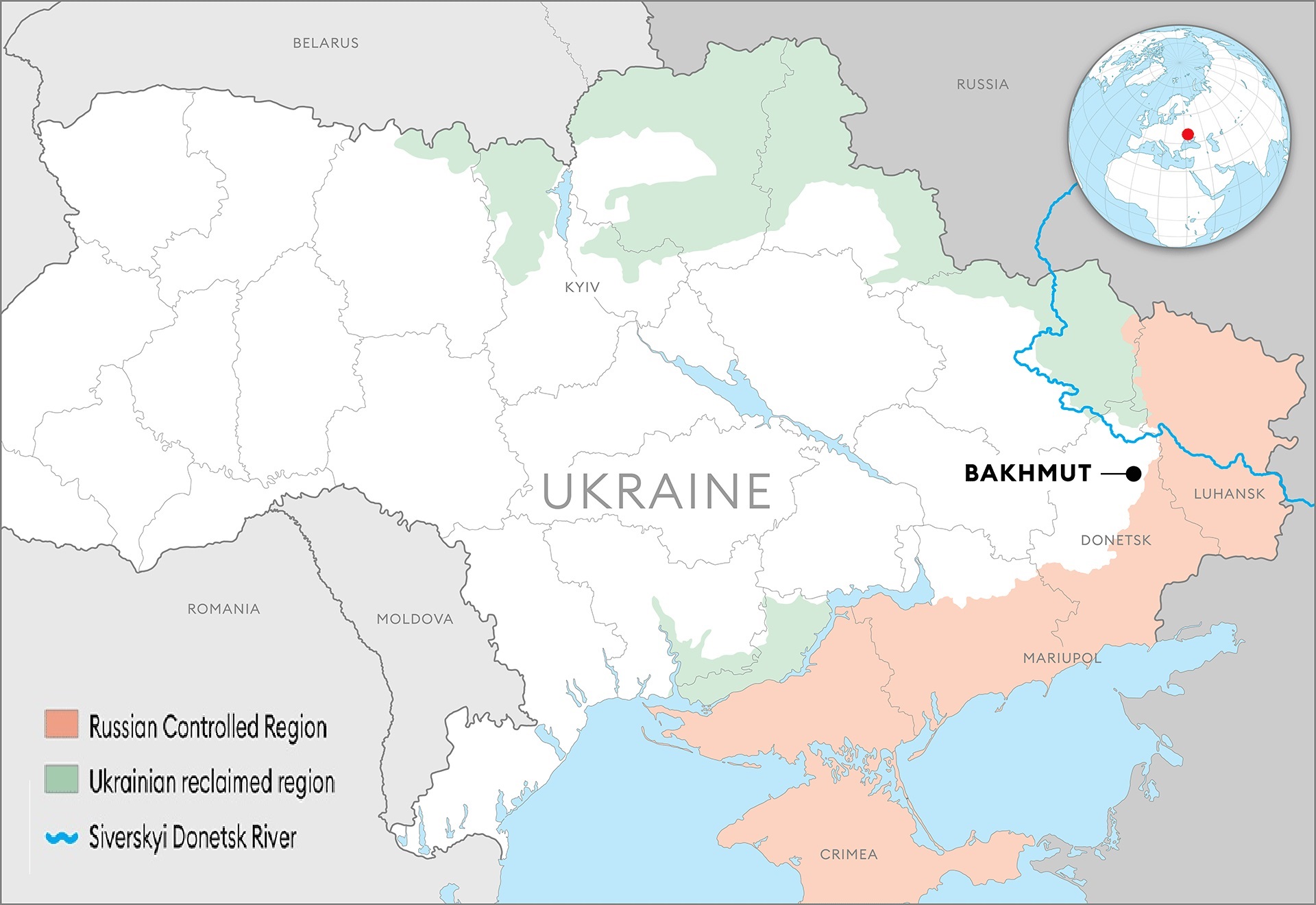
- Russians - They see Bakhmut as a symbol of their resolve to war.
- Ukrainians - They are proud of holding on to the land.
- Significance - Bakhmut does not have either militarily important industry nor is it strategically located such that its capture is vital.
- Bakhmut have less to do with military strategy than political strategy.
- Meat-Grinder - Battle of Bakhmut is a symbol of the bloody struggle.
- The Battle of Bakhmut has taken on a similar character of Battle of Verdun: A meat-grinder.
The Battle of Verdun in World War I has been described by historians as a meat-grinder: where many young men succumbed to death in the war while trying to make negligible strategic gains.
References
- IE - Battle of Bakhmut: Ukraine-Russia War
- Forbes - The Bloody Battle of Bakhmut
Lewis Super Acids
Researchers at the Paderborn University, Germany have been able to make a unique class of catalysts called “Lewis super-acids”.
- ‘Lewis super-acids are derived from Lewis acids, named after the chemist, G N Lewis.
- Lewis super-acids’ are used as catalysts in chemistry to accelerate reactions.
- These are compounds that add electron pairs.
- These can be used to break strong chemical bonds and speed up reactions.
- These are highly reactive reagents, thus difficult to produce and use.
- Significance - It enables non-biodegradable fluorinated hydrocarbons (similar to Teflon) to be converted back into sustainable chemicals.
- It can possibly even convert climate-damaging greenhouse gases, such as sulphur hexafluoride into sustainable ones.
Lewis acid and Lewis base
|
Lewis acid
|
Lewis base
|
|
An electron-pair acceptor
|
An electron-pair donor
|
|
Substances such as a Hydrogen ion (H+)
|
Substances such as the hydroxide (OH-) ion
|
References
- The Hindu - What are Lewis super acids?
Sisupalgarh
Land mafias have damaged a portion of the wall of the fortified ancient city of Sisupalgarh.
- Sisupalgarh is a majestic archaeological heritage that has survived over 2,600 years.
- It is the only fortified site in India having 8 gateways.
- Sisupalgarh is located on the outskirts of Bhubaneswar.
- History - Sisupalgarh is believed to have been built around the 7th to 6th century BCE.
- It served as the capital of the Kalinga kingdom.
- It was also an important centre of trade and commerce during ancient times.
- Excavation - The excavation of the Sisupalgarh site was first taken up in 1948.
- Sisupalgarh, Badadhanpu Lingipur, Raghunathpur and Mahabhoisasan, was declared a Centrally Protected Monument in 1950.
- Findings - The urban centre it was surrounded by a moat.
- The water management system of the city was unique.
- The fortification was carried out in the 4th to 3rd century BCE, when King Kharavela took up the repair of the city 2,100 years ago.
- Sisupalgarh is one of very few historical references of the present capital city of Bhubaneswar.
References
- The Hindu - Land mafias damage rampart of Sisupalgarh
Great Pyramid of Giza
A hidden corridor has been unearthed by scientists close to the main entrance of the 4,500-year-old Great Pyramid of Giza.
- The hidden corridor was roughly 2m wide and 9m long.
- The discovery was made in 2016 using a non-invasive technique called cosmic-ray muon radiography.
- The Great Pyramid of Giza is the largest of the 3 pyramids in Giza.
- It stands roughly 147 m above the Giza plateau.
- It was built 4,500 years ago during the reign of Khufu.
- Khufu is often considered the greatest pharaoh of Egypt’s old kingdom.
- The pyramid is also known as Khufu or Cheops pyramid.
- It is estimated that the pyramid was built using 2.5 million stone blocks, each weighing between 2.5 and 15 tonnes.
- There are 2 distinct tunnel systems inside the Great Pyramid –
- The Descending Passage (described by Greeks like Herodotus) and
- The Ascending Passage (opened by the Arabs in the 9th century).
- Muography - Muon tomography or muography uses muons to generate three-dimensional images of such large structures.
- Muography is conceptually similar to X-ray but capable of scanning much larger and wider structures, owing to the penetration power of muons.
- Muon tomography was first used in the 1960s and recently found widespread utilisation especially in archaeology.
- Applications - Examining archaeological sites, customs security, internal imaging of volcanoes.
- Muon -Muons are subatomic particles raining from space.
- These are high-energy particles, naturally produced and ubiquitous.
- They are created when the particles in Earth’s atmosphere collide with cosmic rays.
References
- IE - Great Pyramid of Giza
- New Indian Express - Egypt reveals chamber inside Great Pyramid
Hallmark Unique Identification
The Union Ministry of Consumer Affairs said that the sale of gold jewellery mandates a Hallmark Unique Identification (HUID) from April 1, 2023.
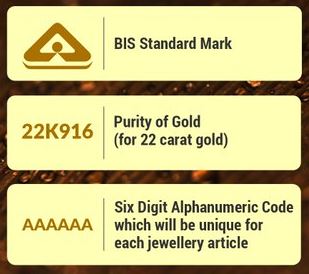
- The HUID is a unique 6-digit alphanumeric code consisting of numbers and letters.
- The HUID will be given to every piece of jewellery at the time of hallmarking and it is unique for every piece of jewellery.
- This unique number is stamped manually, on jewellery at the Assaying & Hallmarking centres.
- Present scenario - Earlier, the HUID used to be of 4 digits and now both 4 and 6 digit HUIDs are used in the market.
- From April 1st 2023, only 6-digit alphanumeric code will be allowed.
- Symbol - The BIS Hallmark consists of 3 symbols -
- Advantages - HUID is unique to each piece of jewellery.
- Ensures the credibility of the jewellery
- Enables its traceability
- Doesn’t jeopardise data privacy or security.
- Verification - The authenticity of hallmarked jewellery can be checked by using 'verify HUID' feature on the BIS Care App.
Bureau of Indian Standards
- The Bureau of Indian Standards (BIS) is the national Standards Body of India established under the Bureau of Indian Standards Act, 1986.
- BIS is working under the aegis of Ministry of Consumer Affairs, Food & Public Distribution, and Government of India.
References
- IE - No sale of gold jewellery without HUID from April 1
- ET - What is HUID number in gold jewellery



