Whip
The Supreme Court hearing petitions filed due to a split in the Shiv Sena, observed that members of a house are bound by the ‘whip’.
Ruling - Members of a House are bound by the ‘whip’, and if any section of MLAs within a political party that is part of a ruling coalition says it does not want to go with the alliance, the MLAs will attract disqualification.
- The term ‘whip’ is derived from the old British practice of “whipping in” lawmakers to follow the party line.
- The ‘office of whip’ is not mentioned or defined in the Constitution.
- The ‘office of whip’ is a Parliamentary convention.
- In parliamentary parlance, a whip may refer to both
- A written order to members of a party in the House to abide by a certain direction, and
- To a designated official of the party who is authorised to issue such a direction.
- Position - In India, all parties can issue whips to their members.
- Parties appoint a senior member from among their House contingents to issue whips.
- This member is called a chief whip, and he/ she is assisted by additional whips.
- Function - A whip may require that party members be present in the House for an important vote, or that they vote only in a particular way.
- Degree of importance of Whip - Whips can be of varying degrees of seriousness and can be inferred from the number of times an order is underlined.
|
A one-line whip
Underlined once
|
Usually issued to inform party members of a vote.
|
|
Allows them to abstain in case they decide not to follow the party line.
|
|
A two-line whip
Underlined Twice
|
Directs them to be present during the vote.
|
|
Abstention from voting invites more scrutiny from party.
|
|
A three-line whip
Underlined Thrice
|
Strongest whip.
Employed on important occasions such as the second reading of a Bill or a no-confidence motion.
|
|
Places an obligation on members to toe the party line.
|
- Penalty - The penalty for defying a whip varies from country to country.
- In India - Rebelling against a three-line whip can put the membership of the House at risk.
- The anti-defection law allows the Speaker/ Chairperson to disqualify such a member.
- Exception - When more than a third of legislators vote against a directive, effectively splitting the party.
- The United Kingdom - An MP can lose membership of the party, but can keep their House seat as an Independent.
- The US - More freedom to House members. The party whip’s role is to gauge and persuade them to vote according to the party line.
- Related topic - The political crisis in Maharashtra
References
- IE - What is a whip in a state Assembly or Parliament?
Yield Curve Inversion
The G-sec yield curve became inverted against the similar phenomenon in the US.
- The yield curve represents the yield or interest rates of similar bonds across various tenors (maturity).
- Usually, the yield rises with an increase in the tenor of bonds.
- Yield Curve Inversion - It occurs when short-term bonds have higher yields than similar profile long-term bonds.
- It occurs under 2 situation.
- When the yield of longer-term bonds dips below that of medium-term bonds or
- The yield of medium-term bonds falls below that of short-term bonds.
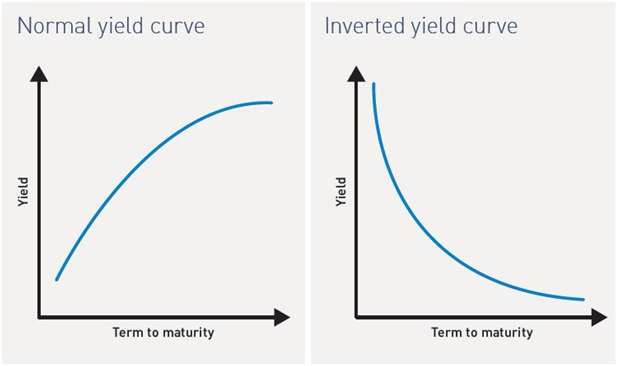
- Indicates - Yield curve inversion could denote an impending economic recession or slowdown.
- However, this phenomenon may be short-lived once the demand for medium papers from banks increases.
- RBI Measures - RBI tries to ensure that the yield curve slopes upwards as the tenor of G-Secs increases by increasing the demand for Treasury bills.
References
- Business Line - Decoding the recent inversion in India’s yield curve
Chhatrapati Sambhaji Nagar
Aurangabad in Maharashtra recently rechristened Chhatrapati Sambhaji Nagar.
- Aurangabad’s history incorporates the Sultanate, Mughals and the Marathas, and goes back further in time.
- Ajanta-Ellora - The famous Ajanta-Ellora caves is in Aurangabad.
- Ajanta - 30 rock-cut Buddhist monuments from second century BC.
- Ellora - The largest rock-cut Hindu temple and its hundred caves dating back to the Rashtrakuta and Yadava dynasties.
- The Ajanta-Ellora caves are UNESCO World Heritage Sites.
- Sultanate - Mohammed Bin Tughlaq, a Sultan, decided to shift his capital to safer Daulatabad or Deogir but failed to do so.
- The fort in Daulatabad was the capital of the Yadava dynasty till the 14th century, and later became a part of the Ahmednagar Sultanate.
- Mughals - The tomb of the Mughal emperor Aurangzeb lies in Aurangabad.
- Aurangzeb’s wife Dilras Banu Begam’s burial mausoleum, known as ‘Bibi ka Maqbara’ also lies here.
- It was built by Aurangzeb and known as ‘Taj of Deccan’.
- Marathas - Aurangabad was rechristened after Sambaji.
- Sambhaji was Maratha ruler Chhatrapati Shivaji’s son.
- The city also hosts the well-known Shivaji Museum.
References
- The Hindu - The journey from Aurangabad to Sambhaji Nagar
BIMSTEC Energy Centre
India hosted the first meeting of the Governing Board of BIMSTEC Energy Centre (BEC) in Bengaluru.
- BIMSTEC Energy Centre (BEC) is one of the 2 centres of BIMSTEC.
- The other being - BIMSTEC Centre on Weather and Climate.
- The establishment of BIMSTEC Energy Centre (BEC) was envisaged during the First BIMSTEC Energy Ministerial Meeting held in New Delhi in 2005.
- Aim - To coordinate, facilitate, and strengthen cooperation in the energy sector in the BIMSTEC region by promoting experience sharing and capacity building.
- Meeting Highlights - There was active participation from all 7 BIMSTEC countries viz. Bangladesh, Bhutan, India, Myanmar, Nepal, Sri Lanka and Thailand.
- India made a presentation on establishing the BIMSTEC Energy Centre (BEC) in India in the premises of the Central Power Research Institute (CPRI), Bengaluru.
- Considering the current energy scenario in BIMSTEC region, the Meeting recommended to add the additional following areas under the specialized Wings of BEC:
- Cyber Security,
- Green Hydrogen
- Energy Transition
- Related Topic - Fifth BIMSTEC Summit - Part 1 and Part 2
References
- PIB - BIMSTEC Energy Centre
- Live Mint - India hosts first meeting of governing board of BEC
- BIMSTEC - BIMSTEC Energy Centre
Fugitive Economic Offender
India has called upon G20 countries to adopt multilateral action for faster extradition of fugitive economic offenders during the first anti-corruption working group meeting.
- Economic offences have been a problem for many countries, especially when the offenders flee from the jurisdiction of the country.
- The process of extradition of fugitives is highly complex and time consuming, leading to delay in investigation and trial of offences.
- India emphasised on multilateral action rather than bilateral coordination against fugitive economic offenders, during the inaugural G20 anti-corruption working group meeting in Gurgaon.
- FEO - India has a specialised legislation for fugitive economic offence, in the form of Fugitive Economic Offenders Act, 2018.
- The act defines the term ‘fugitive economic offender’ (FEO).
- FEO is an individual against whom a warrant of arrest in relation to scheduled offence has been issued by any court in India and
- who has left the country so as to avoid criminal prosecution;
- or the FEO abroad, refuses to return to face criminal prosecution
- A special court is constituted under the Prevention of Money Laundering Act, 2002.
- The court after hearing the application filed by the Director, appointed by the central government, declares an individual as a fugitive economic offender.
- The act empowers authorities for non-conviction-based attachment and confiscation of proceeds of crime and properties and assets of a ‘fugitive economic offender’.
The Enforcement Directorate (ED) has transferred assets worth over $180 billion to public sector banks out of estimated losses of $272 billion on account of frauds by fugitive economic offenders.
References
- The Hindu - India calls upon G20 for faster extradition of FEO
- IE - Faster extradition of fugitive economic offenders



