Prelims: Current events of national and international importance | Environment
Why in News?
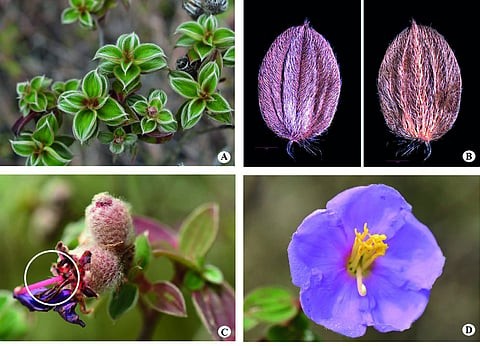
Botanists from the Botanical Survey of India (BSI) identified a new woolly-haired flowering plant species, Osbeckia ulotricha, in the shola grasslands of the Agasthyamala Biosphere Reserve (ABR).
Osbeckia ulotricha
- Family – Melastomataceae.
- Morphology- The name ulotricha stems from the Greek words oulos (woolly/crisp) and thrix (hair).
- It refers to its distinct woolly-curly hair covering on the flower base (sub-globose hypanthium) and an ovary crowned with true bristles.
- Habitat - It grows exclusively along the damp margins of Tropical Montane Wet Temperate Forests (shola) and montane grasslands at high elevations between 1,200 and 1,500 meters.
- Micro-Endemism - The species is critically micro-endemic; botanists recorded only about 50 flowering individuals across three localized sites within an area of less than 1 km².
Agasthyamala Biosphere Reserve (ABR)
- Location - Located at the southernmost tip of the Western Ghats.
- Established in – 2001.
- Inter-State Boundary - Straddles two states, Kerala and Tamil Nadu.
- Core Peak - Named after Agasthyarkoodam (Agasthyamalai Peak), a 1,868-meter-high mountain inside the reserve that holds cultural reverence associated with Sage Agastya.
- Protected Areas- ABR serves as a continuous ecological corridor comprising several wildlife sanctuaries and tiger reserves:
- Kerala Segment- Neyyar Wildlife Sanctuary, Peppara Wildlife Sanctuary, Shendurney Wildlife Sanctuary, and surrounding forest divisions (Achencoil, Thenmala, Konni, Punalur).
- Tamil Nadu Segment - Kalakkad Mundanthurai Tiger Reserve (KMTR) and adjoining forest divisions.
- UNESCO Status - Included in UNESCO’s World Network of Biosphere Reserves (WNBR) in March 2016.
- Recognized as part of the Western Ghats UNESCO World Heritage Site cluster.
- Medicinal Hub - Home to over 2,000 species of medicinal plants used in Ayurveda and Siddha medicine, earning it a reputation as a natural genetic repository.
- Diverse Vegetation- Features tropical wet evergreen forests, South Western Ghats moist deciduous forests, montane rain forests, and high-altitude shola-grasslands.
- Key Wildlife - Provides critical habitat for the Bengal tiger, Asian elephant, Nilgiri tahr, Lion-tailed macaque, and endemic amphibians/reptiles.
- Kani Tribe- Inhabited by the Kani (Kanikaran) tribe, one of the oldest indigenous communities in South India.
Reference
Down To Earth | New woolly-haired flowering plant ABR



