0.1230
7667766266
x

Novel silicon chip allowing terahertz waves

iasparliament Logo
November 14, 2026

Prelims: Current events of national and international importance | Science & Technology

Why in News?

Researchers have developed a novel silicon-based photonic chip that guides terahertz waves across engineered barriers with minimal signal loss.

Key Highlights
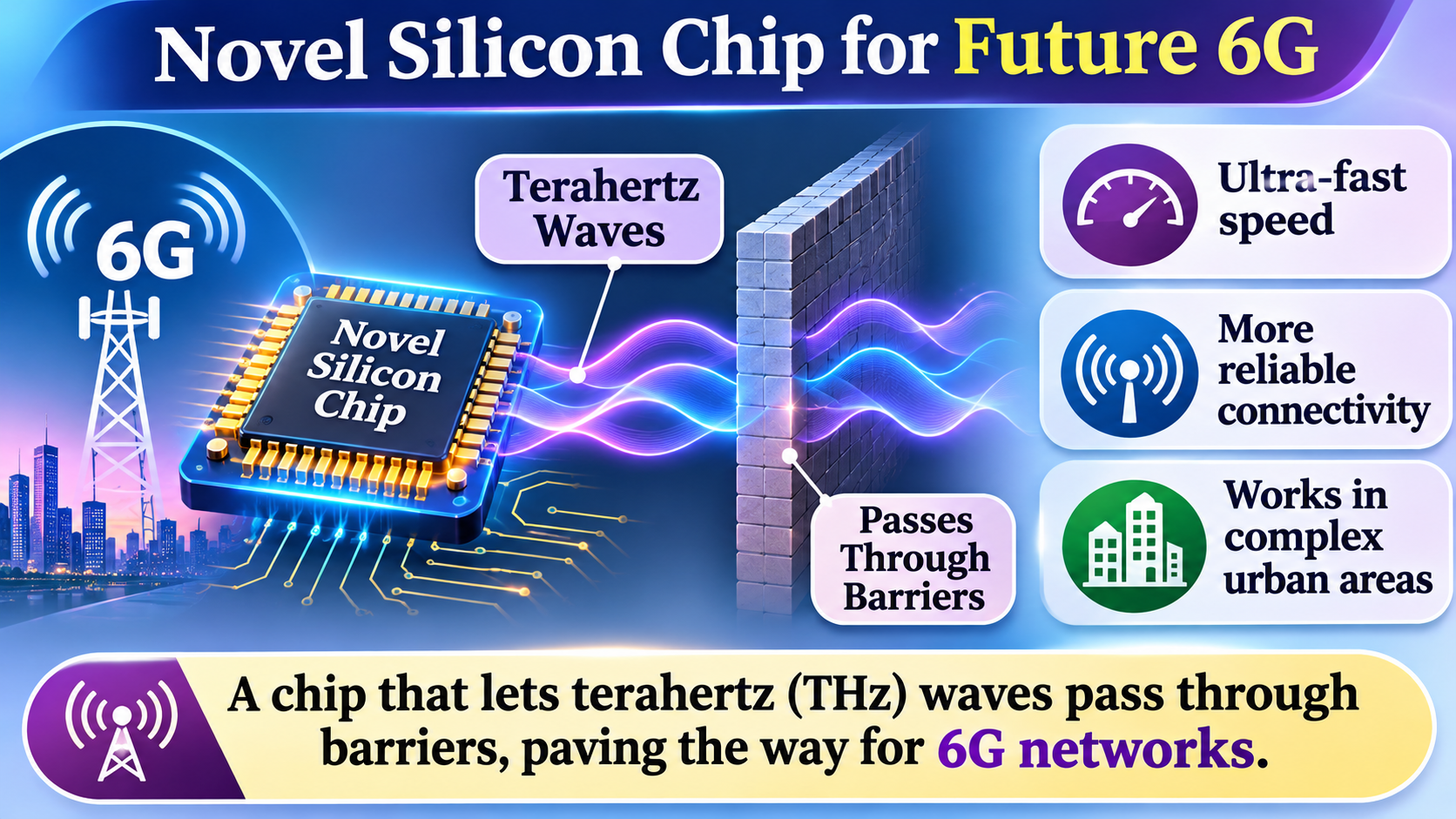
  • The study enables data transmission speeds of up to 100 Gbit/s, overcoming a major hardware bottleneck in developing compact circuits for future 6G wireless communication networks.
  • Photonic Klein Tunnelling - The researchers engineered a graphene-inspired honeycomb-like Silicon Valley photonic crystal by etching triangular holes into a high-resistivity silicon slab.
  • By altering the size of these triangular holes, they created artificial barriers that terahertz waves can pass through via photonic Klein tunnelling resisting signal scattering and back-reflection.
  • Minimal Signal Loss - Measurements across the 310–360 GHz frequency range showed that a single engineered barrier causes only 1–2% signal loss, while two consecutive barriers result in approximately 2–3% loss.
  • Tested Chip Prototypes & Speeds- Three device configurations were fabricated and tested:
    • Double-barrier waveguide - Achieved 48 Gbit/s transmission.
    • Omega-shaped waveguide (with four sharp bends): Achieved 60 Gbit/s transmission.
    • Power splitter - Achieved 100 Gbit/s transmission using QAM-32 (Quadrature Amplitude Modulation).
  • Future Reconfigurability- The research team plans to introduce electrical, thermal, or mechanical tuning of the barriers, allowing future chips to dynamically switch and redirect signals on demand.

Novel-silicon-chip

Reference

PIB | Novel silicon chip allowing terahertz waves

There are no reviews yet. Be the first one to review.

ARCHIVES

sidetext


