Prelims: Current events of National and International Importance | Econ0my
Why is in news?
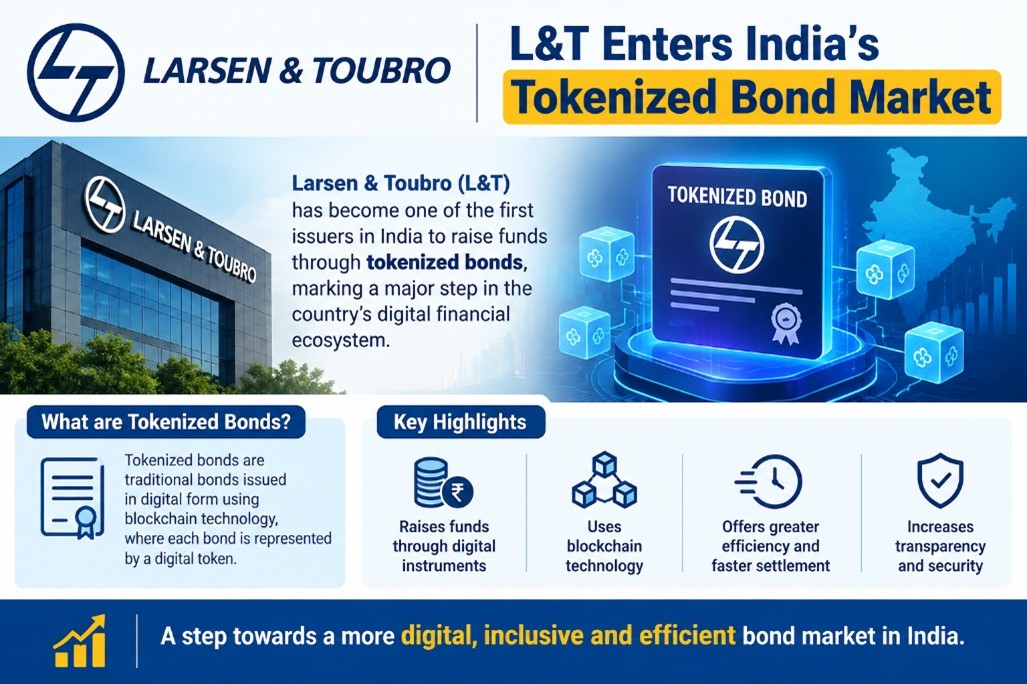
The National Stock Exchange of India (NSE) has enabled tokenised corporate bond issuances worth a combined Rs 1,000 crore.
Objectives
- The transactions were conducted under the Securities and Exchange Board of India’s (SEBI) Regulatory Sandbox Framework with guidance and support from the Reserve Bank of India (RBI).
- The transactions mark an early application of tokenisation in India’s regulated corporate bond market.
- The issuance saw participation from banks, financial institutions, mutual funds and depositories.
- Tokenisation enables securities to be represented and managed digitally using Distributed Ledger Technology (DLT).
- The technology allows digital records of securities to be maintained across a distributed network, with NSE positioning it as a tool for improving processes across the securities lifecycle.
- The technology is designed to facilitate atomic settlement, improve transparency and enhance operational efficiency across the securities lifecycle.
- The system also uses India’s existing digital settlement infrastructure, rather than requiring a separate settlement framework.
- The framework provided the regulatory setting for testing the tokenisation technology within India’s existing capital-market infrastructure.
About
- Corporate bonds in India are fixed-income debt instruments issued by public and private companies, banks, and financial institutions to raise capital for operations, expansion, or refinancing.
- When you buy a corporate bond, you are essentially lending money to the company.
- In return, the company promises to pay you a fixed (or floating) interest rate called the coupon at specified intervals (monthly, quarterly, half-yearly, or annually), and to return your principal (face value) at maturity.
- Unlike buying shares (equity), buying bonds does NOT give you ownership in the company.
- Bond investors are creditors they have a prior claim on the company’s assets compared to equity shareholders in the event of liquidation.
- In India, corporate bonds are also widely known as Non-Convertible Debentures (NCDs) when issued to the public, or commercial paper and bonds in the institutional market.
- They are regulated by SEBI (Securities and Exchange Board of India) for listed securities.
Reference
Business World | India’s first Tokenised Corporate Bond



