Why in News?
The ICAR-Central Marine Fisheries Research Institute (CMFRI) recently said that it decoded the gene expression pattern of Indian squid having major implications from neuroscience to environmental science.
- Scientific Name - Uroteuthis duvaucelii.
- It is also known as the Indian calamari.
- Group - It is a cephalopod species, any member of the molluscan class Cephalopoda.
- This group includes highly advanced species such as squids, octopuses, cuttlefish, and nautiluses.
- Family – Loliginidae, typically called inshore or neritic squids.
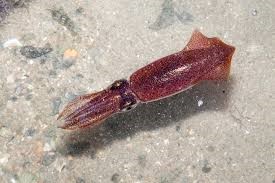
- Appearance - Indian squid has a distinctive coloration, with a light pinkish-gray body and 2 large fins on either side. They have 8 arms and 2 longer tentacles that they use to capture prey.
- Behavior - Generally, squids are extensively known for their rapid growth rate, limited lifespan, and complex population structures
- They are fast swimmers and are capable of propelling themselves through the water using a jet propulsion system.
- This allows them to reach speeds of up to 40 km/h when escaping from predators or chasing prey.
- Squids tend to prefer areas with high levels of dissolved oxygen, as this is crucial for their respiration.
- Distribution - It is distributed in the Indo-Pacific region, occurring in depths between 30 and 170 meters.
- Along the coast of India, squids are commonly found in the waters off the coasts of Tamil Nadu, Kerala, and Goa.
- Diet - This species is an active carnivore that feeds mainly on crustaceans and small fishes and often exhibits cannibalistic behavior.
- Conservation Status
- Uses - Food resource, utilized as fertilizer supplemental food source for highend and expensive cultured animals.
- Other Species - Bigfin reef squid – IUCN Status - “Data Deficient”.
References
- The Hindu | Indian squid
- National Library of Medicine | Uroteuthis duvaucelii



