Prelims: Current events of national and international importance | Environment
Why in News?
Recently, Grey Hornbill has recorded four consecutive years of successful breeding following its reintroduction in the Gir landscape.
- Indian Grey Hornbill reintroduction programme – The initiative was undertaken by the Gujarat Forest Department and its conservation partners.
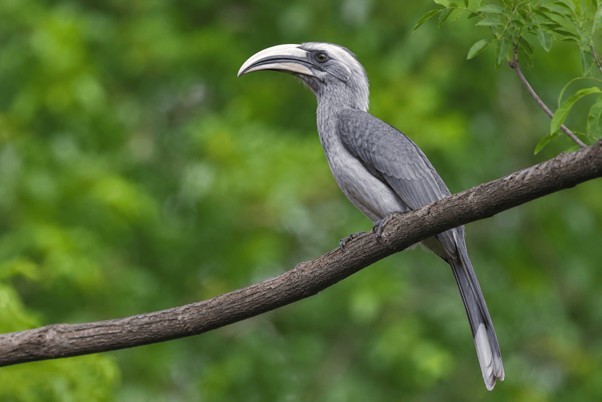
- Reintroduced in – 2021
- Source Population – The birds were translocated from healthy hornbill populations in Gujarat’s Aravalli forests after extensive habitat assessments confirmed that Gir shall provide suitable ecological conditions.
- Phased Release – A total of 40 hornbills was introduced to Gir in two distinct waves
- Phase I (2021–2022) – 28 birds released.
- Phase II (2023) – 12 birds released.
- The birds have adapted to the environment, secured territorial boundaries, and bred successfully every single year since their initial release.
- Telemetry Tracking – 11 males were outfitted with satellite transmitters to monitor long-term daily ranging, territorial habits, and behavioural shifts.
- Forest Preference – The birds showed preference for Gir’s native dry mixed deciduous and teak forests.
- Birds dispersing outside the protected area frequently used orchards, water bodies, and areas close to human settlements.
- Nest Selection – Hornbills selected mature trees with large trunk girths for nesting, particularly Sterculia urens and Terminalia bellirica.
- Dietary Base – Fruits of banyan, peepal, karamda, and dhraman, supplemented by insects and other invertebrates.
- Ecological role – A long-distance seed disperser, helping regenerate forests by transporting seeds of fruit-bearing trees across large areas.
- Cause of Disappearance – Historical records suggest that hunting, rather than habitat degradation, was the primary reason for its disappearance.
- Conservation Status
- IUCN Red List – Least Concern (LC).
- Wild Life (Protection) Act, 1972 – Schedule II.
Gir National Park and Sanctuary – Located in Gujarat, it is the sole global refuge of the wild Asiatic Lion (Panthera leo persica).
Reference
The Hindu | Indian Grey Hornbill



