Why in News?
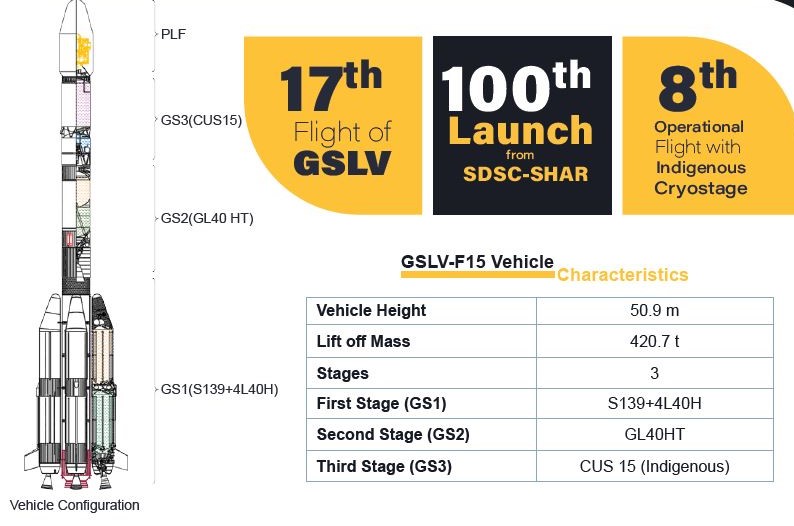
GSLV-F15 NVS-02 mission is the 100th launch from the Satish Dhawan Space Centre in Sriharikota, scheduled for January 29.
- GSLV-F15 NVS-02 – Geosynchronous Satellite Launch Vehicle (GSLV)- F15/ Navigation with Indian Constellation-2 Satellite (NVS-2).
- GSLV-F15 – 17th flight of India’s Geosynchronous Satellite Launch Vehicle (GSLV).
- 11th flight with – Indigenous Cryo stage.
- 8th operational flight with – Indigenous Cryogenic stage.
- Payload – Its fairing is a metallic version with a diameter of 3.4 meters.
- It will place NVS-02 satellite into a Geosynchronous Transfer Orbit (GTO).
- NVS-02 satellite – It is the 2nd satellite in the NVS series.
- Navigation with Indian Constellation (NavIC) – NVS-02 satellite is part of NavIC.
- It is India’s independent regional navigation satellite system designed to provide accurate Position, Velocity and Timing (PVT) service to users in India.
- It extends to region of about 1500 km beyond Indian land mass.
- U.R. Satellite Centre (URSC) – NVS-02 was designed, developed and integrated at the U.R. Satellite Centre (URSC) with the support of other satellite-based work centres.
- Navigation Payloads – It operates in L1, L5, and S bands and employs Tri-band antenna.
- Rubidium Atomic Frequency Standard (RAFS) – Is the main component of the navigation payload.
- RAFS is an atomic clock which acts as a stable frequency reference for the navigation payload.
- Ranging Payloads – It consists of C-band (CxC) transponder used for 2-way Code Division Multiple Access (CDMA) ranging to facilitate precise orbit determination.

- Lift off mass – 2,250 kg.
- Power handling capability – Approximately 3 kW.
- Usage – A combination of indigenous and procured atomic clocks for precise time estimation.
References
- The Hindu| 100th Launch from Satish Dhawan Space Centre
- ISRO| GSLV-F15 NVS-02 Mission



