Prelims: Current events of national and international importance | Ecology & Environment | Conservation
Why in news?
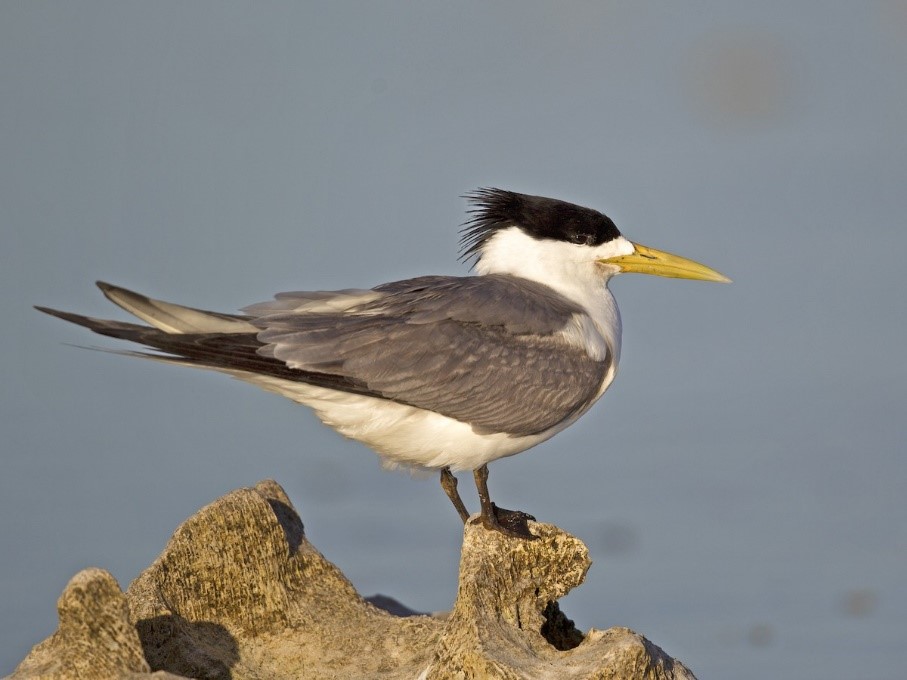
Recently, a Great Crested Tern, which is seen along coasts and estuaries, was spotted at Singanallur tank in Coimbatore, Tamil Nadu.
- Great Crested Tern are small to medium-sized seabirds closely related to the gulls, skimmers and skuas.
- Scientific name – Thalasseus bergii.
- Family – Sternidae.
- It is also known as the Swift Tern, or Crested Tern.
- Distribution – It occurs in tropical and warm temperate coastal parts of the Old World from the Atlantic Coast of South Africa, around the Indian Ocean to the Pacific and Australia.
- Habitat – It primarily inhabits coastal environments, including estuaries and offshore islands.
- It can also be found in lagoons, harbors, and occasionally further out to sea.
- Size – A large tern, about 46–49 cm in length with a wingspan of 125–130 cm.
- Plumage – It has dusky-grey upperparts, white underparts, and a deeply forked tail; forehead is white, which helps distinguish it from other terns.
- Crest – It sports a shaggy, glossy black crest on its head, which becomes more speckled with white during the non-breeding season.
- Bill & legs – The bill is a long, chrome-yellow color, while its legs and feet are black.
- Diet – Its primary diet consists of small, schooling pelagic fishlike anchovies and sardines, but it also consumes crustaceans, cephalopods, and insects.
- Movement – While many populations are non-migratory, birds often disperse widely from their breeding grounds after nesting.
- Breeding site – The nest is a shallow scrape in the sand, rock, or coral.
- In some areas, it has adapted to nesting on human-made structures like roofs and artificial islands.
- Threats – Egg harvesting, human disturbance at nesting sites, and impacts from commercial fisheries.
- Conservation Status –
References
- The Hindu | Great Crested Tern
- Birdlife | Great Crested Tern
- National parks in Thailand | Great Crested Tern



