Prelims: Current events of national and international importance | Environment
Why in News?
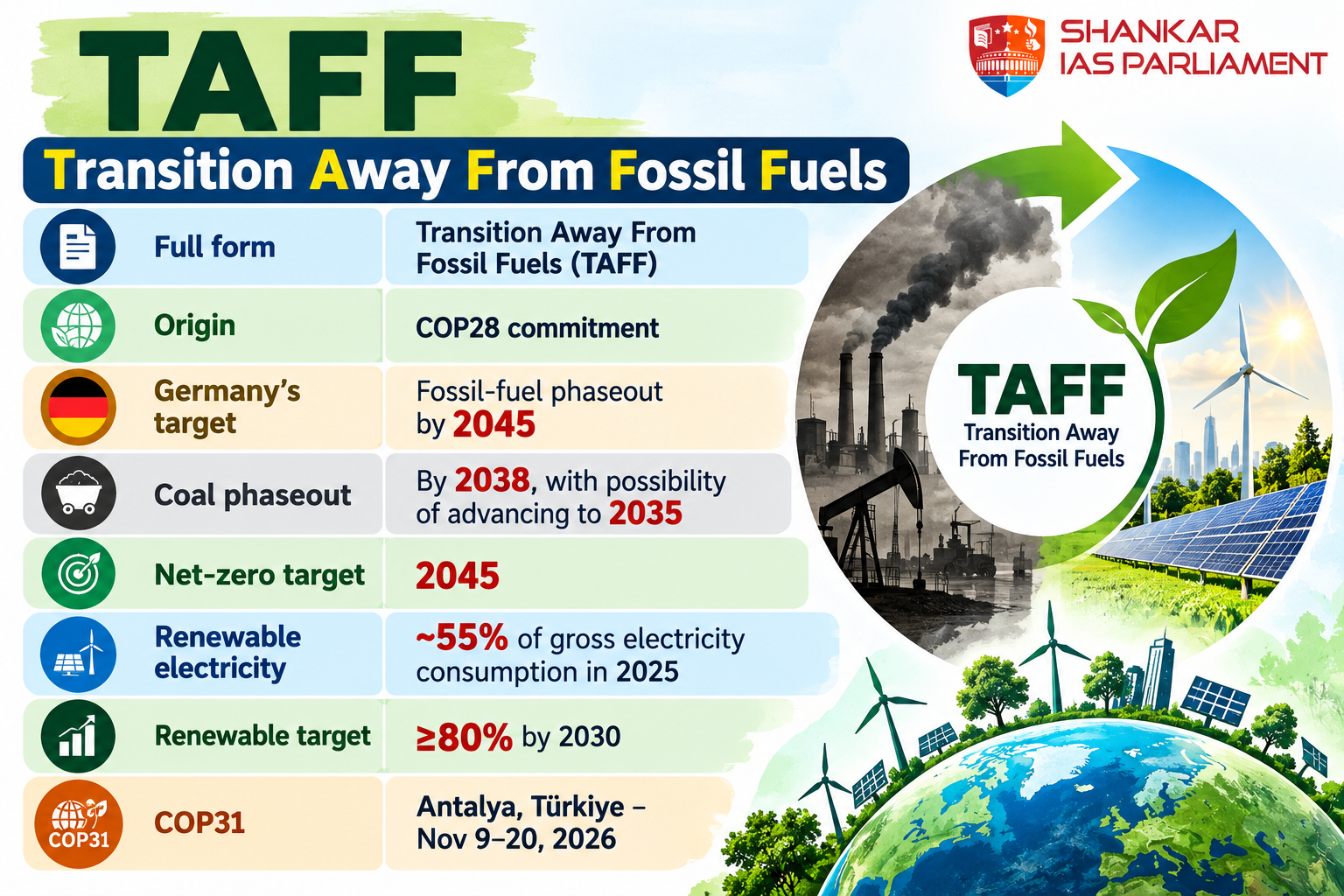
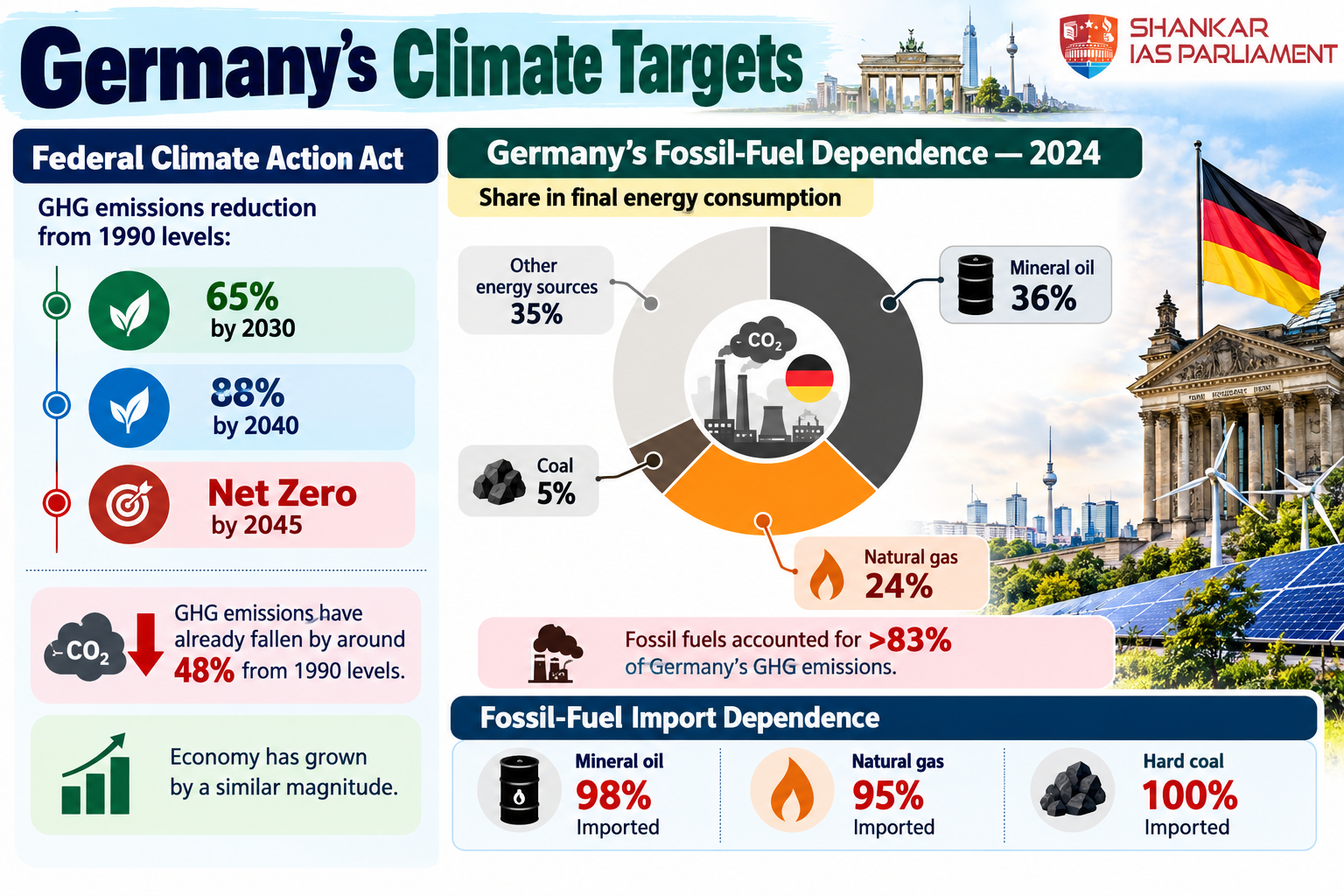
Recently, Germany has released a roadmap to transition away from fossil fuels by 2045.
Germany’s TAFF Roadmap
- Presented by – Federal Environment Minister Carsten Schneider at the UN General Assembly, New York – September 23, 2026.
Germany is the 3rd country after France and the Netherlands to publish such a plan following the COP28 commitment on Transition Away From Fossil Fuels (TAFF).
2026 Climate Action Programme
- The programme comprises 67 measures and is projected to reduce emissions by more than 27 million tonnes by 2030.
- Key measures include the following:
- Expansion of wind energy capacity by 12 gigawatts
- Promotion of electric vehicle adoption
- Support for the deployment of electric heating systems
- Increased utilization of the following technologies:
- Energy storage technologies
- Hydrogen-based energy solutions
- Electrification of energy systems
Global South & Just Energy Transition
Germany supports Just Energy Transition Partnerships (JETPs) with the following countries:
-
- South Africa
- Indonesia
- Vietnam
- Senegal
- The total value of German pledges amounts to €5.4 billion.
Germany also maintains bilateral energy partnerships with 33 countries, including collaboration with India on a Green Hydrogen Roadmap.
- Climate Finance Commitments – In 2024, Germany provided €11.8 billion in international climate finance.
- Of this amount, €3.9 billion was allocated specifically for energy transition initiatives.
- Export Finance and Climate Policy – Germany has proposed policy changes that may reduce the number of projects subject to detailed climate assessments by approximately 40%.
- Certain gas projects may remain eligible for export finance if they are associated with the following criteria:
- Hydrogen readiness
- Carbon Capture and Storage (CCS)
- Germany asserts that its export-credit policy:
- Aligned with the Paris Agreement 1.5°C target
- Aims to achieve a net-zero greenhouse gas (GHG) footprint for export-credit guarantees by 2050.
- The roadmap highlights Carbon Capture, Utilisation, and Storage (CCUS) and suggests implementing Carbon Contracts for Difference (CCfD) to support industrial decarbonisation.
|
Carbon Capture, Utilization, and Storage (CCUS)
|
- CCUS – It captures carbon dioxide (CO₂) emissions from power plants and industrial sources before they enter the atmosphere, then either reuses or permanently stores them.
- Mechanism
- Capture – Separates CO₂ from industrial flue gases using post-combustion absorption, pre-combustion separation, or oxy-fuel combustion.
- Transport – Moves captured CO₂ by pipeline, ship, or truck to a designated site.
- Utilization or Storage – Reuses CO₂ to produce commercial products such as urea, building materials, and chemicals (CCU), or injects it deep underground into saline aquifers and depleted oil fields for permanent storage (CCS).
|
|
Carbon Contracts for Difference (CCfDs)
|
- CCfDs – These are long-term public-private agreements that reduce risk and accelerate investment in industrial decarbonisation.
- They provide a price guarantee, usually between a government and a private company, to help costly low-carbon technologies such as green hydrogen or carbon capture compete financially with fossil-fuel processes.
|
Reference
Down to Earth | Germany’s TAFF Roadmap



