0.1434
7667766266
x

Discovery of Extinct Long-Snouted Crocodilian

iasparliament Logo
October 10, 2026

Prelims: Current events of national and international importance | Environment

Why in News?

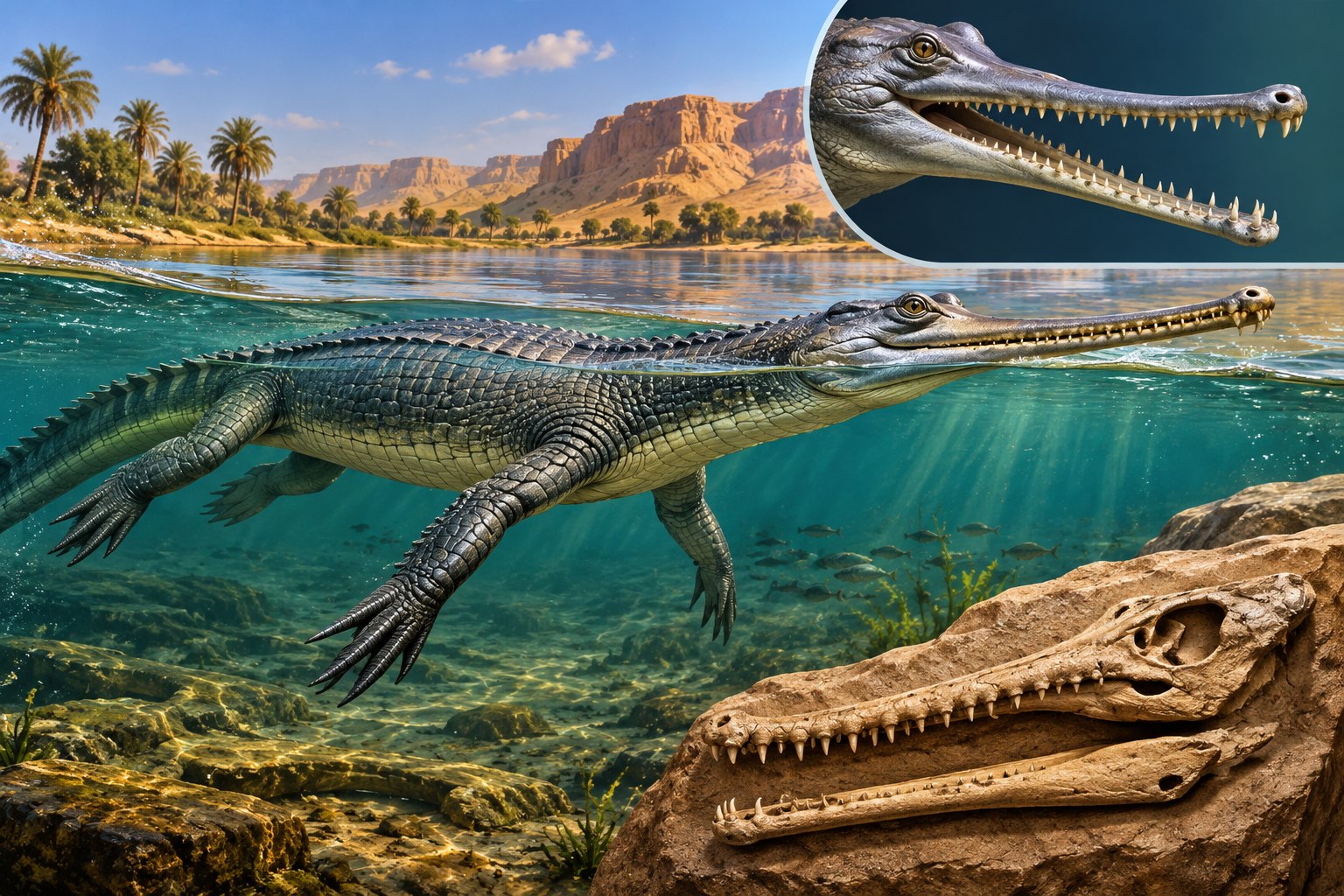
Recently, researchers identified a new species of extinct crocodilian, Herugavialis cairensis, which closely resembles the critically endangered gharial (Gavialis gangeticus) found today in Northern India.

  • The fossil skull was originally recovered in the 1920s from northern Egypt's Mokattam Formation, the same limestone formation used to build the Great Sphinx of Giza.

Key Attributes

  • Morphological Features - Possessed an elongated, narrow snout characteristic of gavialoids, specialised for piscivory (fish hunting) in ancient aquatic ecosystems.
  • Modern high-resolution CT scanning revealed distinct internal cranial structures that differentiated it from Tomistoma (false gharials), establishing a new genus.
  • Etymology & Cultural Echo - Named after Heru (Horus), the ancient Egyptian deity associated with the Great Sphinx.
  • Coincidentally, like the Great Sphinx (which famously lacks its nose), the discovered skull fossil is notably missing the tip of its snout.
  • Habitat & Paleoecology - During the Middle Eocene (~45 million years ago), northern Egypt was covered by shallow warm seas and tropical estuaries.
  • Unlike living freshwater gharials, Herugavialis was a shallow-marine gavialoid that swam in ancient coastal waters alongside at least two other extinct gharial species.

Herugavialis cairensis

Comparative Analysis

Parameter

Indian Gharial (Gavialis gangeticus)

Herugavialis cairensis (Extinct)

Era & Status

Extant; Critically Endangered (IUCN).

Extinct; lived during the Middle Eocene Epoch (~45 Mya).

Habitat Preference

Strictly freshwater riverine systems (Chambal, Girwa, Ramganga).

Shallow marine, coastal lagoonal, and estuarine waters of the Tethyan Mediterranean.

Distribution

Restricted to northern Indian subcontinent rivers.

Ancient Tethys Sea margins (present-day Egypt / North Africa).

Significance

  • It demonstrates that long-snouted gharials were once globally widespread, ecologically diverse, and highly adapted to marine environments before shrinking into isolated freshwater river systems in Asia.
  • Shows how Mediterranean crocodilian diversity fluctuated in tandem with major global temperature drops and sea-level shifts during the Cenozoic Era, culminating in their total disappearance from the Mediterranean region around 6 million years ago.

Reference

Down to Earth | New species of extinct crocodilian

There are no reviews yet. Be the first one to review.

ARCHIVES

sidetext