Prelims: Current events of national and international importance | Science & Technology
Why in News?
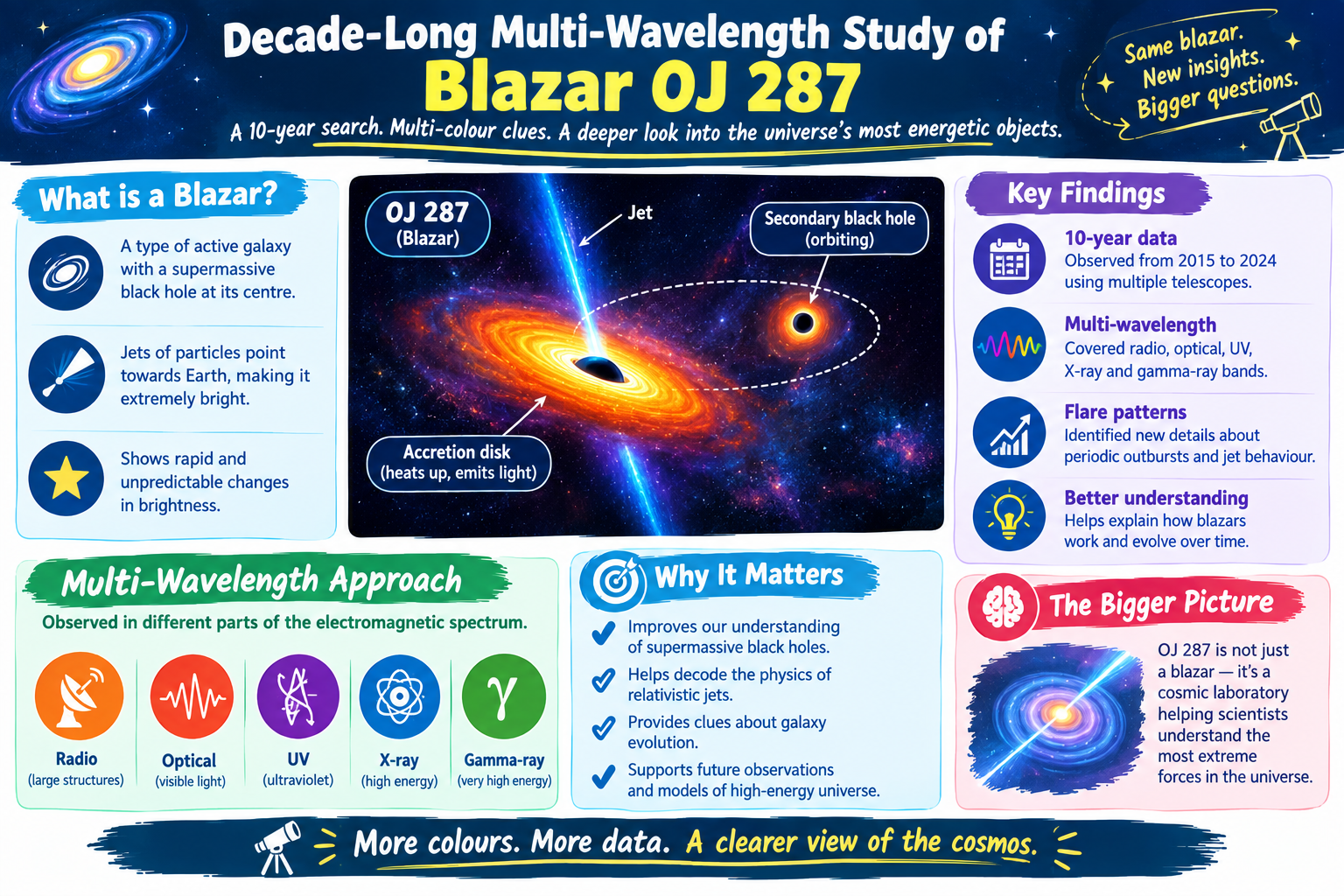
Recently, the Department of Science & Technology (DST) announced key findings from a comprehensive decade-long observational study of the famous blazar OJ 287.
Key Observations
- The study tracked the multi-wavelength brightness, color variations, and spectrum of OJ 287.
- Led by - Scientists from the Aryabhatta Research Institute of Observational Sciences (ARIES) in Nainital (in collaboration with the University of Turku, Finland, and international observatories).
- The research provides crucial confirmation regarding the dynamics of its rare supermassive binary black hole (SMBH) system and refines mass constraints on the primary black hole.
- System Architecture - Located roughly 4 billion light-years away in the constellation Cancer, OJ 287 is an active galactic nucleus (AGN) belonging to the BL Lacertae (BL Lac) blazar class.
- It harbors a secondary supermassive black hole in a tight, precessing 12-year orbit around a primary black hole.
- Mass Refinement of Central Black Hole - By analyzing 8 optical spectra recorded during low-brightness states in 2017 using the Steward Observatory (USA), researchers evaluated the spectral broadening of the O III emission line.
- This spectral analysis established that the central primary black hole's mass is at least 3.89 billion solar masses (3.89×10⁹M⊙).
- Decade-Long Multi-Wavelength Flickering – It recorded complex optical and X-ray variability.
- Helping untangle the complex interplay between thermal accretion disc emission, non-thermal jet radiation, and periodic impact flares produced when the smaller companion pierces the primary's accretion disc twice per orbit.
Significance
- Testing General Relativity in Extreme Gravity Regimes
- OJ 287 acts as a cosmic laboratory to test Einstein's theory of general relativity in strong gravitational fields.
- The companion's orbital precession rate is extreme (~39° per orbit) due to energy loss from gravitational wave radiation, providing direct observational validation of general relativistic orbital mechanics.
- Multi-Messenger Astronomy Target
- Supermassive binary black hole systems like OJ 287 are primary candidate sources for low-frequency gravitational waves detectable by Pulsar Timing Arrays (PTAs) and future space-based detectors like LISA.
- Linking electromagnetic variations (light, X-rays) with gravitational wave predictions bridges key gaps in multi-messenger astrophysics.
- Understanding Relativistic Jet Formation
- Insights into how dual black hole dynamics affect jet precession, particle acceleration, and energy output help explain how relativistic jets in active galaxies are powered and sustained.
Reference
DST | Giant binary black hole system



