Prelims: Current events of national and international importance | Environment
Why in News?
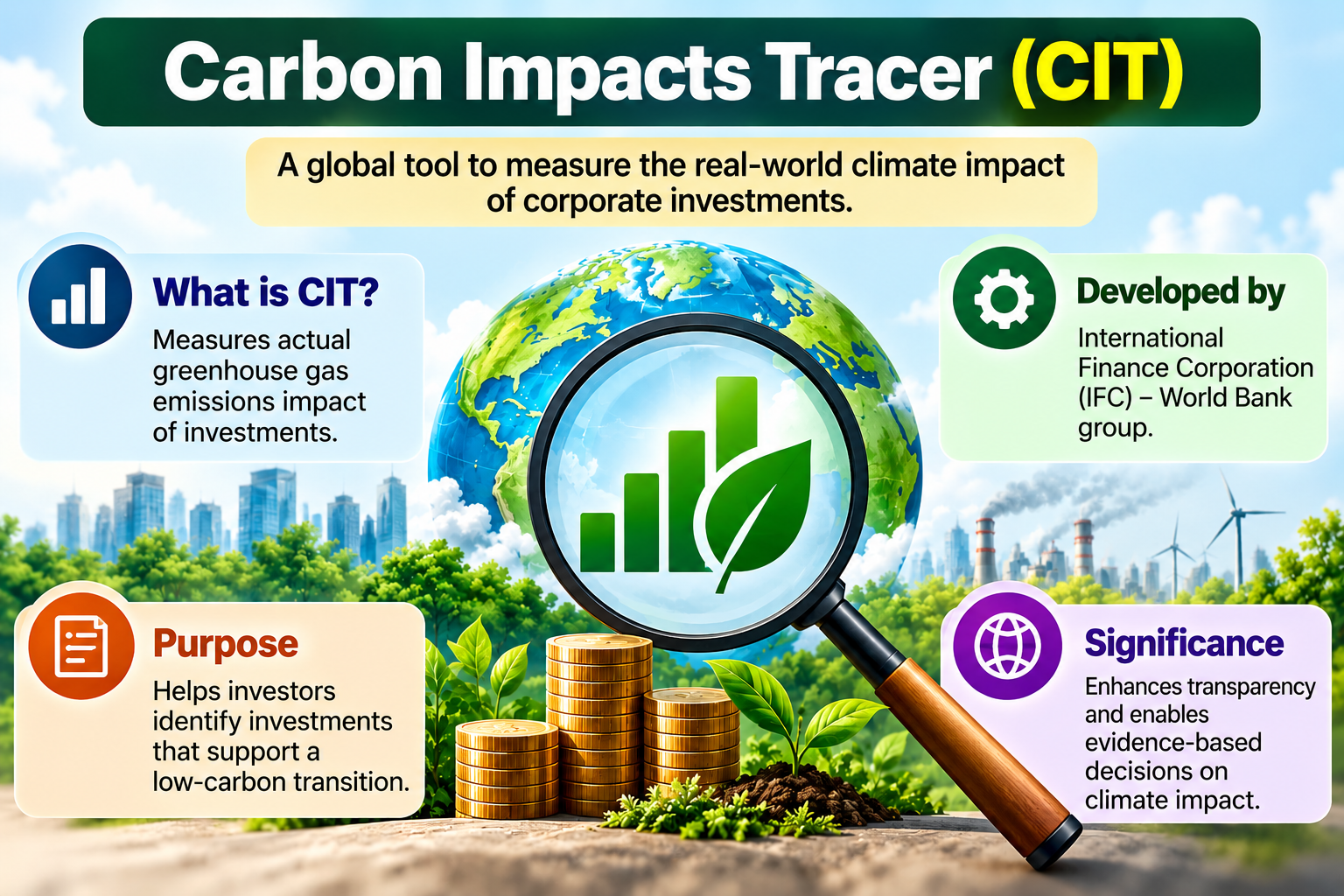
Recently, climate scientists and environmental researchers introduced a pioneering open-source spatial modelling framework known as the Carbon Impacts Tracer (CIT).
Key Capabilities
- Aim - The CIT isolates an individual mine's spatial footprint to forecast site-specific environmental and public health externalities over its projected operational lifespan.
- Developed by – International Finance Corporation – World Group.
- Integrated Multi-Pollutant Modelling
- Global Climate Impact- Quantifies cumulative direct (CO2) and fugitive methane (CH4) emissions generated during extraction and subsequent coal combustion.
- Localized Health Externalities - Models atmospheric dispersion of fine particulate matter (PM5), sulfur dioxide (SO2), and nitrogen oxides (NOx) down to a 1 km grid to estimate premature mortality, respiratory hospitalizations, and lost workdays in surrounding communities.
- Biodiversity Valuation- Integrates satellite land-use data to measure forest canopy loss, groundwater table depletion, and habitat fragmentation caused by surface mining and overburden dumps.
Significance
- Transforming Environmental Impact Assessments (EIAs)
- Traditionally, project EIAs evaluate localized air/water pollution in isolation from long-term systemic climate impacts.
- CIT bridges this gap by combining hyper-local public health risks with global carbon accounting, providing a scientifically rigorous basis for regulatory bodies to review Environmental Clearances.
- Empowering Climate Litigation
- Provides verifiable, site-specific evidentiary data for judicial review in national green tribunals and environmental courts.
- Enhances accountability by assigning measurable, financialized social costs to individual fossil fuel extraction assets.
- Informing Just Transition Frameworks
- Helps policymakers identify high-risk mining projects where localized human health costs and ecological damage far outweigh short-term economic benefits, facilitating prioritized phase-outs.
Reference
The Hindu | Carbon Impacts Tracer



