Prelims: Current events of national and international importance | Environment
Why in News?
Recently, CCU Technologies has been in focus amid India’s efforts to scale up low-carbon technologies to reduce emissions from hard-to-abate sectors.
- CCU Technologies – Technologies that capture CO₂ emissions from industrial sources or directly from the air and convert them into useful products, unlike in CCS.
Carbon Capture and Storage (CCS) is where CO₂ is Captured permanently stored underground rather than reused.
- Aim – To utilise the captured CO₂ in the economy as inputs for fuels, chemicals, building materials, or polymers.
- Framework – CCU follows the 3 Rs of the Circular Carbon Economy (CCE)
- Remove – First step aims to remove the amount of carbon entering the atmosphere through innovative ‘point-of-source’ carbon capture technologies.
- Reuse – Using captured CO₂ directly without chemically altering the carbon molecules.
- Example – CO₂ for industrial processes like the carbonation of drinks.
- Recycle – Captured CO₂ is converted into value-added products or alternative energy sources through chemical processes.
- Example – Production of synthetic fuels, chemicals and materials from CO2.
- For instance, CO2 combined with hydrogen creates synthetic hydrocarbons for use in transportation or feedstock for the chemical industry.
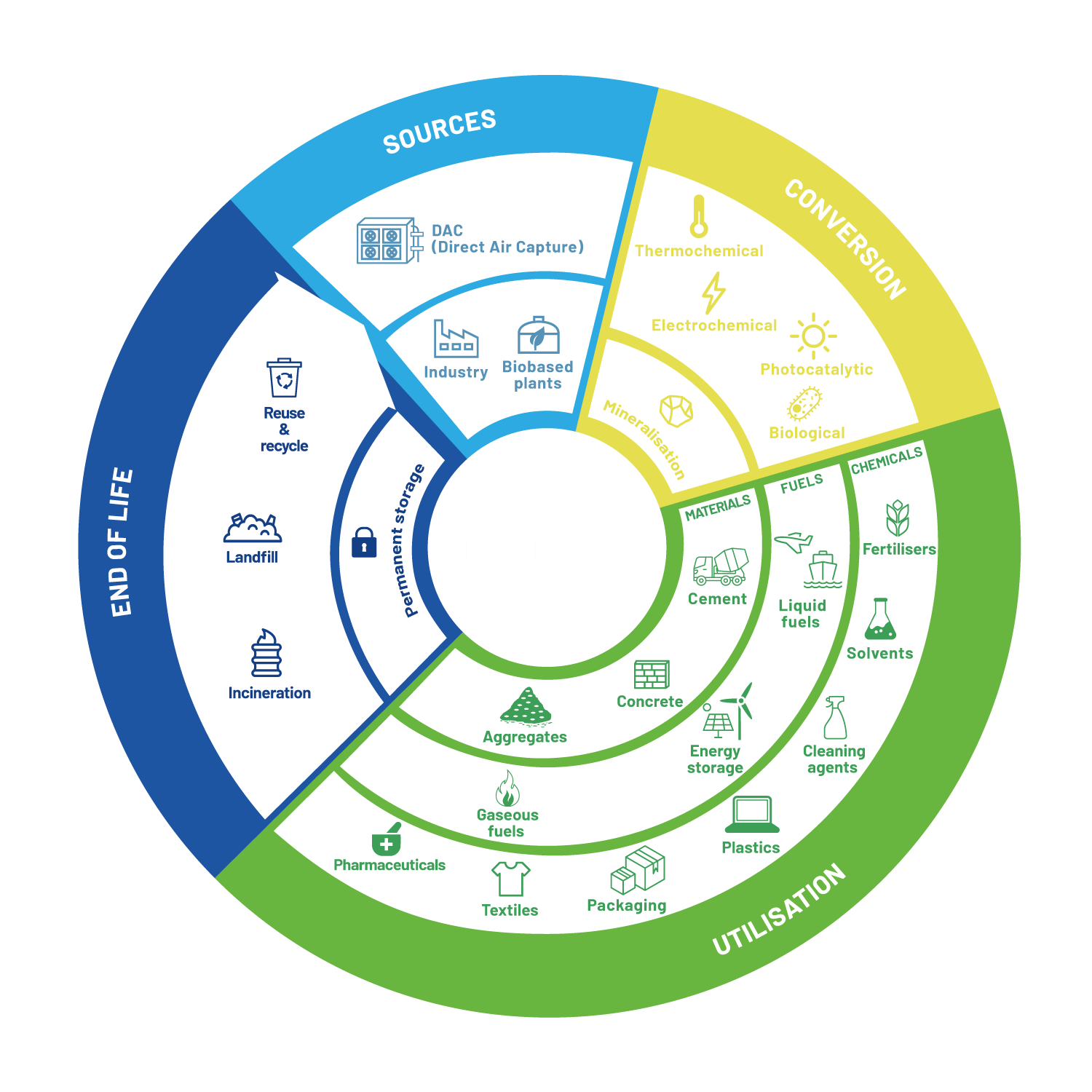
- India’s Need for CCU – Source of CO₂ – Mainly from Iron, steel, cement, fertilisers, and refineries. They are highly carbon-intensive and hard to decarbonize or hard-to-abate Sectors.
- CCU offers a sustainable solution to this issue while simultaneously creating new industrial value chains.
- Net-Zero – Aligns with India’s net-zero targets for 2070 and pushes to build a circular, low-carbon economy.
India has consistently ranked as the world’s third-largest emitter of CO₂.
- India's CCU Status – Research Funding – Supporting CCU through research funding from the Department of Science and Technology.
- Union Budget 2026 – Provides a total outlay of Rs. 20,000 crore (over 5 years) for Carbon Capture, Utilisation, and Storage (CCUS).
- Initial Allocation – Rs. 500 crores to the Ministry of Power for R&D.
- Policy Roadmap – The Ministry of Petroleum and Natural Gas has presented the draft 2030 roadmap for CCUS.
- Private Initiatives – The Adani Group is developing an Indo-Swedish CCU pilot project in collaboration with IIT Bombay to transform captured CO₂ into fuels and materials.
- Industrial Testbed – JK Cement is working on a CCU for uses like lightweight concrete blocks and olefins.
- Bio-CCU Platform – Organic Recycling Systems Limited (ORSL) is leading India’s first pilot Bio-CCU platform, converting CO₂ from biogas into bio-alcohols and chemicals.
- Global Practices – EU – EU Bioeconomy Strategy and Circular Economy Action Plan support CCU to transform CO₂ into feedstocks, promoting circularity and sustainability.
- U.S.A – The U.S. employs a mix of tax credits and funding to expand CCUs, especially for fuels and chemicals derived from CO₂.
- UAE – The UAE’s Al Reyadah project and planned CO₂-to-chemicals hubs use CCU with green hydrogen.
References
- TH | Carbon Capture and Utilisation Technologies
- WEF | CCU