Why in News?
Recently, an article suggested that black kites have nesting habitats at a tower structure in Chennai.
- Black Kite – It is a bird of prey and a migratory bird extends to an extremely large range of habitats.
- Scientific Name – Milvus migrans.
- It is often called Fork-Tailed Kites.
- Habitat – Close access to water bodies such as rivers, ponds, lakes, and wetlands, woodlands, grassland and open savannas.
- Distribution – Tropical portions of Australasia, Eurasia, and Africa.
- Morphology – Medium-sized raptors, dorsal, ventral and tail color is brown with darker brown striped feathers within.
- It has small, bead-like dark brown eyes and a large black, hook-shaped beak, long black talons and pale-yellow legs.
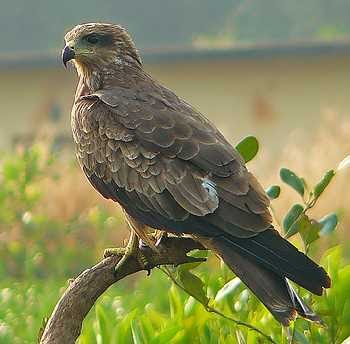
- Sexual dimorphism
- Female – It has a slightly larger body size than males, though they feature similar coloration.
- Characteristic – It typically lives in social groups.
- It migrates from Europe and northern Asia wintering in sub-Saharan Africa and southern Asia.
- It has well developed intraspecific communication and very loud vocalizing.
- Diet – An extremely versatile feeder, it takes carrion, birds, mammals, fish, lizards, amphibians, invertebrates and forage on vegetable matter such as palm oil fruits.
- Threats – Poisoning
- Shooting
- Electrocution by power lines
- Pollution of water by pesticides and other chemicals
- Vulnerable to the effects of wind energy development.
- Conservation Status
- IUCN – Least Concern.
- CITES – Appendix II.
- Wild Life Protection Act, 1972 – Schedule-II.
References
- The Hindu| Nesting activity by Black kites
- ABW| Black kite’s Habitat & Distribution
- Birdlife| Black kite’s Diet, Threats & Conservation



