0.1095
7667766266
x

Black Hole Spin and Quasi-Periodic Oscillations (QPOs)

iasparliament Logo
October 25, 2026

Prelims: Current events of national and international importance | Space

Why in News?

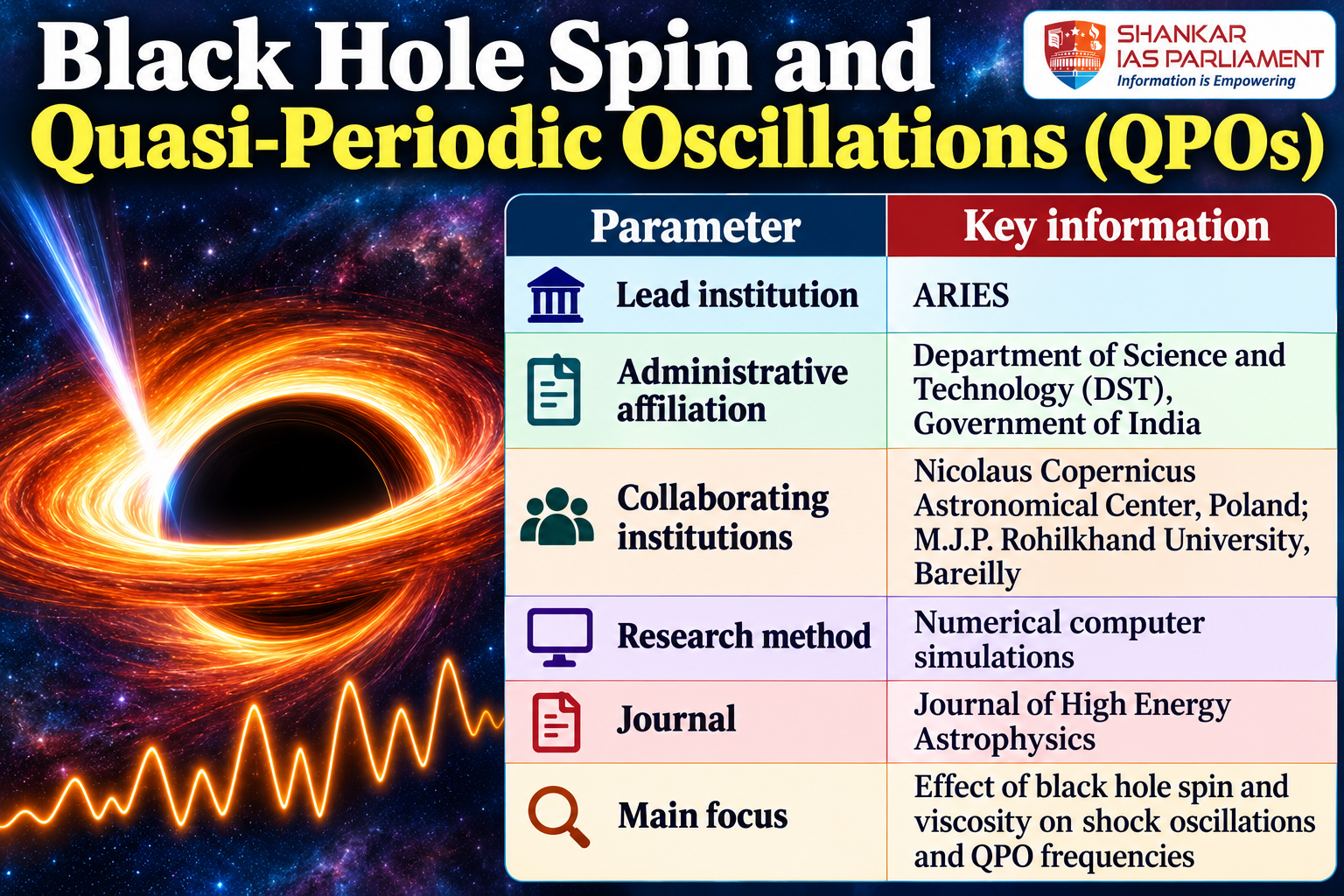
Scientists at ARIES have discovered the physical mechanism showing how a black hole's spin influences variations in X-ray emissions from matter orbiting around it.

ARIES – Aryabhatta Research Institute of Observational Sciences.

black-hole-spin-and-qpos-infographic.png

Methodology

  • A numerical simulation developed by the Numerical and Theoretical Astrophysics Group at ARIES was employed.
  • The simulation modelled viscous accretion flows surrounding rotating black holes.
  • The model accounted for the conservation of key physical quantities, such as mass, energy, and momentum.
  • Thermodynamic relations characteristic of a relativistic fluid was incorporated into the simulation.

Black Hole

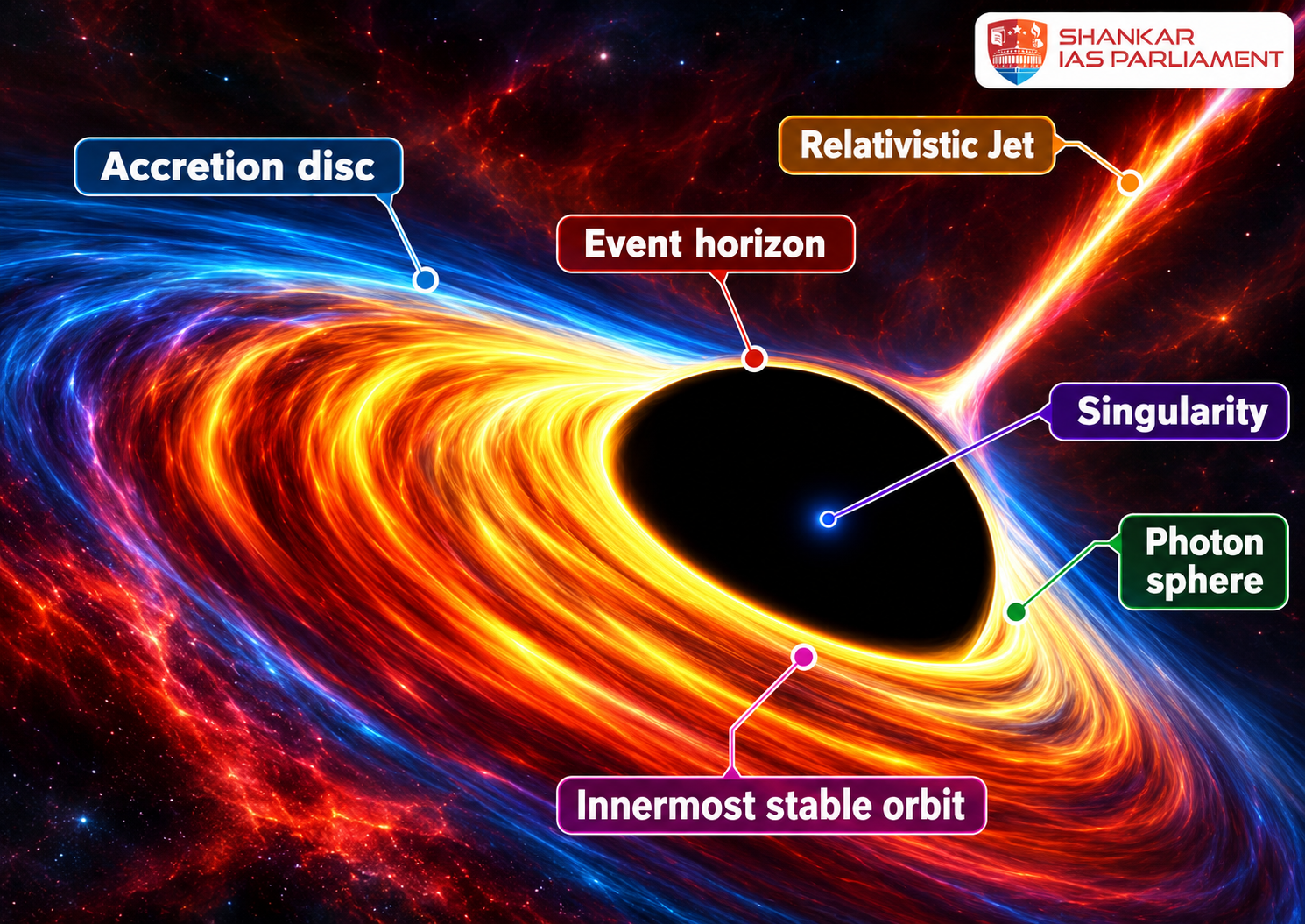
  • An extremely compact astronomical object with an intense gravitational field.
  • The gravitational field of a black hole is so strong that it prevents even light from escaping from within its event horizon.
  • A black hole can rotate or spin about its axis.
  • The spin of a black hole can influence the motion of nearby matter and affect the properties of radiation emitted by that matter.

Accretion Flow and Accretion Disc

  • Accretion flow – The movement of matter toward a compact object as a result of gravitational attraction.
  • Accretion disc – A disc-shaped structure that forms as infalling matter accumulates and orbits an astronomical object.
  • Viscosity, or internal friction within the flow, facilitates the redistribution of angular momentum and energy.
  • Matter within the accretion flow may emit high-energy radiation, such as X-rays.
annotated-black-hole-system-infographic.png

Quasi-Periodic Oscillations (QPOs)

  • QPOs are nearly regular, recurring variations in the brightness of radiation emitted by astronomical systems.
  • In black hole X-ray binaries, QPOs manifest as variations in X-ray intensity.
  • The frequencies of QPOs range from less than one cycle per second to several hundred cycles per second.
  • QPOs provide insights into the physical processes occurring in the vicinity of black holes.

Key findings

  • It provides new insights into black hole behaviour and accretion processes.
  • The study demonstrates that oscillations in the accretion flow can produce Quasi-Periodic Oscillations (QPOs) over a broad frequency range.
  • Influence of viscosity
    • If the viscosity of the accretion flow surpasses a critical threshold, a previously stable shock may become unstable.
    • As a result, the shock initiates oscillatory behavior.
    • These oscillations generate variations in the emitted radiation, which are observed as quasi-periodic oscillations (QPOs).
  • Effect of black hole spin
  • Slowly spinning black holes
    • The oscillating shock typically remains at a greater distance from the black hole.
    • The resulting quasi-periodic oscillations (QPOs) are predominantly low-frequency.
  • Rapidly spinning black holes
    • The oscillating shock moves closer to the black hole.
    • Oscillations exhibit increased amplitude.
    • Quasi-periodic oscillations (QPOs) can occur over a broader frequency range, including high frequencies.
  • Simulations indicate that for a black hole with approximately ten times the mass of the Sun, QPO frequencies can exceed 100 Hz at very high spin rates.
  • The study identified a correlation between QPO frequency and the photon index, which characterises the spectral distribution of emitted photons.

Significance

  • Unified QPO model – Explains low- and high-frequency QPOs through a single mechanism.
  • Improved black hole studies – Aids interpretation of X-ray variability and analysis of black hole properties.

Reference

PIB | Black Hole Spin and Quasi-Periodic Oscillations (QPOs)

There are no reviews yet. Be the first one to review.

ARCHIVES

sidetext