Prelims: Current events of National and International Importance| Environment
Why in News?
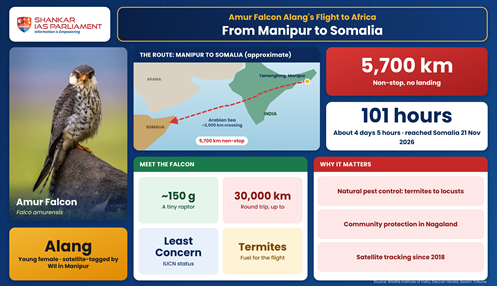
Alang, a satellite-tagged young female Amur Falcon, flew non-stop from Manipur to Somalia, about 5,700 km in 101 hours, reaching the Horn of Africa on November 21, 2026.
- A second tagged bird, the male Apapang, also completed the crossing.
About Amur Falcon
- Scientific name – Falco amurensis; a small raptor weighing about 150 g.
- Breeding grounds – South-eastern Siberia and northern China; winters in southern Africa.
- Migration – Among the longest of any raptor, with round trips of up to 30,000 km.
- India stopover – North-East India (Nagaland and Manipur) in October–November, where the birds feed on termites to build fat reserves.
- Conservation status – IUCN: Least Concern.
- Ecological role – Natural pest controllers: termites in India, locusts in Africa.
Alang’s Journey
- Tagging – Fitted with a satellite transmitter on November 11, 2025 at Chiuluan, Tamenglong (Manipur), under Phase 2 of the Wildlife Institute of India (WII) and Manipur Forest Department project.
- First cycle – Returned to Manipur on October 22, 2026, 11 days after leaving north-eastern China.
- Second cycle – After about 25 days feeding on termites, flew over central India and a 3,000 km Arabian Sea crossing to Somalia without landing.
- Third bird – Ahu, an adult female, has stayed in the Horn of Africa since November 2025.
- Research – A 2026 study in Ibis found that wind patterns shape the falcons’ routes and flight efficiency.
Conservation Significance
- Satellite tagging began in Tamenglong in 2018 and was repeated in 2020, 2022, 2024 and 2025.
- Tracking data help identify stopover sites and threats along the route.
- Community-led protection in Nagaland ended mass hunting of the falcons at their roosts.
Reference
Deccan Herald | Manipur to Somalia non-stop: Tagged Amur falcons cover over 5,700 km



