Prelims: Current events of national and international importance | Environment
Why in News?
Recently, the Africa Early Warnings Forum adopted the Addis Ababa Call to Action to accelerate disaster protection and achieve universal early‑warning coverage.
Africa Early Warnings Forum
- Held in – UN Conference Centre, Addis Ababa, Ethiopia from September 2–4, 2026.
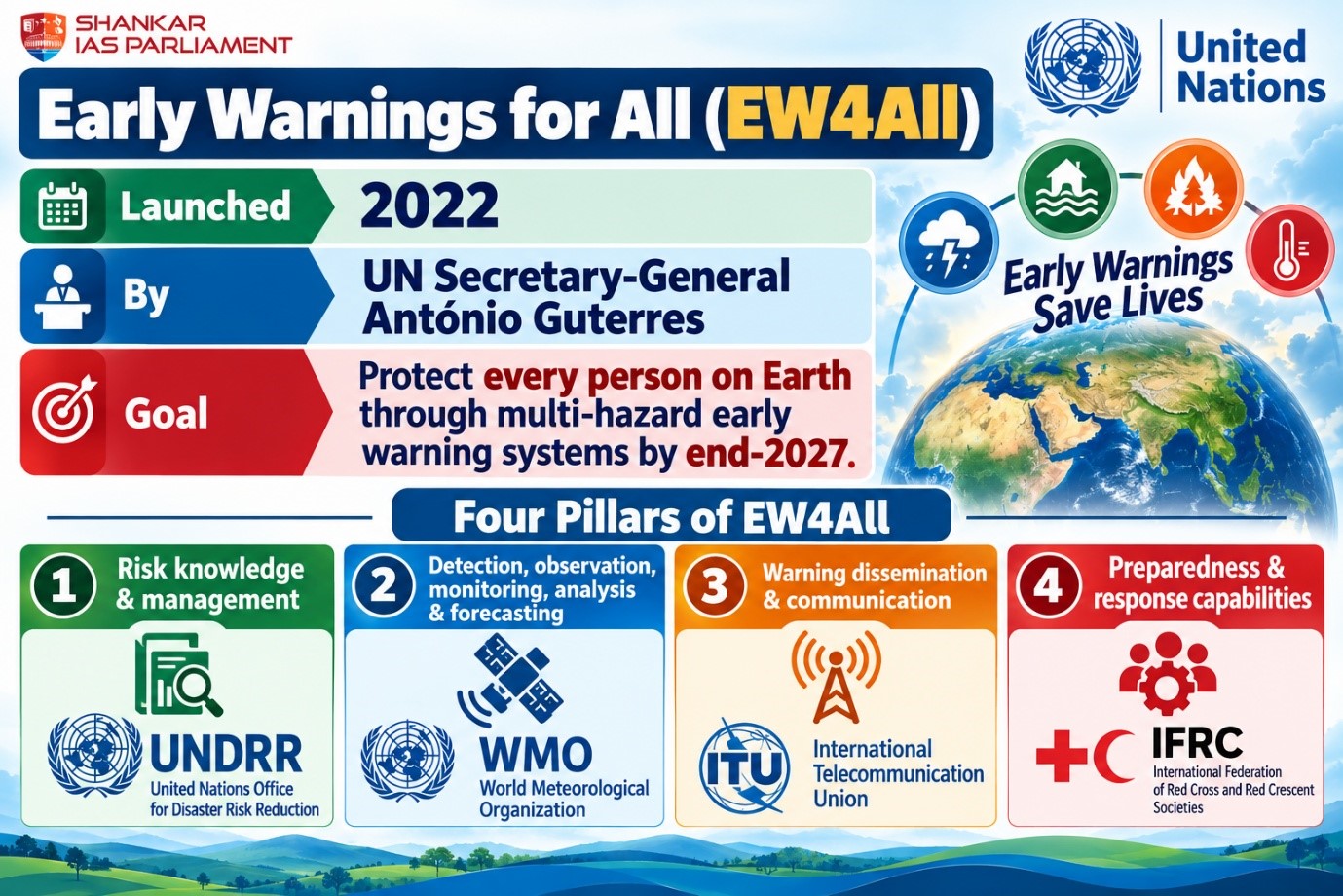
- Conveners – UNDRR, World Meteorological Organisation (WMO), International Telecommunication Union (ITU), International Federation of Red Cross and Red Crescent Societies (IFRC), and the African Union Commission (AUC)
- Attendance – Over 400 participants from 50+ countries.
- 2027 Target – Aligns with the global Early Warnings for All initiative to protect every person on Earth by the end of 2027.
- Addis Ababa Call to Action – 5 Priorities
- Carry forward Early Warnings for All
- Bridging the remaining gaps and reach the last mile, including in fragile countries
- Make multi-hazard early warning systems a core public investment
- Enable early action based on warnings
- Make universal protection a shared and measurable responsibility
- Key Progress in Africa
- The number of African countries implementing multi-hazard early warning systems has increased:
- In 2015, 14 countries had such systems in place.
- By 2026, this number is projected to reach 41 countries.
- The comprehensiveness of these early warning systems has more than doubled since 2022.
- In 2025, extreme weather and climate-related events affected at least 13 million people and resulted in more than 3,000 reported deaths across Africa.
|
Africa Multi-Hazard Early Warning and Early Action System (AMHEWAS)
|
- Led by – African Union Commission (AUC).
- Aim – To promote regional cooperation for multi-hazard early warning and early action.
|
References
UNDRR | Africa’s Early Warning
WMO | Addis Ababa Call to Action



