Neuralink
Elon Musk's brain chip firm, Neuralink wins US approval for human study.
- Neuralink Corporation is an American neuro-technology company that is developing implantable brain–computer interfaces.
- Neuralink hopes to use its microchips to treat conditions such as paralysis and blindness, and to help certain disabled people use computers and mobile technology.
- The chips, which have been tested in monkeys, are designed to interpret signals produced in the brain and relay information to devices via Bluetooth.
- The company plans to use its microchips to treat conditions such as paralysis.
- Its initial aim was to start planting chips in human brains in 2020, in order to honour a pledge made the year before and it later vowed to get started in 2022.
- Mr Musk also suggested that the proposed technology could help ease concerns about humans being displaced by AI.
- Experts have cautioned that Neuralink's brain implants will require extensive testing to overcome technical and ethical challenges if they are to become widely available.
A paralysed man from the Netherlands was able to walk simply by thinking about it, because of a system of implants which wirelessly transmit his thoughts to his legs and feet.
References
- Business Standard │What is Neuralink?
- BBC │Elon Musk's brain chip firm wins US approval for human study
Babool
Features
- Babool is also known as gum arabic (Acacia nilotica).
- This perennial tree, whose pods grow abundantly in the months of April and May.
- It can thrive on marginal land, which is unsuitable for agriculture, and can survive both droughts and floods.
- Babool seeds are highly nutritious and are also rich in minerals such as potassium, phosphorus, magnesium, iron and manganese.
- The tree works as a windbreak and haven for biodiversity where it is planted.
- As a nitrogen-fixing legume, it also helps in reclamation of areas degraded by mining or erosion.
- Negative – Excess consumption of babool seeds may affect milk yield in cows.
Health Benefits
- The babool tree is packed with medicinal properties.
- Babool pods have antibacterial activity.
- They are effective against gram-positive bacteria such as Bacillus cereus and Staphylococcus aureus.
Bacillus cereus is a food-borne pathogen that causes gastro-intestinal illnesses, and Staphylococcus aureus can infect soft tissue in the body.
- Extracts of the pods can be used to replace synthetic food preservatives that have negative impact on health.
- The pods and seeds are used as feed after grinding them up for easy digestion and better absorption of nutrition.
- People chew on its young leaves to improve digestion, and on the woody stems to keep teeth clean and gums healthy.
- Farmers also use the leaves and pods of babool as animal feed, and say that the feed prepared using babool seeds is comparable to cottonseed meal in terms of nutrition.
- The bark is used to treat burns, skin diseases and clean infected wounds and is a common ingredient in toothpastes.
- Its resin helps deal with skin diseases, oral inflammation and indigestion.
Status of India
- Though native to Africa, the Arabian Peninsula and the Indian subcontinent, babool is found in almost all tropical and subtropical areas of the world.
- India is home to at least three of nine subspecies of the tree, with natural babool forests found in Maharashtra, Gujarat, Andhra Pradesh, Rajasthan, Haryana and Karnataka.
- Historically in India, the bitter babool has been used as famine food in arid and semi-arid regions like Rajasthan.
- Even now, people in these regions consume its seeds both raw and roasted, or grind them and mix with sorghum or pearl millet flour.
- Some also use the young babool pods or phali, which look like a string of beads with flat, elliptical seeds separated by constrictions, as vegetable.
- As part of the natural vegetation of Madhya Pradesh and Uttar Pradesh, the tree has been extensively for the reclamation of the Chambal ravines.
Reference
- Down To Earth│ Babool
GSLV-F12 & NVS-01
The GSLV-F12/NVS-01 mission was launched from the second launch pad at the Satish Dhawan Space Centre SHAR, Sriharikota.
- The Indian Space Research Organisation (ISRO) successfully placed the NVS-01 navigation satellite, weighing about 2232 kg, into Geosynchronous Transfer Orbit (GTO).
- The GSLV-F12 is the 15th flight of India’s GSLV and the 9th flight with indigenous cryostage.
- This is the 6th operational flight of GSLV with indigenous cryogenic stage.
- The NVS-01 carried navigation payloads L1, L5 and S bands.
- The satellite would ensure the continuity of navigational (NavIC) services and also provide new service in L1 band.
- Interestingly, for the first time, an indigenous atomic clock was flown in NVS-01.
An atomic clock is an extremely accurate type of clock which is regulated by the vibrations of an atomic or molecular system such as caesium or ammonia.
L1, L5 and S bands
- The GPS L1 band (1575.42 MHz) has turned to be the most important band for navigation purposes.
- The two sorts of services given by the Indian Regional Navigational Satellite System (IRNSS) satellites are Standard Positioning Service (SPS) and Restricted Service (RS).
- Both services will be given at two frequencies of L5 (1164.5 MHz) and S (2472.5 MHz) band.
References
- The Hindu │ ISRO’s GSLV-F12
- Economic Times │ GSLV-F12 successfully places 2G navigation satellite
Deep ocean currents in Antarctica
Deep ocean currents in Antarctica are slowing earlier than predicted.
- Antarctica sets the stage for the world’s greatest waterfall, where the action takes place beneath the surface of the ocean.
- Trillions of tonnes of cold, dense, oxygen-rich water cascade off the continental shelf and sink to great depths.
- This Antarctic bottom water then spreads north along the sea floor in deep ocean currents, before slowly rising, thousands of kilometres away.
- In this way, Antarctica drives a global network of ocean currents called the overturning circulation that redistributes heat, carbon and nutrients around the globe.
- The overturning is crucial to keeping the earth’s climate stable and is the main way oxygen reaches the deep ocean.
Recent findings
- There are signs this circulation is slowing down and it’s happening decades earlier than predicted.
- This slowdown has the potential to disrupt the connection between the Antarctic coasts and the deep ocean.
- Melting of Antarctic ice is disrupting the formation of Antarctic bottom water.
- The meltwater makes Antarctic surface waters fresher, less dense, and therefore less likely to sink.
- This puts the brakes on the overturning circulation.
- As the flow of bottom water slows, the supply of oxygen to the deep ocean declines.
- The shrinking oxygen-rich bottom water layer is then replaced by warmer waters that are lower in oxygen, further reducing oxygen levels.
Implications
- Ocean animals, large and small, respond to even small changes in oxygen.
- Deep-ocean animals are adapted to low oxygen conditions but still have to breathe.
- Losses of oxygen may cause them to seek refuge in other regions or adapt their behaviour.
- The overturning circulation carries carbon dioxide and heat to the deep ocean, where it is stored and hidden from the atmosphere.
- As the ocean storage capacity is reduced, more carbon dioxide and heat are left in the atmosphere.
- This feedback accelerates global warming.
- Reductions in the amount of Antarctic bottom water reaching the ocean floor also increases sea levels because the warmer water that replaces it takes up more space (thermal expansion).

References
- The Hindu │ Deep ocean currents in Antarctica
- The Guardian │Slowing ocean current by melting Antarctic ice
Foucault’s Pendulum
The pendulum hangs from a skylight at the top of the Constitution Hall at the new Parliament building.
- The original Foucault’s pendulum, named after 19th century French scientist Leon Foucault, is an experiment to demonstrate the earth’s rotation.
- When Foucault carried out this experiment for the public in 1851, it was the first direct visual evidence of the fact that the earth rotates on its axis.
- The experimental set-up involves a heavy object hung from a height with a string, free to swing in any direction.
- Once set in to-and-fro motion, the pendulum is seen to change its orientation slowly over time.
- For example, if the initial motion imparted to it was in the north-south direction, after a few hours it could be seen moving in the east-west direction.
- Actually, it is not the pendulum that changes its plane of motion, but the ground beneath it.
- Observers standing on the ground do not notice the earth’s rotation, because they too are rotating with the earth, but can notice the change in orientation of the pendulum.
Working
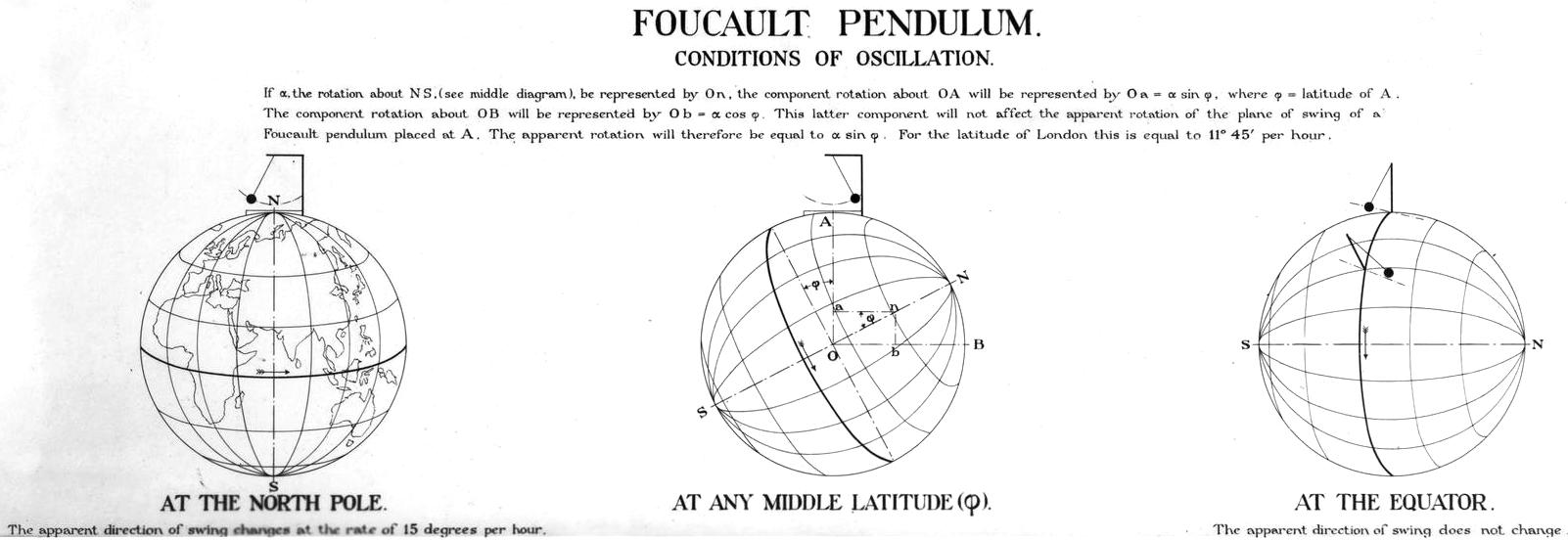
- At the north and south poles, when the pendulum is aligned with the axis of rotation of the earth, the pendulum’s back-and-forth motion comes back to its original plane in exactly 24 hours.
- That is, if it starts swinging in the north-south direction, it then slowly turns in the northeast-southwest direction, then in the east-west direction.
- It keeps on changing its orientation, till it is back in its original orientation after 24 hours.
- At other latitudes, it takes longer for the pendulum to return to its original orientation of swinging.
- That is because the pendulum is not aligned with the axis of rotation of the earth.
- At the equator, the pendulum is perpendicular to the axis of rotation, and hence it never changes its orientation of the swing.
- Meaning, a Foucault’s pendulum at the equator would not show any deviation from its original course.
- At other latitudes it will, and would return to the original course after fixed time periods.
India
- The pendulum signifies the integration of the idea of India with the idea of the cosmos.
- Created by the National Council of Science Museum (NCSM) in Kolkata, the pendulum is being dubbed as the largest such piece in India, 22 metre in height, and weighing a staggering 36 kg.
- On the ground, a circular installation has been created to allow the pendulum’s movement.
- At the latitude of the Parliament, it takes 49 hours, 59 minutes, and 18 seconds for the pendulum to complete one rotation.
References
- The Indian Express │What is a Foucault’s Pendulum?
- The Hindu │ A Foucault pendulum inside the new Parliament



