Share of Religious Minorities (1950-2015)
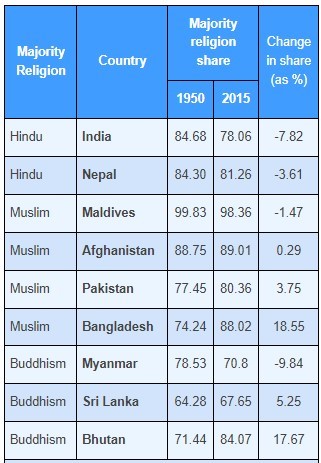
A recent working paper by the Economic Advisory Council to the Prime Minister (EAC-PM) pointed out that India witnessed a reduction in the share of the majority religious denomination by 7.82%.
- About - The paper is a cross-country descriptive analysis of the status of minorities around the world measured in terms of their changing share in a country’s population over 65 years between 1950 and 2015.
- Baseline year - For the 167 countries analysed, the average value for the share of the majority religious denomination in the baseline year of 1950 is 75%.
Key findings
|
Religion
|
% of population in 1950
|
% of population in 2015
|
Changes
|
|
Hindus
|
84.68%
|
78.06%
|
Decrease in population
|
|
Jains
|
0.45%
|
0.36%
|
Decrease in population
|
|
Parsis
|
0.03%
|
0.004%
|
Decrease in population
|
|
Muslims
|
9.84%
|
14.09%
|
Increase in population
|
|
Christians
|
2.24%
|
2.36%
|
Increase in population
|
|
Sikhs
|
1.24%
|
1.85%
|
Increase in population
|
- Global trends - In keeping with the global trends of declining majority, India too has witnessed a reduction in the share of the majority religious denomination by 7.82%.
- Trends in South Asian Countries - The share of the majority religious denomination has increased and minority populations have shrunk alarmingly across countries like Bangladesh, Pakistan, Sri Lanka, Bhutan and Afghanistan.
Reference
The Hindu | Share of Religious Minorities: A Cross-Country Analysis (1950-2015)
The Dietary Guidelines for Indians
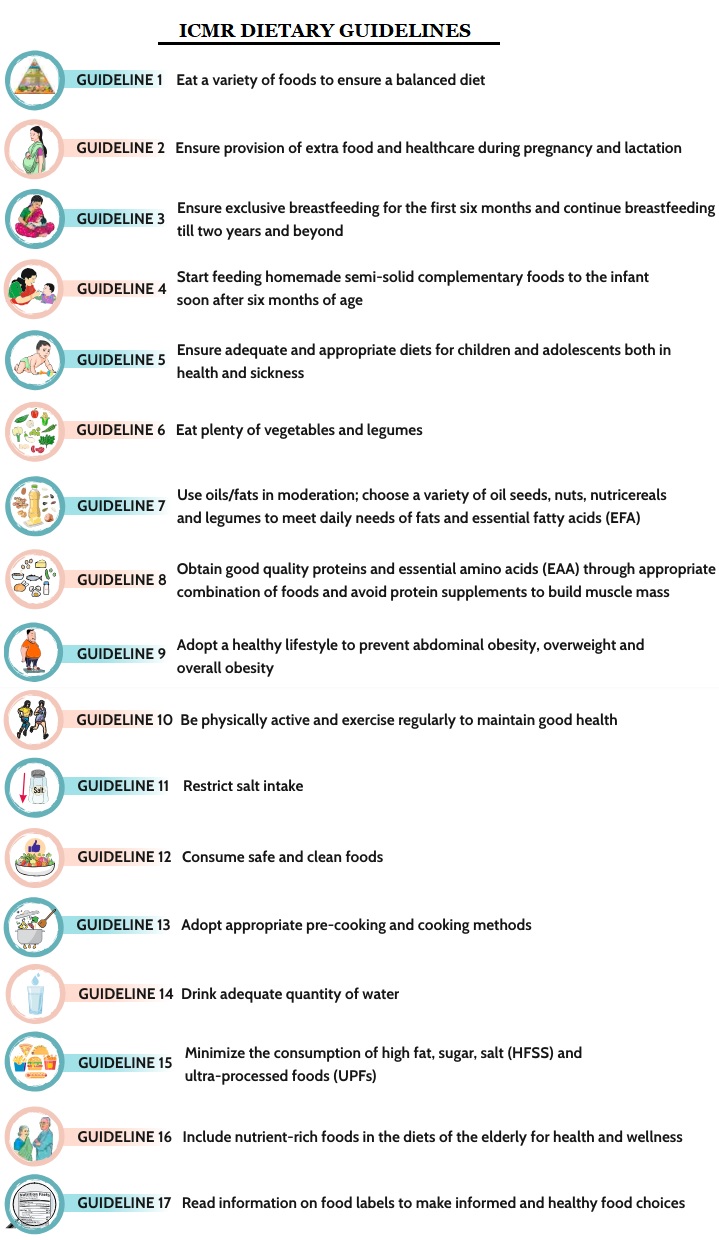
Indian Council of Medical Research (ICMR) released 17 dietary guidelines to meet the requirements of essential nutrients and prevent non-communicable diseases (NCDs) such as obesity and diabetes.
- Issued by - National Institute of Nutrition (NIN), Hyderabad, which works under the Indian Council of Medical Research (ICMR).
- The guidelines has been drafted by a multi-disciplinary committee of experts led by Dr Hemalatha R (Director of ICMR-NIN).
- 17 guidelines have been listed in the DGI.
- Balanced diet - A balanced diet should provide not more than 45% calories from cereals and millets and up to 15% of calories from pulses, beans and meat.
- Rest of the calories should come from nuts, vegetables, fruits and milk.
|
Disease burden in India
|
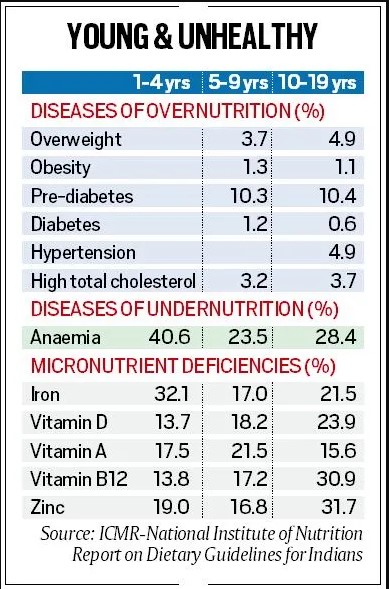
- Estimates show that 56.4% of the total disease burden in India is due to unhealthy diets.
- Healthy diets and physical activity can reduce a substantial proportion of coronary heart disease (CHD) and hypertension (HTN) and prevent up to 80% of type 2 diabetes.
|
References
- The Hindu | ICMR releases 17 dietary guidelines
- ICMR | Dietary Guidelines
Trichoderma asperellum
Punjab Agricultural University has developed a biocontrol agent Trichoderma asperellum to manage ‘foot rot’ disease, in Basmati rice crops.
- Biocontrol agent- Ludhiana Punjab Agricultural University has developed Trichoderma asperellum and registered it with the Central Insecticides Board and Registration Committee (CIBRC).
- Purpose- To manage foot rot disease in Basmati rice crops.
- Foot rot disease- It is caused by Fusarium verticillioides, a soil-seed borne pathogen which spreads the infection through the root of the plant, and eventually leads to the colonisation of the stem base.
- Occurrence- It affects basmati rice at the seedling stage and can lead to crop rejection. The infected seedlings first turn pale yellow, then elongate and dry up, and eventually (usually) die.
- Eco-friendly- The new agent offers a non-chemical alternative to pesticides, reducing environmental harm and avoiding toxic residues.
- Trichoderma asperellum- It is a species of fungus that belongs to the genus Trichoderma, which is well-known for its biocontrol properties against plant pathogens.
- ACCD enzyme- ACC deaminase enzyme produced by Trichoderma asperellum influences plant defense mechanisms and development.
Quick facts
|
Central Insecticides Board and Registration Committee
|
- About-It is an Indian regulatory authority responsible for the registration and regulation of insecticides in the country.
- Admintration- Ministry of Agriculture and Farmers Welfare, Government of India.
- Governance- Insecticide Act, 1968
- Objective- To ensure the safety and efficacy of insecticides used in agriculture, public health, and other sectors, while also promoting the sustainable use of these chemicals.
|
Reference
- Indian Express- A new biocontrol agent
- Science Direct- Trichoderma asperellum
FLiRT
New COVD-19 strains KP.2 and KP1.1 known as FLiRT variants causing a surge in cases in the U.S., U.K., South Korea and New Zealand.
- FLiRT group of variants- KP.2 and KP1.1 are recent descendants of the JN.1 variant of the SARS-CoV-2 virus. These mutations confer greater invasive properties to the virus.
- Symptoms- It is similar to other Omicron subvariants, including sore throat, cough, nausea, congestion, fatigue, headache, muscle or body ache, loss of taste or smell.’
- KP.2- It is considered the ‘great-grandson’ of JN.1 and is more prevalent across countries which accounts for about 25% of new cases in the U.S. and U.K.
- JN.1- It is a descendant of the Pirola variant (BA.2.86), which itself stems from the Omicron sub-variant. It was classified as Variant of Interest.
- Immunity evasion- Research indicates that the FLiRT variants, especially KP.2, can evade immunity from vaccines and previous infections, posing challenges for COVID-19 management.
- India’s status- INSACOG has detected cases of FLiRT variants in India with a rise in COVID-19 cases, emphasizing the need for updated vaccinations and continued precautions.
INSACOG is an Indian SARS-CoV-2 Genomics Consortium, a network of genomic laboratories.
- Cyclical disease- COVID-19 is described as a cyclical disease with periodic spikes, rather than an endemic one, necessitating sustained surveillance and universal protection measures.
Reference
Indian Express- All about FLiRT



