0.1037
7667766266
x

PRAXIS, NASA Mission to Graze Planet Rings

iasparliament Logo
July 28, 2026

Prelims: Current events of national and international importance | Science and Technology

Why in News?

NASA has selected a novel mission concept called PRAXIS (Planetary Rings Autonomous EXploration with In-situ Sampling) for its NIAC 2026 Phase I funding.
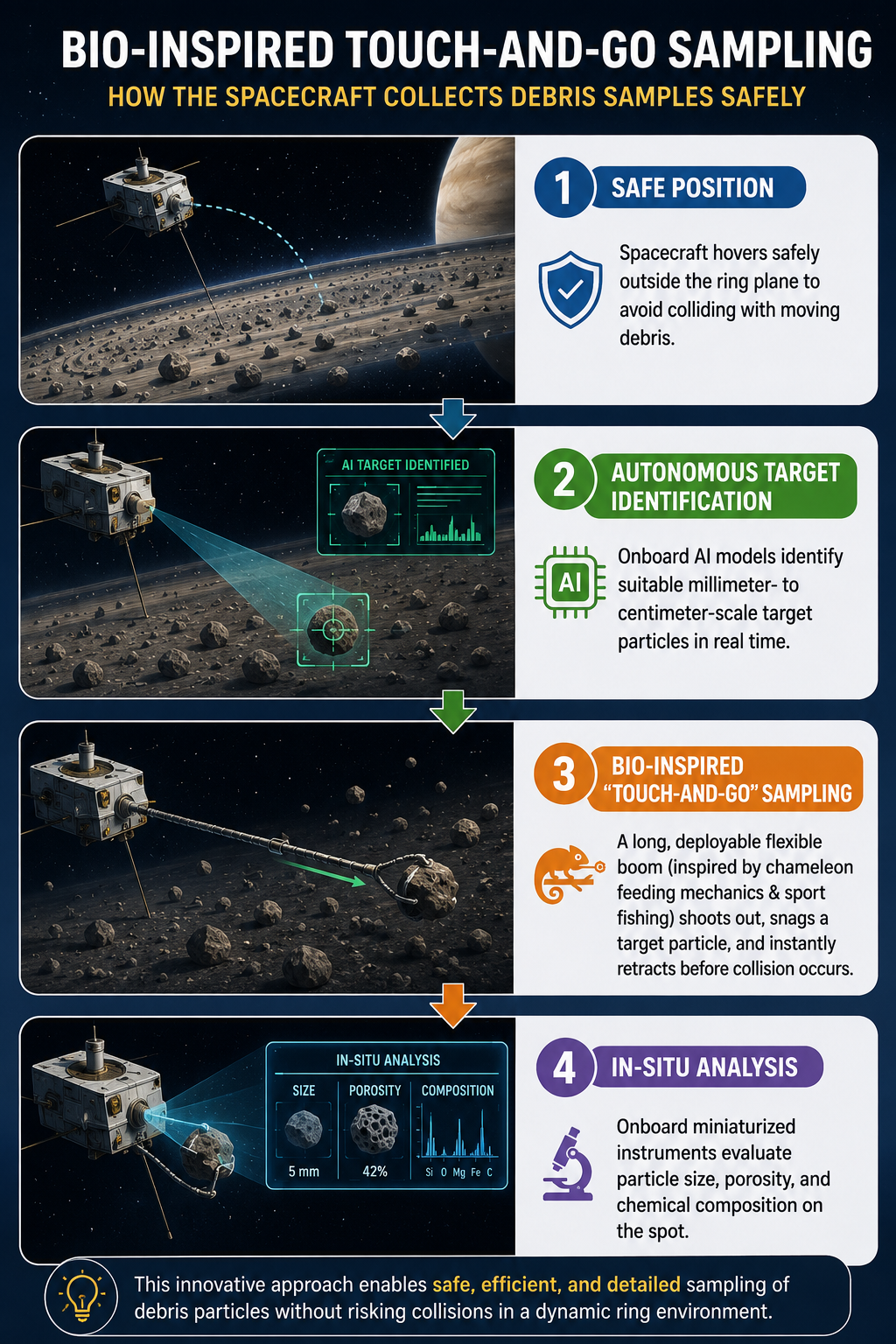
  • Aim - To directly touch, collect, and analyse physical samples from ring particles ranging from millimeter to centimetre scale) orbiting ringed planets like Saturn, Uranus, and Neptune.
  • It is for the first time in space exploration history.
  • Barrier of Direct Penetration - Planetary rings consist of millions of fast-moving particles ranging from microscopic dust to house-sized boulders made largely of water ice mixed with rocky material.
  • Flying a spacecraft directly through the dense ring plane creates severe collision hazards that could instantly destroy the probe.
  • Unresolved Science Post-Cassini - While the historic Cassini mission provided groundbreaking close-range photography, it could not directly capture or analyze real particles in-situ.
  • Thus, PRAXIS bridges this gap.

PRAXIS Mission

  • Technology - Rather than penetrating the hazardous ring structure, PRAXIS relies on autonomous robotics and AI to "graze" the ring plane.
  • NIAC Progression - Phase I selection allows the development team to run computer simulations and refine system designs.
  • Advancing to Phase II will allow the creation of physical prototypes.
  • Multi-Target Versatility - The sampling system is designed to explore dense ring systems (Saturn) and faint/tenuous rings (Uranus and Neptune), as well as ringed Centaurs like Chariklo and Chiron.

Reference

The Hindu | PRAXIS: a NASA mission

Login or Register to Post Comments
There are no reviews yet. Be the first one to review.

ARCHIVES

sidetext


