Mains: GS Paper II – Governance
Why in News?
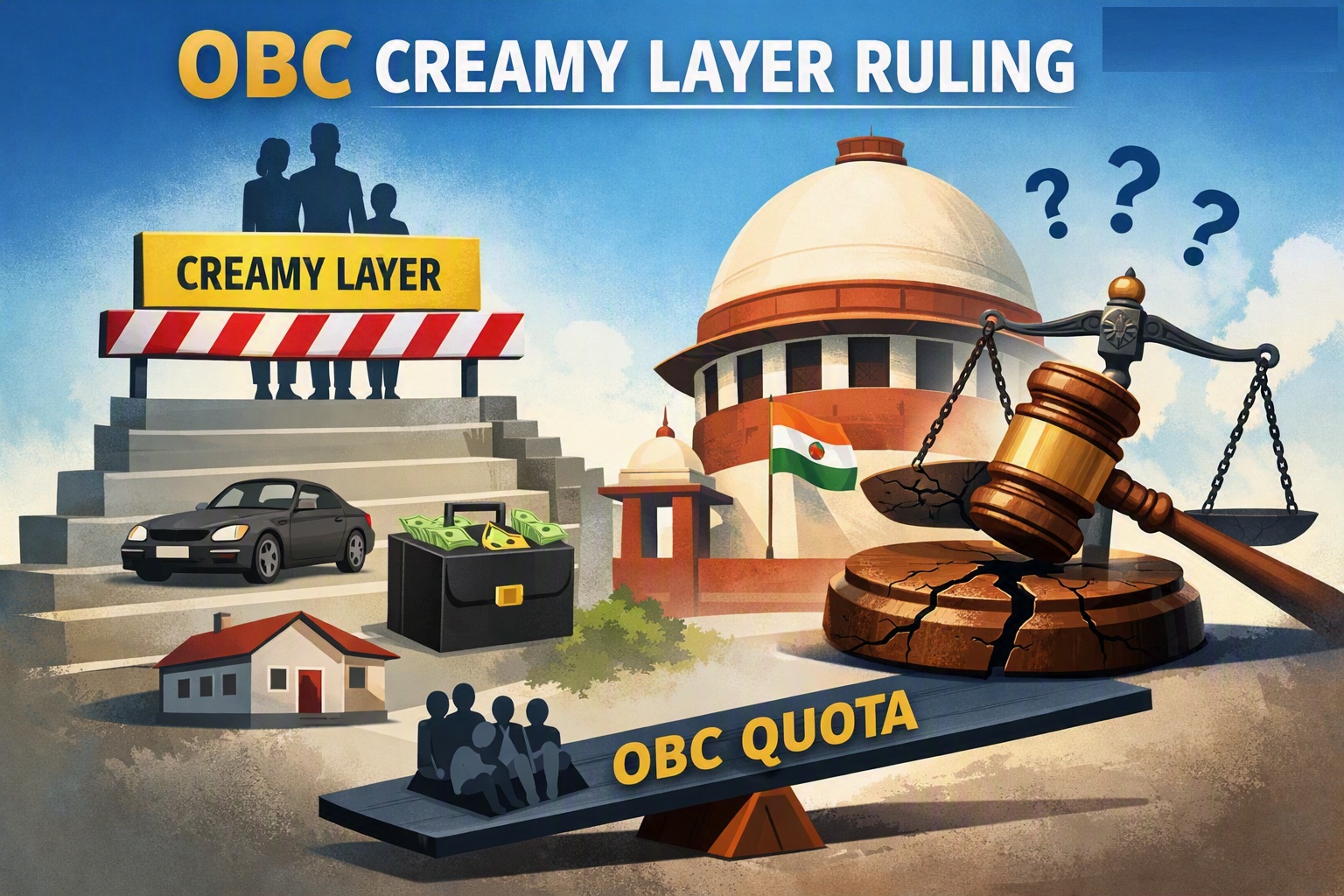
The Supreme Court of India agreed to constitute a special bench regarding whether the Other Backward Classes (OBC) creamy layer criteria apply retrospectively to the Civil Services Examination (CSE) 2025.
What is the OBC Creamy Layer?
- Creamy Layer – It refers to the socially, educationally, and economically advanced members among the OBCs who are excluded from government reservation benefits in jobs and admissions.
- Origin - Introduced following the landmark Indra Sawhney case (1992).
- In this case, the Supreme Court upheld 27% OBC reservation but mandated the exclusion of the "creamy layer" to ensure benefits reach the truly disadvantaged.
- 1993 Office Memorandum (OM) - The Department of Personnel and Training (DoPT) issued a structured framework for identification
- Status-Based Test - Exclusion based on high-ranking constitutional or government posts (e.g., Group A/Class I and certain Group B officers).
- Income/Wealth Test - Applied to individuals outside government service.
- Crucially, the 1993 OM explicitly excluded income from salary and agricultural sources when computing the income limit.
What was the problem with the 1993 OM and 2004 letter?
|
Parameter
|
1993 DoPT Office Memorandum
|
2004 DoPT Clarificatory Letter
|
|
Treatment of Salary Income
|
Excluded salary and agricultural income from the income/wealth test.
|
Treated salary income of PSU and private-sector employees as part of the income test.
|
|
Equivalence Principle
|
Mandated evaluating posts in PSUs/private sectors for equivalence with Group A/B government posts.
|
Permitted pure income-based exclusion where formal post-equivalence was not determined.
|
|
Impact on Candidates
|
Protected wards of non-Group A/B employees from being excluded solely on gross salary.
|
Led to the rejection of ~100 successful CSE candidates' OBC certificates since CSE 2015.
|
How did the Supreme Court interpret the income test?
- The division bench comprising Justices P.S. Narasimha and R. Mahadevan ruled in Union of India v. Rohith Nathan.
- Salary income cannot be the single determining factor for creamy layer exclusion without evaluating the status and nature of the post (Group A, B, C, or D equivalent).
- Treating wards of PSU/private employees differently from government employees solely based on salary violates Article 14 (Right to Equality).
- It will lead to arbitrary distinctions within the same social class.
- The exclusion framework must primarily remain status-based, with income acting only as a supplementary factor when equivalence cannot be established.
- The court held that an executive clarification (2004 letter) cannot override or distort the foundational scheme laid out in the 1993 policy.
Why is the centre seeking clarification?
- The Centre has approached the Supreme Court seeking prospective application of the March 11 verdict, citing several administrative and legal complexities.
- The Supreme Court delivered its verdict on March 11, 2026, 5 days after UPSC declared the final results of CSE 2025 (March 6, 2026) recommending 958 candidates.
- Applying the ruling to CSE 2025 at the terminal stage of service allocation would delay academy training schedules, cadre allocations (IAS/IPS), and seniority lists.
- Candidates who opted out of claiming OBC NCL benefits under the pre-March 2026 interpretation (and applied under General Category) could face discrimination relative to candidates who claimed it.
- The Centre expressed concern that retrospective implementation could trigger re-evaluations across completed university admissions, awarded degrees, and historical recruitment cycles since 2015.
What are the key legal principles involved?
- "Rules of the Game Cannot Be Changed Mid-Way" - Established in Tej Prakash Pathak v. Rajasthan High Court (2024), this doctrine mandates that selection criteria cannot be altered once the recruitment process has commenced or concluded.
- Doctrine of Prospective Overruling- Allows courts to lay down a new legal interpretation while clarifying that past actions, selection processes, or settled rights conducted under the old interpretation remain valid.
What are the challenges?
- Administrative Vaccum - Successive governments have failed to formally determine equivalent posts between government services and PSUs/Banks/Private sector entities, leaving an administrative vacuum.
- Inflationary Pressures - The current income threshold of Rs. 8 lakh per annum (last revised in 2017) has not kept pace with inflation, creating friction for salaried middle-class candidates.
- Arbitrary Interpretations- Inconsistent application of DoPT circulars across states and competent authorities has caused widespread litigation for civil service aspirants.
What is the way forward?
- The Ministry of Personnel, Public Grievances and Pensions must establish a comprehensive post-equivalence matrix for PSUs, public sector banks, and private corporations relative to central government cadres.
- Execute periodic indexation of the OBC non-creamy layer income threshold to reflect prevailing economic conditions and inflation rates.
- Establish a clear transition window for ongoing recruitment cycles to prevent administrative stalemate while upholding judicial directions for future selections.
Reference
The Hindu | OBC creamy-layer income test



