Prelims: Current events of national and international importance | Science & Technology
Why in News?
Recently, Indian researchers have developed a novel lead-free, eco-friendly photodetector, offering a sustainable alternative to conventional toxic lead-based photodetectors.
- Photodetectors are sensors that can convert the photon energy of light into an electrical signal.
- Developed by – International Advanced Research Centre for Powder Metallurgy and New Materials (ARCI), Hyderabad
- In collaboration with IIT Hyderabad.
- Nodal Authority – Department of Science and Technology (DST), Government of India.
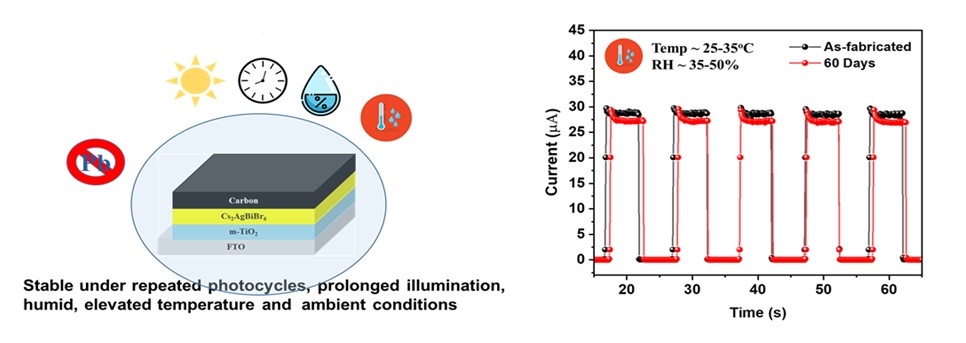
- Components – Material – It is based on the double perovskite Cs₂AgBiBr₆ that delivers strong and stable performance.
- Electrodes – Low-cost carbon electrodes.
- Design – Hole Transport Material (HTM)-free, fabricated at room temperature via a one-step coating method.
- Key Features – Eco-Friendly – The novel Photodetector is lead-free and environmentally friendly.
- Sensitive – It exhibits a strong response to visible light.
- Self-Powered – Efficient charge separation enables self-powered operation without external voltage.
- Long-term stability – Retains >90% performance after 60 days.
- Fabrication – Made using a one-step coating at room temperature under normal conditions, reducing cost and complexity.
- HTM-Free – Works without protective layers, so no expensive vacuum or glovebox is required.
- Applications –
- Consumer electronics (cameras, smart wearables).
- Industrial monitoring.
- Security systems.
- Biomedical imaging.
- Benefits – Reduces toxicity associated with lead-based photodetectors.
- Low-cost and energy-efficient due to self-powered operation.
- Durable under real-world environmental conditions.
- Significance – Supports India’s goals of green manufacturing, sustainable materials, and self-reliance in next-generation electronics.
References
PIB | Novel Photodetector



